
The short answer
Tablet sticking can sometimes be reduced without a special punch coating, but changing the lubricant is only one part of the solution. Sodium stearyl fumarate, talc and stearic acid have different functions and limitations. Zinc stearate and carnauba wax need a more specific justification, while vegetable-source magnesium stearate remains the same type of lubricant. Select a candidate through formulation, tooling and process trials—not a universal substitution rule.
On this page
If powder keeps building up on your punch faces, it is tempting to add more lubricant or replace magnesium stearate immediately. That can address one symptom while introducing another: weaker tablets, difficult ejection, slower wetting or inconsistent product performance.
This guide compares the six choices often discussed for tablet sticking, separates supported benefits from overclaims, and sets out a practical investigation plan. It is intended for formulation, production and equipment teams preparing a controlled trial.
What causes tablet sticking—and how is it different from picking?
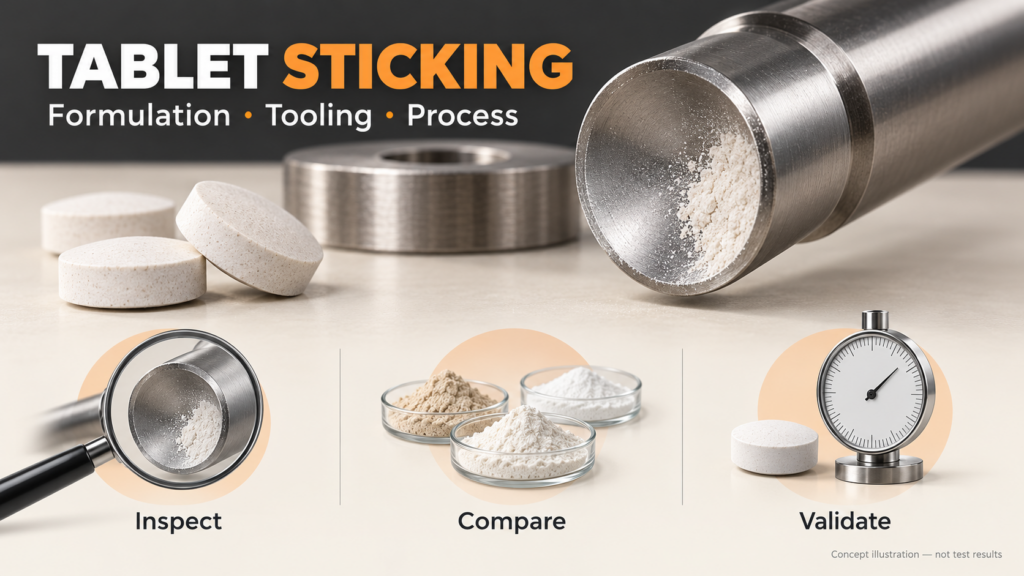
Tablet sticking describes formulation material adhering to a punch face. Picking is a more localized defect, commonly around lettering, logos or other engraved details. Recording which punch and which part of its face collect material is therefore more useful than describing every defect as “poor lubrication.” Natoli’s tooling whitepaper explains this distinction and the influence of tablet design.
Three functions are easy to confuse:
- Lubrication: reducing friction, particularly as the compact leaves the die.
- Antiadherence: reducing attachment of material to tooling surfaces.
- Flow improvement: helping powder move and feed more consistently.
A material can contribute to more than one function without performing each equally well. Research on lubricant selection shows that powder flow and finished-tablet properties must both be considered. Read the published powder-flow study.
Tablet sticking: compare 6 lubricant and sourcing choices
The comparison below is a screening guide, not a list of interchangeable additives. No concentration in this article should be interpreted as an approved production recipe.
| Option | Why consider it? | Main limitation |
|---|---|---|
| Sodium stearyl fumarate (SSF) | A candidate when magnesium stearate creates formulation or processing difficulties | Test the actual grade, blend and release performance |
| Talc | An antiadherent / glidant option within a suitable formulation | Do not assume that better flow provides sufficient die-wall lubrication |
| Stearic acid | A fatty-acid lubricant worth comparing in selected formulations | It is hydrophobic; dissolution neutrality is not guaranteed |
| Zinc stearate | A material requiring a separate suitability assessment | Do not treat it as a routine oral-tablet replacement |
| Carnauba wax | A wax option for a specifically justified formulation | High melting point alone does not establish anti-sticking performance |
| Vegetable-source magnesium stearate | A sourcing choice when documented origin matters | Still magnesium stearate; certification and performance must be checked |
1. Sodium stearyl fumarate: a candidate for a comparative trial
Sodium stearyl fumarate, often abbreviated SSF, is a credible starting point when magnesium stearate presents compatibility or manufacturing difficulties. JRS PHARMA describes its PRUV grade as suitable for challenging formulations and high-speed direct compression, with greater robustness to over-lubrication. These are supplier claims for that material; they do not establish identical performance for every SSF grade or formulation. See the PRUV product information.
In a JRS comparative study, SSF performed favorably in the tested model formulations, including an ibuprofen formulation prone to punch adhesion. That supports testing SSF—not promising that it will eliminate tablet sticking in every blend. “Less hydrophobic” is also more accurate than calling it completely non-hydrophobic. See the study conditions and results.
2. Talc: separate antiadherence from lubrication
Talc is used as a glidant and lubricant in tablet formulations, but its contribution must be assessed against the problem being investigated. A powder that flows better may still require a different lubrication balance for reliable ejection. The published lubricant and powder-flow study discusses talc alongside other common lubricants.
Use a grade appropriate to the intended product and obtain its current quality documentation. Do not present talc as a universal antistatic treatment or assume that adding it cannot affect tablet composition or performance. Define the desired outcome before comparing trial blends.
3. Stearic acid: an alternative with its own trade-offs
Stearic acid is a fatty-acid lubricant, and it is hydrophobic. The claim that it is automatically neutral toward dissolution is too strong. In the JRS model study, stearic-acid tablets showed relatively high hardness but also higher ejection forces under the conditions tested. The authors noted that the level used might not have provided sufficient lubrication for that grade. Read the comparative lubricant study.
For a stearic-acid trial, record ejection behavior as carefully as tablet appearance. A clean-looking surface alone is not enough to select the formulation.
4. Zinc stearate: verify suitability before considering a trial
Zinc stearate should not be promoted as a routine, ready-to-use substitute for an oral pharmaceutical or supplement tablet. Before including it in a development program, establish the intended product category, market, route, grade and relevant supporting documentation.
For US drug products, the FDA Inactive Ingredient Database guidance and FAQs explain why route of administration, dosage form and the amount used matter when interpreting prior use. An ingredient name by itself does not establish suitability for a new product. “Use cautiously with acidic ingredients” is not a complete assessment.
5. Carnauba wax: melting point is not proof of performance
Carnauba wax is a hard vegetable wax. For example, Koster Keunen specifies an 80–86°C melting range for its Yellow Carnauba Wax NF grade. That describes a material property; it does not demonstrate that the wax will solve tablet sticking during high-speed compression. See the supplier specification.
Consider a wax-based approach only when the formulation rationale and trial data support it. Check release behavior, distribution in the blend and performance over the intended run. Avoid describing carnauba wax as a standard high-speed tableting solution simply because it has a high melting point.
6. Vegetable-source magnesium stearate: a sourcing change
Vegetable-source magnesium stearate may fit a documented ingredient-origin requirement. It is still magnesium stearate, so changing the source does not by itself remove the need to evaluate lubrication sensitivity and tablet performance.
Supplier documentation must support any sourcing or certification claim. Peter Greven, for example, lists vegetable raw materials and certification information for its pharmaceutical excipient range. Check the exact grade and current certificate rather than assuming that all plant-derived material is automatically halal, kosher or suitable for a particular vegan claim. See the supplier’s pharmaceutical excipient information.
Why there is no universal replacement percentage
A percentage that works in one blend is not a transferable production setting. Different grades, particle properties, fillers and manufacturing conditions can change the balance between friction reduction and tablet quality. A comparative study of magnesium stearate, SSF and stearic acid assessed their behavior in both plastic and brittle matrices, illustrating why the formulation context matters. See the study abstract.
Other options also exist outside the original six. Gattefossé, for example, offers glyceryl-behenate-based tablet lubricants with grade-specific recommendations. Such recommendations can inform a screening plan, but they do not replace product-specific evaluation. Read the supplier’s lubricant guidance.
For tablet sticking trials, ask the formulation lead to set candidate levels from the selected grade’s documentation and the product’s requirements. Keep the basis explicit: percentage by weight of the final blend, material grade, addition sequence and the process stage at which samples are taken.
Three process checks before changing the formula
Check tooling condition and tablet design
Inspect the punch faces and engraved areas before changing the recipe. Discuss surface finish, wear and tablet geometry with the tooling supplier. A universal mirror-polish target is not justified: Natoli reports that some products release better from a matte finish than from a mirror finish. See the tooling discussion.
For an equipment review, identify your press model and tooling dimensions. Our rotary press tooling and single-punch tooling pages provide starting points for that conversation.
Validate the lubrication stage
“Add the lubricant for the last three minutes” should be treated as a trial condition, not a universal rule. The JRS study used a defined blender, preparation sequence and mixing period; copying the time alone does not reproduce that experiment. Review the study method.
For each trial, document blender type, fill level, speed, addition order and mixing duration. If sieving or deagglomeration is needed, choose a procedure suitable for the actual material instead of imposing one mesh size on every lubricant.
Control moisture and temperature from evidence
There is no single room-humidity target that prevents tablet sticking for every formulation. I Holland’s technical discussion describes both moisture-related adhesion and electrostatic effects in very dry material. It also explains why temperature can matter for susceptible ingredients. Read I Holland’s discussion of sticking mechanisms.
Record room conditions together with a suitable measure of blend moisture. A room reading alone cannot explain the history of a powder that has been stored, dried or transferred elsewhere. If defects grow during a run, compare early and late samples before deciding that the lubricant is responsible.
Build a useful tablet sticking trial record
A trial is more valuable when another person can understand what changed and what stayed constant. Use the following record as a discussion template with your formulation and quality team:
- Define the defect: photograph representative tablets and tooling; identify the affected stations and when the buildup first appears.
- Record the baseline: identify the formula revision, ingredient grades, lots, moisture results, tooling set and press settings.
- State one clear question: for example, whether a different lubricant grade reduces buildup while maintaining the required tablet properties.
- Choose a comparison plan: use controlled comparisons or a planned experimental design; do not change several settings without recording the reason.
- Measure both process and product: track sticking, ejection behavior where measurable, tablet weight consistency, strength, friability and the relevant disintegration or dissolution results.
- Include time in the assessment: compare startup and later samples, and note cleaning interruptions or rejection rates.
- Review before scaling: accept a candidate only against predefined criteria, then confirm performance on the intended equipment and run conditions.
A promising tablet sticking result is a reduction in the documented defect without an unacceptable trade-off elsewhere. Set the acceptance criteria before viewing the outcome. Record unsuccessful trials too: they help prevent the same unsupported change from being repeated.
Prepare a market-specific ingredient brief
For an export project, include the destination country, product category and intended ingredient grade in the brief. Ask the responsible team to check the current documentation for that market. Keep origin declarations, grade specifications, certificates and the formulation decision together so that a supplier change can be reviewed against the same requirements.
Separate the technical trial record from purchasing approval. A lubricant can perform acceptably on the press while still requiring additional supplier or market documentation. Before ordering production quantities, confirm the exact grade, intended use, responsible reviewer and any unresolved requirements with your quality and procurement teams.
Questions about tablet sticking and magnesium stearate alternatives
Can tablet sticking be reduced without coated punches?
Sometimes. Tooling condition, tablet design, formulation and process adjustments can all be investigated before selecting a coating. However, some products may still benefit from a different surface treatment. The decision should follow the observed sticking behavior and trial results.
Is sodium stearyl fumarate always better than magnesium stearate?
No. SSF is a useful candidate when a formulation performs poorly with magnesium stearate, but the comparison must include the selected grade, compression performance and finished-tablet requirements. Supplier studies support evaluation, not a universal ranking.
Does vegetable magnesium stearate solve over-lubrication?
Not automatically. Vegetable origin describes sourcing. It does not remove the need to evaluate the grade, concentration and mixing process. Check certification requirements separately from compression performance.
Should humidity always be kept at 55–65%?
No. A fixed humidity range can be unsuitable for a particular material. Establish environmental limits from the formulation’s moisture sensitivity, handling behavior and validated process requirements.
What information should I send when asking about tablet sticking?
Provide the press model, tooling drawing or dimensions, formulation context, photographs of the defect, when it appears, current operating conditions and the changes already tried. Identify any limits on what formulation information you can share.
Discuss the equipment side of your investigation
Preparing a tablet sticking investigation? Review our powder-to-tablet production process and tablet press range, then contact TabletPress.shop with your press, tooling and production requirements.
A clear brief helps separate equipment questions from formulation questions and makes the next trial more useful. Final excipient selection and process approval belong with the responsible formulation and quality team.