
The short answer
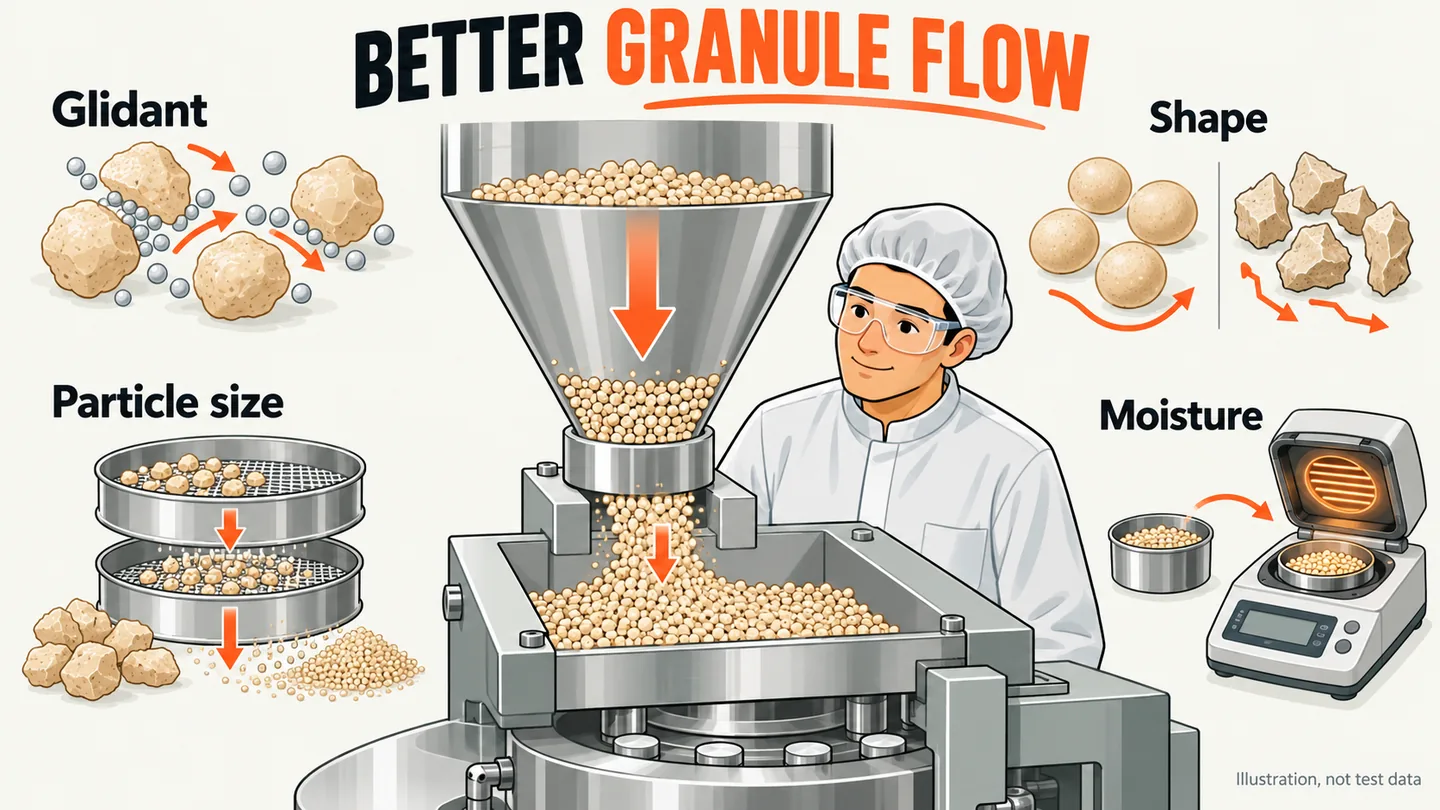
To improve granule flowability, first identify where feeding becomes unstable. Then evaluate four factors: glidant selection and blending, particle size distribution, particle shape, and moisture. Compare controlled trials using consistent test methods, and confirm the result on the intended equipment. A powder that pours more easily is only an improvement if blend uniformity and tablet quality remain acceptable.
On this page
Uneven hopper discharge can interrupt tablet production, complicate die filling and make troubleshooting difficult. This guide turns four common formulation suggestions into a practical investigation plan for granule flowability. It explains what to measure, which assumptions to avoid, and how to compare changes without losing sight of the finished product.
Use it when preparing development trials or discussing a feeding problem with your formulation and equipment teams. The examples are decision aids, not a universal additive recipe or a validated manufacturing procedure.
What is granule flowability?
Granule flowability is the ability of a particulate material to move under defined conditions. Those conditions include the applied stress, container geometry, contact surfaces and handling history. Consequently, a result from one laboratory test cannot describe every transfer, hopper or feed-frame operation. USP describes powder behavior as multifaceted in its General Chapter <1174> Powder Flow overview.
Define the production problem before choosing a remedy. Does material stop above an outlet, discharge in surges, separate during transfer, or feed inconsistently as the hopper empties? Note the batch, fill level, hold time and operating conditions. This gives each trial a specific question to answer.
Also separate flow problems from punch adhesion. If material reaches the die consistently but sticks during compression, review our guide to tablet sticking and lubricant options alongside the feeding investigation. These problems can coexist, but they need different observations.
Diagnose bridging, ratholing and uneven feeding
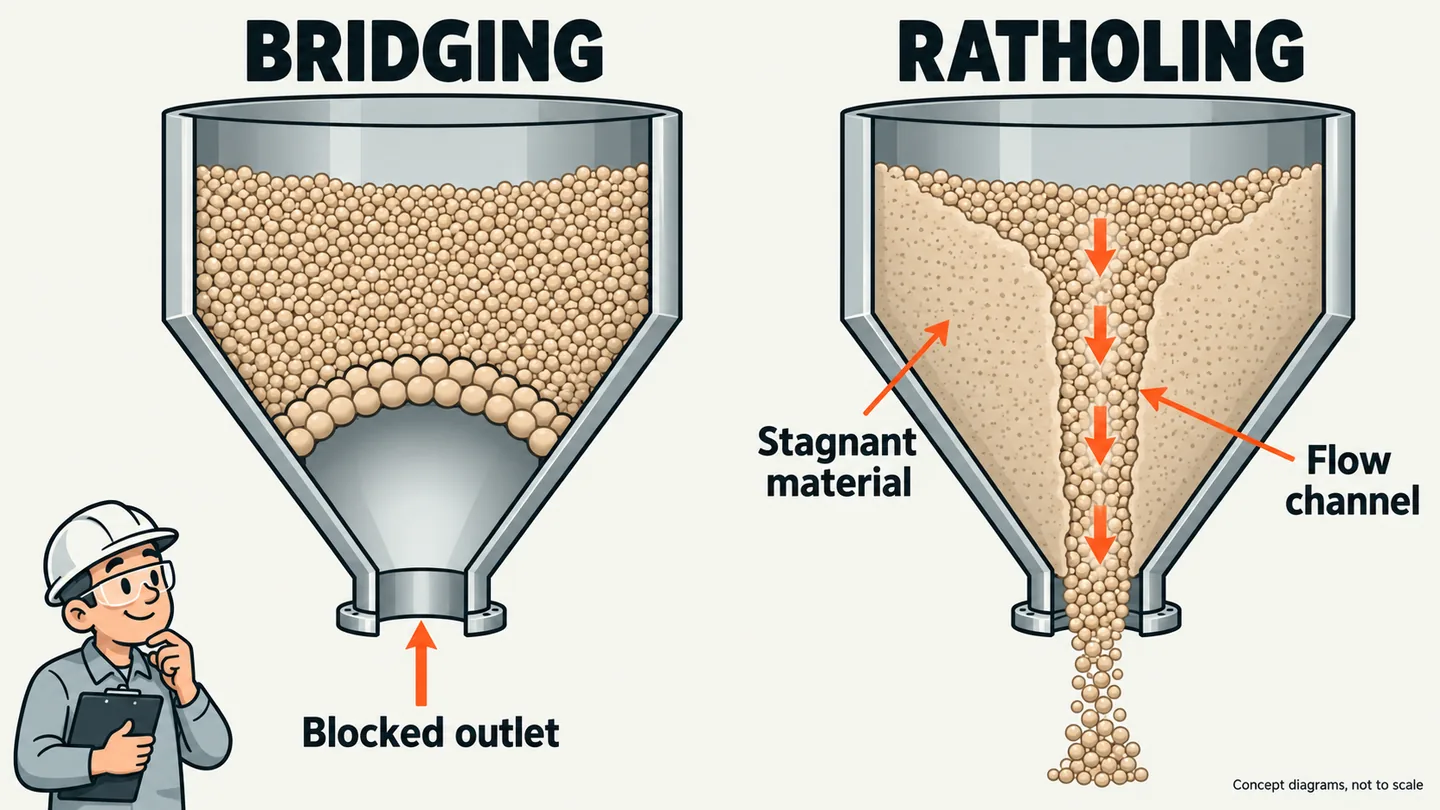
Bridging occurs when a stable arch obstructs discharge. Ratholing leaves a flow channel surrounded by material that remains stagnant. These patterns should prompt a review of both the material and the hopper. Outlet size, wall friction and geometry can matter as much as an additive change. See Freeman Technology’s technical guide to powder behavior.
| Observation | Question to investigate |
|---|---|
| Discharge stops or repeatedly surges | Where does the obstruction form, and under what fill level or storage time? |
| A central channel empties while material stays at the sides | Is the discharge pattern consistent with ratholing? Review the hopper and material together. |
| The beginning and end of a run behave differently | Could segregation, changing head pressure, moisture exposure or residence time explain the change? |
| A laboratory result improves but machine feeding does not | Does the laboratory method represent the stresses and movement in the actual process? |
Photograph or record the failure only where observation is permitted by the equipment’s operating procedure. Plan the observation before the run so the team can connect the visible pattern with the process data.
Four ways to improve granule flowability
1. Evaluate a glidant and its blending conditions
A glidant is used to improve particle movement; a lubricant is primarily used to reduce friction during operations such as tablet ejection. Some excipients have several functions, but adding more lubricant is not automatically an effective treatment for poor granule flowability.
Colloidal silicon dioxide is one candidate for a formulation study. Its performance depends on the host powder, grade, concentration and dispersion during blending. Evonik’s technical information on colloidal silicon dioxide explains why mixing conditions and particle interactions affect the result. Supplier guidance can help design a trial, but it does not replace testing the complete formulation.
In a study of one lactose system, different silica grades and levels produced different flow responses. That is evidence for screening a defined system, not for prescribing the same percentage to every blend. Read Blanco and colleagues’ experimental study of colloidal silicon dioxide and powder flow.
- Compare the current blend with a small, documented set of candidate conditions.
- Keep the addition sequence, mixer loading and blending time controlled.
- Record the grade and lot of the additive, not just its generic name.
- Check feeding, blend uniformity and the relevant tablet quality results before accepting a change.
Talc may be considered for some formulations, but a generic statement such as “use up to 5%” is not a sufficient specification. Its purpose, grade, suitability for the product and effect on performance need to be established. Do not treat talc and colloidal silica as interchangeable.
2. Control particle size distribution and fines
Particle size distribution describes the range and proportion of sizes in the material. A change in fines can change how a blend handles; a change in the coarse fraction can also alter packing and feeding. However, neither “larger is always better” nor “a perfectly uniform size always flows best” is a reliable design rule.
Experimental work on excipients and their blends shows that size and shape need to be considered together. In Yu and colleagues’ study of particle size, shape and powder flow, flow was measured under defined test conditions. Apply the same discipline to your material: compare distributions using the same sampling and measurement method.
Sieve analysis is a useful starting point when it suits the material. Record the size fractions before and after the transfer or granulation step under investigation. If screening removes a fraction, assess what that removal does to composition, yield and downstream performance; do not assume that discarded fines contain only unimportant material.
For a granulated product, review the variables that can change the distribution, such as binder addition, processing time, screening and drying. Establish the acceptable range through trials. A sieve specification is most useful when it is connected to stable feeding and product quality.
3. Review shape and the granulation route
More rounded particles can be a useful development objective, but shape is only one part of the problem. A shape change may arrive with changes in size, surface texture, density, porosity or mechanical strength. Compare the resulting material, not simply the name of the process.
Spheronization, spray granulation or a different granulation route may be worth evaluating where they suit the formulation. They are not automatic upgrades for every product. Ask whether the candidate granules retain their properties through drying, handling, storage and feeding.
If granules break down during a transfer, a satisfactory sample taken immediately after granulation may not represent the material reaching the press. Include the relevant handling steps in the trial and sample at meaningful locations.
4. Establish a material-specific moisture range
Moisture does not have one universal effect on granule flowability. A material may behave differently as humidity, exposure time and water content change. Freeman Technology’s experimental investigation of humidity and powder properties illustrates why responses should be measured for the actual material rather than predicted from room humidity alone.
Do not assume that drier is always better, or that adding water will reliably cure poor flow. Direct misting can create uneven wetting and introduce other product or process concerns. Any conditioning step should be justified within an approved development or manufacturing procedure.
- Measure material moisture using a method appropriate to the formulation.
- Record temperature, relative humidity and exposure time as separate observations.
- Compare packaging, storage and open handling conditions when results change between locations.
- Review stability, microbial considerations where applicable, and finished-product requirements before changing moisture conditions.
How to measure granule flowability
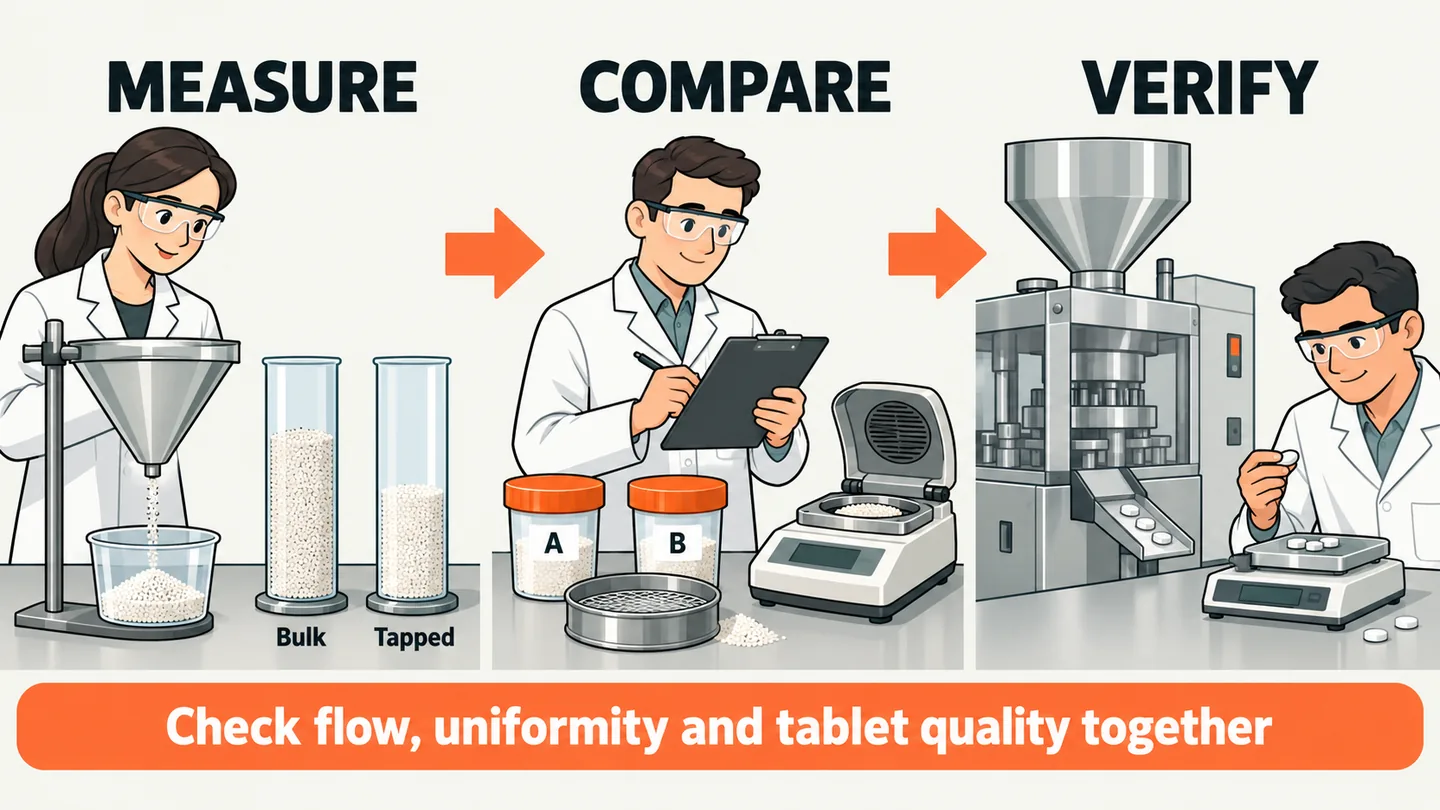
Choose measurements that answer the process question. The familiar methods below describe different aspects of powder behavior. USP’s archived powder-flow harmonization document discusses these approaches and their limitations; use the current applicable procedure when a compendial test is required.
- Angle of repose: a screening measurement based on the pile formed under a defined procedure. Apparatus and sample handling affect comparability.
- Bulk and tapped density: measurements used to calculate compressibility index and Hausner ratio. Keep the vessel, sample mass and tapping procedure consistent.
- Flow through an orifice: a discharge measurement tied to a specified outlet and setup. Failure to discharge is itself useful information.
- Shear testing: characterization under controlled stress conditions, useful when investigating consolidated material or hopper discharge.
Compressibility index (%) = 100 × (tapped density − bulk density) ÷ tapped density.
Hausner ratio = tapped density ÷ bulk density.
Use densities expressed in the same units. These calculations support comparison; they do not, by themselves, prove that a blend will feed consistently on a tablet press.
Repeat the baseline and candidate measurements enough to understand their variability. Keep the test procedure unchanged within a comparison. A 2024 experimental comparison of four flow methods found limitations in each approach and supports using complementary measurements. If results disagree, investigate which test better represents the intended operation instead of choosing only the more favorable number.
A controlled trial checklist
An improvement plan for granule flowability should make the decision traceable. The following sequence is a practical way to organize the work with your technical team.
- Define the failure: identify the equipment location, operating condition and observable consequence.
- Record the baseline: retain the formulation revision, raw-material lots, process settings and representative sample information.
- State the hypothesis: explain why a particular additive, size distribution, shape or moisture change might help.
- Plan the comparison: change one factor at a time initially, or use a designed experiment when interactions need to be assessed.
- Set acceptance criteria in advance: include the feeding result and relevant quality measures, such as blend uniformity, tablet weight variation, strength, friability, disintegration or dissolution as applicable.
- Verify under intended conditions: evaluate the relevant hopper fill range, run duration and handling sequence before approving wider use.
Keep a concise trial record: sample ID, material moisture, size distribution, additive grade and level, blending conditions, test method, repeated results, machine observations and the final decision. Record unsuccessful trials too. They help the next investigation start with evidence.
Transfer the process between climates and production sites
A country name is not a process specification. For a project in a humid coastal location or a dry inland facility, request actual site data: material storage conditions, packaging, room conditions, exposure time and the proposed equipment arrangement. Avoid transferring a moisture target based only on geography.
For an international enquiry, also identify the intended product, destination market, material grade and quality requirements. This makes the discussion specific enough to assess feasibility without claiming that one formulation or machine configuration is suitable everywhere.
Use the same trial record at each location so teams can compare results directly. Include measured starting conditions, the changes evaluated and the verified outcome. This helps distinguish a material change from a difference in storage or handling.
Granule flowability FAQs
What is the first step when granules do not flow?
Identify the location and pattern of the failure, then establish a repeatable baseline. A hopper obstruction, segregation during transfer and punch sticking are different observations. Choosing an additive before identifying the problem can make the next trial harder to interpret.
Does adding more silica always improve flow?
No. Silica performance depends on the formulation, grade, level and blending conditions. Screen suitable conditions and assess the whole product. A percentage reported for one powder system should not be copied into another formulation without development work.
Is lower moisture always better for granule flowability?
No. Establish the useful range for the actual material and process. Compare measured moisture with flow, feeding and product quality, while also recording environmental exposure. Avoid unvalidated water addition or drying changes.
Can Carr’s index alone predict tablet press feeding?
No. Carr’s index, also called compressibility index, is a useful comparative calculation from bulk and tapped density. It does not reproduce every stress, surface or motion in a feed system. Confirm the laboratory comparison on the intended equipment.
Should I change the mixer, granulator or hopper first?
Let the failure evidence determine the next trial. A material distribution problem may require process development; a discharge obstruction may require a hopper assessment. Share the observations with the formulation and equipment teams before selecting a machine change.
Discuss your material and equipment requirements
Review our YK oscillating granulator and VH V-type mixer as starting points for an equipment discussion. Product selection still requires a review of your material, process and capacity requirements.
For a more useful enquiry, include the material description, current granule flowability problem, available test results, target throughput and intended product. Contact TabletPress Shop to discuss your process, or browse the Resources & Knowledge Hub for related technical guidance.