
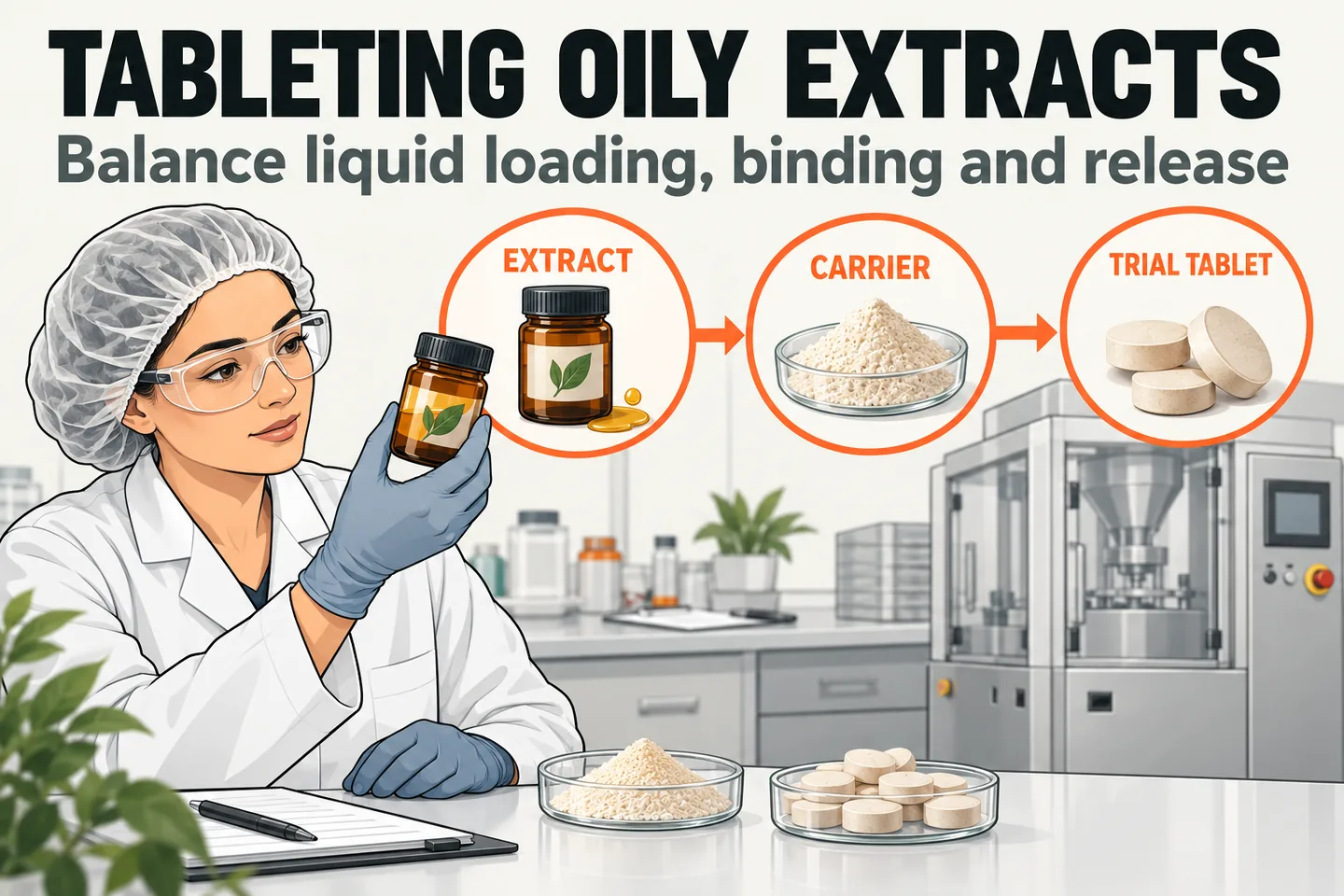
Oily extract tableting can become difficult when a formulation flows inconsistently, leaves residue on punches, or produces tablets that are too weak for handling. Yet an oily appearance does not identify the cause, and a dry-looking powder does not prove that the material is ready for compression.
Quick answer: Characterize the extract, establish an appropriate liquid load for the chosen carrier, and evaluate binding, flow, compression and release together. Granulation, lubricant changes, surface treatments and press settings are options to test. No single oil-content threshold, excipient percentage or drying temperature can define the solution for every extract.
This guide covers oil-rich botanical extracts and related liquid-loaded intermediates used in pharmaceutical and supplement development. It provides investigation questions and trial checklists, not a production recipe. The product category, intended dose, material specifications and approved site procedures determine which requirements apply.
On this page
Why oily extract tableting needs more than a dry powder
Three questions should be separated: can the intermediate feed consistently, can it form a sufficiently robust tablet, and can that tablet deliver its contents as intended? Passing one test does not answer the others. A formulation may flow acceptably yet bind poorly; another may produce strong tablets but release its contents inadequately.
Research on lipid-based self-emulsifying systems illustrates this distinction. Gumaste and colleagues produced tablets from liquid formulations adsorbed onto a porous silicate, but release depended on the composition and behavior of the liquid system. Gel formation during contact with water could obstruct release in some tested formulations. These were specific experimental systems, not universal botanical-extract recipes. Gumaste, Dalrymple and Serajuddin (2013): Compaction and Drug Release of Solid SEDDS.
For oily extract tableting, describe the observed failure before choosing a correction. Replace “the oil is causing everything” with a statement such as “punch-face residue increases during the run while tablet strength remains within the trial target.” That statement can be checked against material, tooling and operating records.
1. Characterize the extract and define what “oil content” means
“High oil” is a useful description of a concern, but it is not a standardized formulation class in this guide. A percentage has limited meaning unless the method, denominator and sample condition are clear. Total extract, extract solids, fixed oils, volatile constituents, water and processing solvent are different quantities.
- Identity and history: record the botanical source, extraction process, supplier grade, lot and any carrier already present.
- Composition: establish what the reported oil or lipid result measures and whether it is on an as-received or dry-solids basis.
- Physical behavior: document appearance, liquid separation, moisture, particle properties and changes during a defined hold.
- Product target: specify the required extract amount or marker content per tablet and the relevant quality attributes.
FDA’s botanical-drug guidance emphasizes raw-material controls, characterization and manufacturing consistency for botanical drugs. Its discussion also recognizes that processing changes can change a botanical material’s chemical profile. The guidance is not a blanket rule for all supplements, but it reinforces the need to understand the material before altering its preparation. FDA: Botanical Drug Development, Guidance for Industry.
Do not assume every plant extract is oil-rich, or that every low-strength tablet has excessive free oil. Preserve a representative sample and compare the suspected lot with a documented reference lot where available. This makes the first oily extract tableting trial a comparison rather than an open-ended sequence of adjustments.
2. Match liquid loading to the carrier and binding system
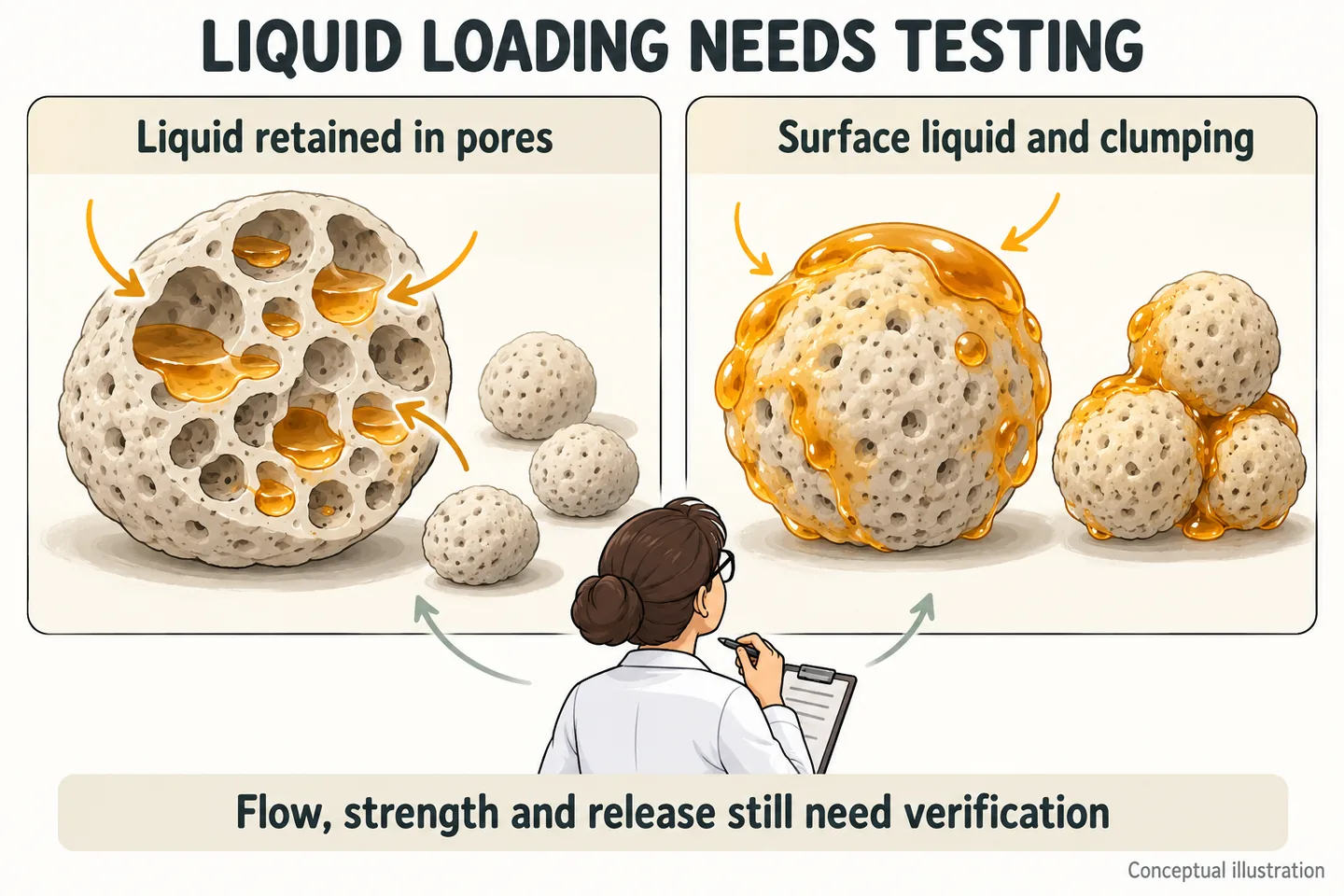
A carrier can help convert a liquid formulation into a powder-like intermediate, but its ability to retain liquid is not the same as its ability to form a tablet. Carrier identity and grade matter. A material used as a flow aid should not automatically be substituted for a porous liquid carrier at the same percentage.
Appelhaus and colleagues found that liquid loading and filler/binder selection influenced tabletability in mesoporous-silica systems. Strong binding capacity and plastic deformation of the filler/binder supported the tested high-load formulations. The paper also distinguishes mass-based liquid load factor from volume-based liquid load level. Its laboratory mixtures and compaction conditions should not be copied directly into an extract product. Appelhaus, Steffens and Wagner (2024): Liquid Load Level and Binder Type.
Document the units: a liquid-to-carrier ratio expressed in g/g is not interchangeable with a loading level expressed in mL/g. State whether the liquid includes dissolved solids, surfactants or other components. Do not confuse either ratio with the extract percentage in the finished tablet.
- List the carrier grade, liquid formulation, addition sequence and mixing conditions for each trial.
- Compare several justified loading conditions, keeping a clear record of what else changes.
- Check appearance and feeding behavior immediately and after the proposed hold period.
- Evaluate the resulting tablets, including binding, visible liquid migration and relevant release requirements.
For oily extract tableting, “more carrier” is not an unlimited remedy. Additional excipient may make the target dose impractically large or reduce the space available for a binder and disintegrant. Review the complete tablet composition and intended size before choosing a loading condition.
3. Select the preparation route from evidence
Wet granulation should not be the automatic first choice simply because an extract contains oil. Direct compression of a developed liquid-loaded intermediate is a possible route, while granulation or another solidification approach may be needed for a different formulation. The choice depends on demonstrated performance and material compatibility.
The solid-SEDDS study cited above shows that adsorbed lipid formulations can be compressed into tablets under suitable experimental conditions. It supports considering the route, not claiming that every untreated oily extract can be directly compressed. Gumaste, Dalrymple and Serajuddin (2013): Compaction and Drug Release of Solid SEDDS.
- Direct compression: establish that the prepared intermediate has suitable feeding, uniformity and tablet-forming behavior.
- Wet granulation: assess liquid compatibility, binder grade, granule development, drying and retained quality.
- Dry granulation: assess whether the additional compaction and milling steps improve the intermediate without creating other defects.
If a binder solution is proposed, confirm that the particular polymer grade is compatible with the intended solvent system. A generic instruction such as “use HPMC in ethanol” is incomplete without grade and solvent-composition information. Do not assume contact with water will cause the same phase behavior in every extract.
Screening or milling should have a defined purpose. Removing fines from an established blend can alter its composition, so assess material balance and uniformity before discarding a fraction. See our guide to granulation and tablet quality for the wider process comparison.
4. Treat drying as a defined separation step
In oily extract tableting, drying and de-oiling are different operations. Establish what a drying step is intended to remove. Fixed oils are not simply removed by ordinary low-temperature drying; loss of volatile constituents may also remove part of the intended extract. A lower sample mass alone does not prove that an undesirable oil fraction has been selectively removed.
A 2022 study of plant extracts on a porous carrier compared processing conditions and found differences in properties including hardness, friability and disintegration. This is evidence that drying conditions can affect the resulting dosage form. It does not establish one drying method or temperature for all plant extracts. Kostelanská et al. (2022): Processing Plant Extracts with a Porous Carrier.
- Specify the relevant endpoint, such as water or residual-solvent content, using a suitable method.
- Record product temperature and exposure history, rather than relying only on an equipment setpoint.
- Check retention of relevant extract constituents and any stability indicators selected for the product.
- Compare the intermediate after drying and after its proposed storage or transfer period.
When an organic solvent is used, selection and residual levels need assessment under the applicable pharmaceutical framework. ICH Q3C addresses residual solvents; a dry appearance does not demonstrate that the relevant limits are met. Solvent handling also requires compatible equipment and the site’s established controls. EMA / ICH Q3C(R9): Residual Solvents.
Avoid presenting a temperature such as 55°C as a universal safe limit. The defensible conditions are those supported for the material, process and product, including the effect of exposure time. Changing the solvent or drying route warrants a documented review of what else may change.
5. Balance binding, lubrication and release
An oily extract tableting formulation needs distinct excipient functions. A carrier manages the liquid-containing intermediate; a binder supports tablet cohesion; a glidant assists powder flow; and a tablet lubricant manages friction during compression and ejection. One ingredient may serve more than one role, but those roles still need to be evaluated separately.
The presence of oil does not demonstrate adequate lubrication at the die wall. Equally, adding more lubricant does not guarantee a better tablet. Natoli notes that lubrication can assist ejection while excessive lubricant can reduce compactability and tablet hardness. This supports a measured comparison rather than automatically halving magnesium stearate or substituting another lubricant. Natoli: How to Avoid Sticking and Picking.
- Compare the proposed lubricant level and mixing history with ejection behavior and tablet quality.
- Assess binder changes alongside tablet size, strength and release, rather than judging appearance alone.
- Choose disintegrant trials from the intended dosage-form performance and test their effect.
- Record the grade and function of each excipient so that later substitutions can be assessed.
Disintegration and dissolution answer different questions: breaking a tablet apart does not by itself show that its contents are released appropriately. Do not promise that a named disintegrant will offset every hydrophobic effect. Select the relevant product tests and acceptance criteria before judging the trial outcome.
Our tablet sticking and lubricant guide provides related background. Keep machine lubrication separate from formulation lubrication; equipment lubricants are not ingredients to add to the blend.
6. Evaluate the press and tooling with the prepared material
For oily extract tableting, record what reaches the feeder, what happens through the run, and what emerges from the press. Inspect the contact surfaces and map residue to specific locations. Distinguish sticking, filling variation, capping, and mechanical tool damage before selecting a trial.
Natoli’s capping discussion identifies precompression, main compression, penetration settings and speed as variables for investigation. Their effect depends on formulation and equipment configuration; a fixed reduction in turret speed is not a transferable process specification. Natoli: Preventing Capping and Other Tablet Defects.
Surface finish and coating selection also require a formulation-specific comparison. Natoli reports that a matte finish can perform better than a mirror finish for some products. Polishing or coating should therefore address an observed interaction, not be presented as an assured solution for oily blends. Natoli: How to Avoid Sticking and Picking.
- Filling: track hopper level, feed interruptions and tablet-mass variation against time.
- Compression: compare a justified operating range within the permitted limits of the press and tooling.
- Ejection and surfaces: document ejection behavior, residue growth and tablet defects at defined intervals.
- Exposure: record material temperature, room conditions and hold time where relevant to the investigation.
Do not prescribe a universal room temperature, humidity or speed reduction. Likewise, an agitator is a proposed equipment change to assess, not an automatic cure for bridging. Follow the machine’s stop and isolation procedures before cleaning punches or dies. The precompression and main compression guide explains how to frame the compression comparison.
A defect checklist for oily extract tableting
| Observation | Evidence to collect | Trial question |
|---|---|---|
| Residue or oily-looking spots | Retain samples; document where deposits first appear. | Review liquid loading, preparation history and surface interaction. |
| Weak or friable tablets | Compare strength, dimensions and handling observations. | Review the carrier/binder balance and compression response. |
| Capping or lamination | Record when separation appears and the affected stations. | Compare formulation, compression sequence and operating conditions. |
| Variable tablet mass | Trend mass against time, feed interruptions and hopper level. | Investigate flow and filling; assess segregation separately. |
| Slow or incomplete release | Use the appropriate product test and retain the full results. | Review the complete formulation and preparation route. |
This table suggests questions, not one-to-one diagnoses. A useful result may rule out a proposed explanation. For example, acceptable tablet mass does not establish uniform distribution of an extract or its relevant constituents. Use the product’s defined sampling and analytical approach to investigate that separate concern.
Plan a trial that checks more than appearance
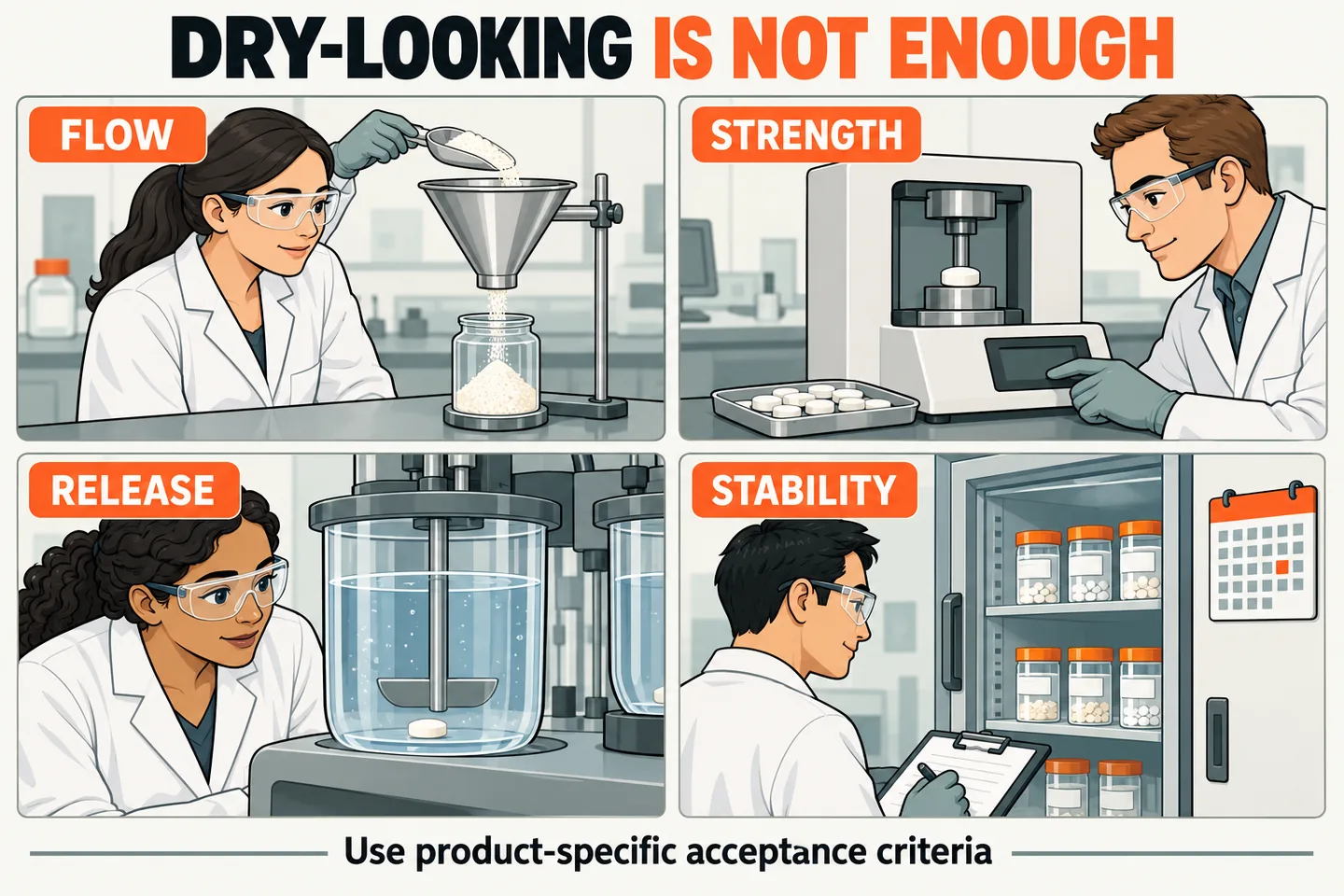
Use the following worksheet as a starting point for a product-specific plan. It is an editorial checklist, not a validated manufacturing or laboratory procedure.
- Question and baseline: state the defect, reference condition and proposed explanation.
- Inputs: identify the extract lot, carrier grade, full composition, preparation history and tooling set.
- Experimental design: define planned comparisons and consider interactions between liquid load, binding and operating conditions.
- Measurements: record relevant flow, uniformity, strength, friability, release and stability results.
- Decision criteria: agree acceptance criteria, stopping rules and who reviews the findings before the trial.
- Implementation: document the evidence needed for scale-up, routine manufacture and continued monitoring.
FDA’s process-validation guidance describes a lifecycle that includes process design, qualification and continued verification. A promising bench trial is useful development evidence, but does not establish that a commercial process is validated. FDA: Process Validation, General Principles and Practices.
When transferring oily extract tableting between facilities or countries, compare material specifications, solvent systems, analytical methods, equipment configuration and units. Similar trade names do not establish equivalent grades. Confirm product-category and market requirements through the responsible quality and regulatory teams; do not assume a pharmaceutical excipient use automatically applies to a supplement.
Oily extract tableting FAQs
What oil percentage is too high for tablet compression?
There is no universal cutoff in this guide. Define how the percentage is measured, then assess the complete formulation. A suitable liquid load depends on the carrier, binding system, target dose, tablet size and demonstrated performance.
Should every oily extract be wet-granulated?
No. Some developed liquid-loaded intermediates can be directly compressed; others may benefit from granulation or another preparation route. Base the choice on compatibility, processability and product-quality results, rather than oil content alone.
Does low-temperature drying remove excess oil?
Not necessarily. First identify the component being removed. Drying may remove water or solvent, while volatile extract constituents may also be lost. Do not describe the step as selective de-oiling without evidence that it achieves that purpose and preserves the intended material.
Can I reduce magnesium stearate by half?
That is a formulation change to test, not a general rule. Review ejection behavior, the mixing process, tablet strength and relevant release results. An oily ingredient does not establish the appropriate lubricant level.
Are stronger tablets enough to confirm a successful trial?
No. Evaluate the applicable identity, dose uniformity, physical quality, release and stability requirements. A stronger tablet may still fail another important criterion, and a short run does not establish long-term manufacturing consistency.
Prepare a useful equipment and tooling enquiry
For an oily extract tableting project, share the intended tablet size, output, material preparation route and observed trial limitations. A concise record of feeding, sticking and compression behavior helps define the equipment questions. Contact TabletPress Shop to discuss the project and rotary press tooling requirements for further evaluation.
Sources and scope
These sources include original formulation research, manufacturer technical guidance and pharmaceutical development guidance. Experimental findings are specific to the studied systems; this article does not claim production validation or measured customer results. Technical review remains appropriate before applying changes. Accessed 23 October 2026.
- FDA: Botanical Drug Development, Guidance for Industry
- Appelhaus, Steffens and Wagner (2024): Liquid Load Level and Binder Type
- Gumaste, Dalrymple and Serajuddin (2013): Compaction and Drug Release of Solid SEDDS
- Kostelanská et al. (2022): Processing Plant Extracts with a Porous Carrier
- EMA / ICH Q3C(R9): Residual Solvents
- Natoli: How to Avoid Sticking and Picking
- Natoli: Preventing Capping and Other Tablet Defects
- FDA: Process Validation, General Principles and Practices