
Herbal extract tableting can be challenging when a powder fills the dies inconsistently, sticks to the punches, or produces weak and capped tablets. The useful starting point is to identify the material and the observed defect. Treating every botanical powder as a high-fiber material can lead to the wrong formulation and tooling decisions.
Quick answer: Distinguish milled herbs from extracts, characterize the prepared powder, and assess five connected areas: material conditioning, excipients, preparation route, press conditions and tooling. Choose operating ranges from trials that check tablet quality. No single moisture percentage, binder ratio, compression-force ratio or punch-to-die clearance applies to every herbal extract.
This guide focuses on manufacturing investigations for Chinese herbal extracts and other botanical preparations. It discusses process development, not clinical benefits or a ready-to-run formula. The intended product category, composition and quality requirements determine which tests and controls are appropriate.
On this page
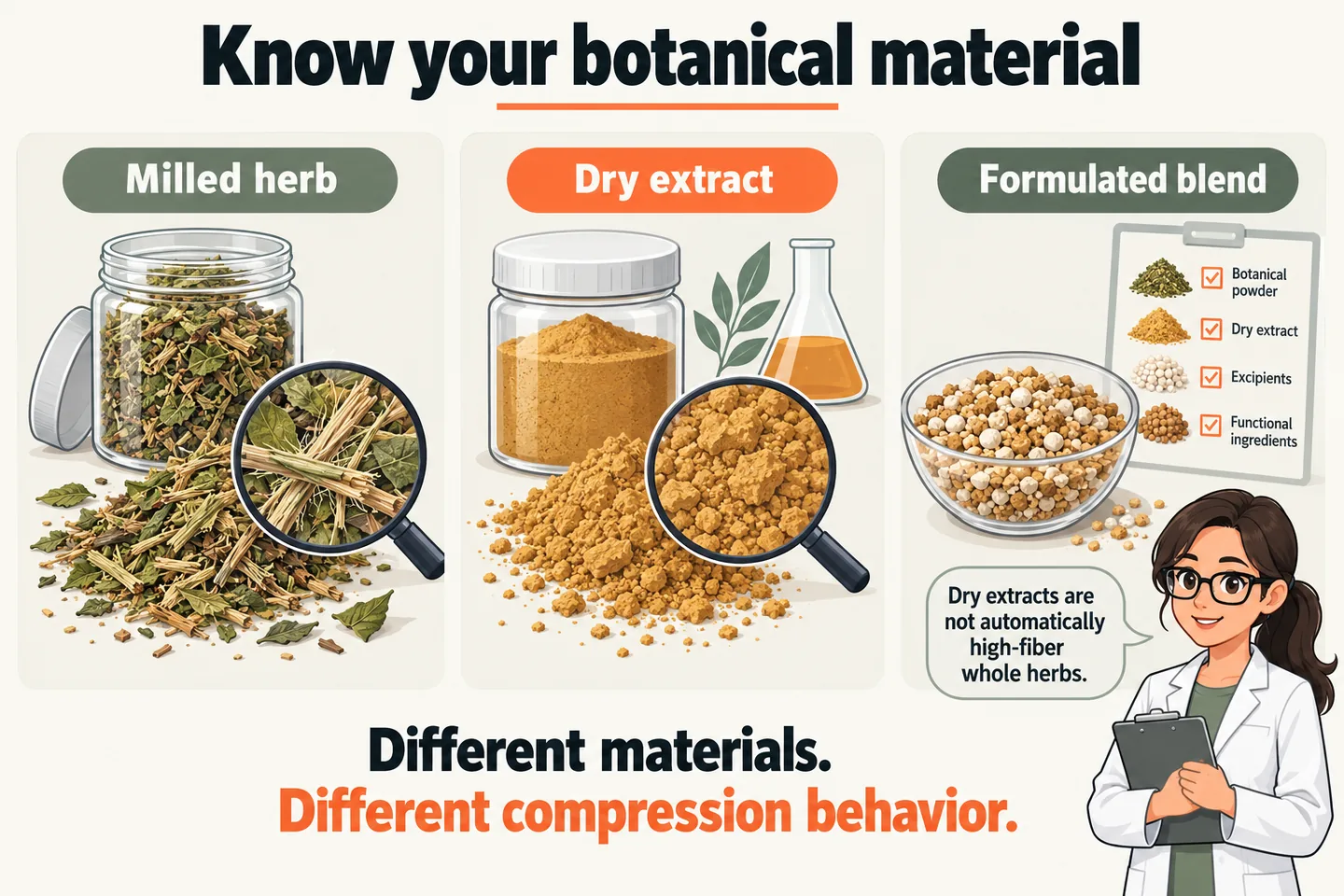
Herbal extract tableting starts with the right material definition
A milled root or leaf and a dry extract made from that plant are different materials. Milling changes particle size while retaining the plant material. Extraction produces a preparation whose composition depends on the process. The supplied dry powder may also include a carrier or other processing excipients.
EMA distinguishes powdered herbal substances from preparations produced by extraction and other processing. Its quality guidance also distinguishes genuine extract from extract containing excipients. These distinctions help interpret a supplier specification; they do not establish the fiber content or compression behavior of an individual lot. EMA: Quality of Herbal Medicinal Products, Revision 3.
- Milled herb: investigate the actual particle shape and remaining plant structures.
- Dry extract: obtain the extraction and drying history and characterize the supplied powder.
- Formulated extract blend: identify the native extract fraction, added ingredients and preparation steps.
For example, “Astragalus extract” is not enough information to specify a tablet formulation. Request the botanical identity, plant part, extract grade, extraction solvent, relevant assay or marker information, and any carrier already present. A product name does not show whether fibrous particles remain or whether the dominant issue is moisture uptake, poor feeding or weak bonding.
FDA’s botanical-drug guidance emphasizes raw-material characterization and manufacturing consistency. It recognizes that process changes can affect a botanical material’s chemical profile. Its scope is botanical drug development; it should not be presented as a single regulatory rule covering every supplement or market. FDA: Botanical Drug Development, Guidance for Industry.
1. Characterize particles, moisture and holding conditions
The first herbal extract tableting check is to describe the powder that actually reaches the press. Compare the incoming material with the blend after preparation and after its proposed hold period. Record when clumps, tackiness, bridging or feeding interruptions appear instead of attributing them automatically to fiber.
- Record supplier, lot, material grade, carrier content and storage history.
- Assess the particle-size distribution and visible morphology using suitable methods.
- Record the moisture test method and sample condition alongside the reported result.
- Compare bulk handling, clumping and feeding observations before and after a defined hold.
- Retain representative samples and photographs from the suspected and reference conditions.
Milling should address a demonstrated problem. A smaller particle size is not automatically a better feeding condition, and a sieve designation alone does not describe the whole particle distribution. If milling is being evaluated, check the resulting fines and the performance of the complete blend. Avoid adopting an 80–100 mesh target solely because the material is botanical.
Likewise, a proposed water-content range needs support for the particular formulation. Record the drying method, product exposure and endpoint, then check the properties that matter after drying. A single result collected immediately after the dryer does not describe what happens during transfer, storage and feeding.
A study by Kostelanská and colleagues processed plant extracts with an aluminometasilicate carrier and compared preparation conditions. The resulting tablet properties, including strength-related measures and disintegration, varied with processing. This supports examining the complete process history; it does not establish a universal drying temperature or moisture specification for herbs. Kostelanská et al. (2022): Processing Plant Extracts with a Porous Carrier.
For a practical investigation, prepare a material-history sheet: received condition, preparation step, sample time, container condition and measured result. The purpose is to identify where behavior changes. Our granule flowability guide provides related questions for evaluating feeding performance.
2. Select excipients by function and grade
Herbal extract tableting requires a balance between the intended extract dose and the excipient space available in the tablet. Start by assigning a purpose to each proposed ingredient. “Add filler” is less useful than identifying whether the trial is intended to improve bonding, handling, disintegration or ejection.
- Filler and binder: evaluate whether the chosen grade supports the intended tablet size and cohesion.
- Glidant: test its effect on the prepared blend and actual feeding behavior.
- Disintegrant: assess breakup under the relevant product test.
- Lubricant: compare ejection behavior with tablet strength and release performance.
Microcrystalline cellulose, or MCC, is a useful example of why “cellulose” does not automatically mean poor tablet formation. JRS lists MCC grades with different particle sizes, bulk densities, moisture characteristics and recommended applications. A grade appropriate for one preparation route is not necessarily interchangeable with another. JRS Pharma: VIVAPUR Microcrystalline Cellulose Grades.
MCC with pregelatinized starch can be a candidate combination, but a fixed ratio is not a general recipe for extracts. Describe the ingredient grades, proportions and addition sequence in the trial plan. Judge the complete tablet, including the intended dose and size, rather than selecting the blend with the highest breaking force alone.
Lactose or another filler also requires a compatibility and performance assessment. Do not promise that adding a particular percentage will improve flow without affecting disintegration or dissolution. Changing an excipient changes the formulation; the relevant chemical and physical quality checks still apply.
For herbal extract tableting, make the comparison explicit: what is held constant, what changes, and what result would justify the change? A useful formulation worksheet includes ingredient identity, function, grade, quantity, mixing history and measured outcome. This also makes a later supplier substitution easier to assess.
3. Choose direct compression or granulation from evidence
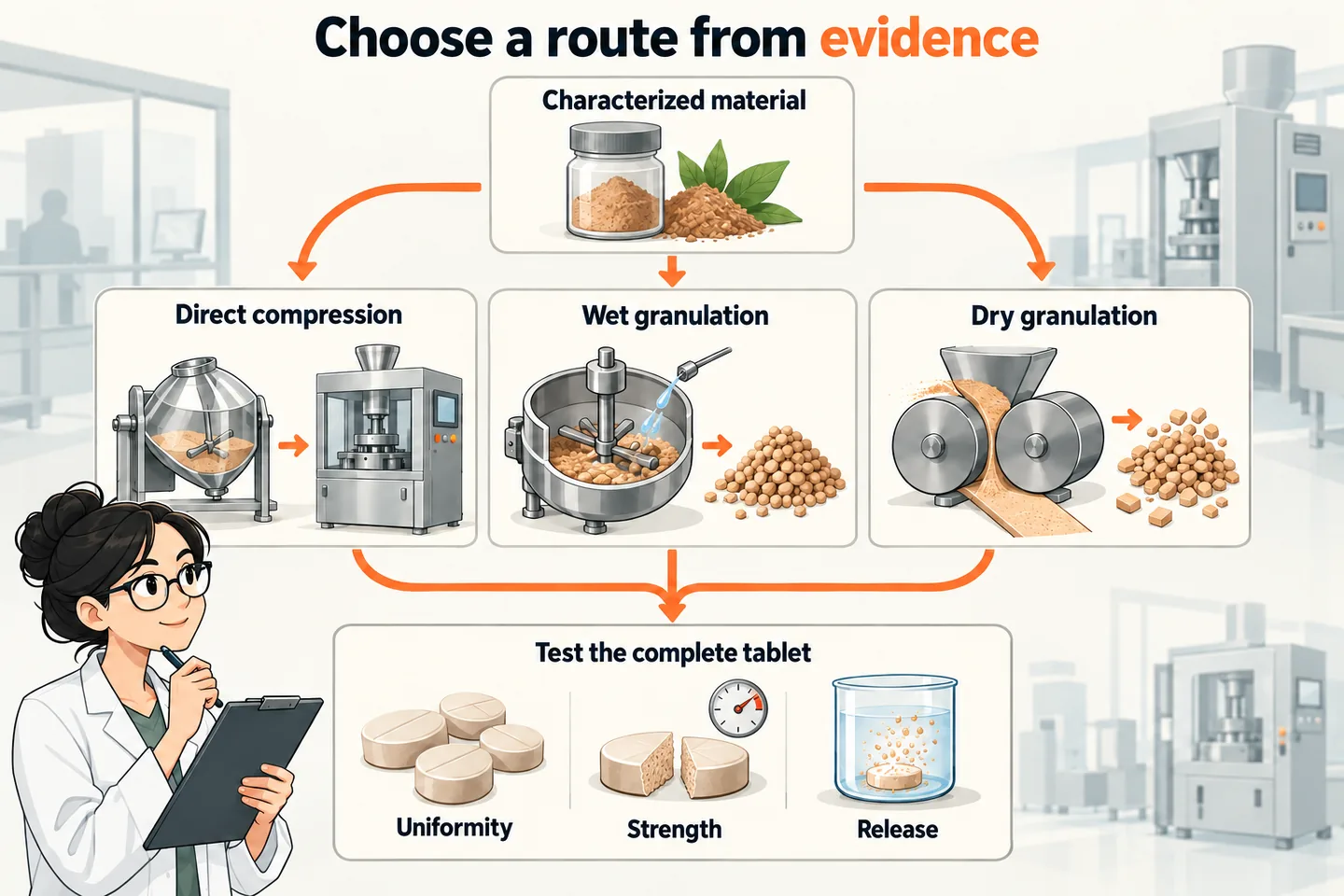
Wet granulation is one development option, not a requirement triggered by an assumed fiber percentage. Direct compression, wet granulation and dry granulation each deserve consideration according to the material and product. The objective is a suitable intermediate and tablet, rather than granules that merely look uniform.
- Direct compression: assess the prepared blend for feeding, uniformity and tablet formation under representative conditions.
- Wet granulation: evaluate liquid and binder compatibility, granule development, drying and retained quality.
- Dry granulation: evaluate the additional compaction and milling steps and the behavior of the resulting granules.
Before comparing routes, agree on the same intended extract amount per tablet and the same product-quality questions. A route that needs a different excipient level may also change tablet size. Record those differences so that the comparison remains understandable.
Avoid specifying one binder-solution concentration, drying limit or final sieve size for every extract. In the plant-extract study cited earlier, a porous carrier was part of the formulation and process under evaluation. Its results apply to those experimental systems and should not be converted into a universal wet-granulation prescription. Kostelanská et al. (2022): Processing Plant Extracts with a Porous Carrier.
For herbal extract tableting trials, record the intermediate yield and account for material removed during screening. If a fraction is discarded or reintroduced, assess the effect on composition and uniformity. Simply removing the particles that feed poorly may also change the material being compressed.
The granulation and tablet quality guide discusses related process choices. Use the comparison to decide what evidence is missing, then define a targeted trial rather than repeatedly changing binder, particle size and compression settings together.
4. Evaluate compression, feeding and exposure together
Separate filling behavior from compression response. A press adjustment cannot be interpreted clearly if the blend entering the dies is changing during the run. Trend tablet mass, visible defects and relevant press readings against time, hopper condition and material holds.
Natoli identifies precompression, main compression, punch penetration, speed and tooling configuration as variables in capping investigations. The response depends on the formulation and equipment. More compression force or longer dwell time is not always the appropriate answer. Natoli: Preventing Capping and Other Tablet Defects.
In herbal extract tableting, a fixed instruction such as “use 30–40% precompression” is incomplete. It does not define the reference force, material response or press limits. Plan a justified comparison within the permitted operating range, and record the actual conditions alongside the tablet results.
- Define the baseline run and the defect being investigated.
- Record feeder configuration, hopper behavior and tablet-mass trends.
- Document precompression and main compression with their units and the press configuration.
- Record speed, tooling identity and sample times for comparisons.
- Track temperature, humidity and exposure time where relevant to the observed change.
Room humidity can be part of the investigation, but one room setting does not characterize every powder’s exposure. Include packaging, open-container time and transfer steps. Select conditions from the material’s demonstrated behavior and applicable site requirements rather than applying a universal room-temperature and humidity pair.
A short run that looks acceptable is a starting point. Extend the evaluation as justified to see whether feeding, residue or tablet quality drifts. The precompression and main compression guide gives additional context for comparing the compression stages.
5. Match tooling to the formulation and tablet design
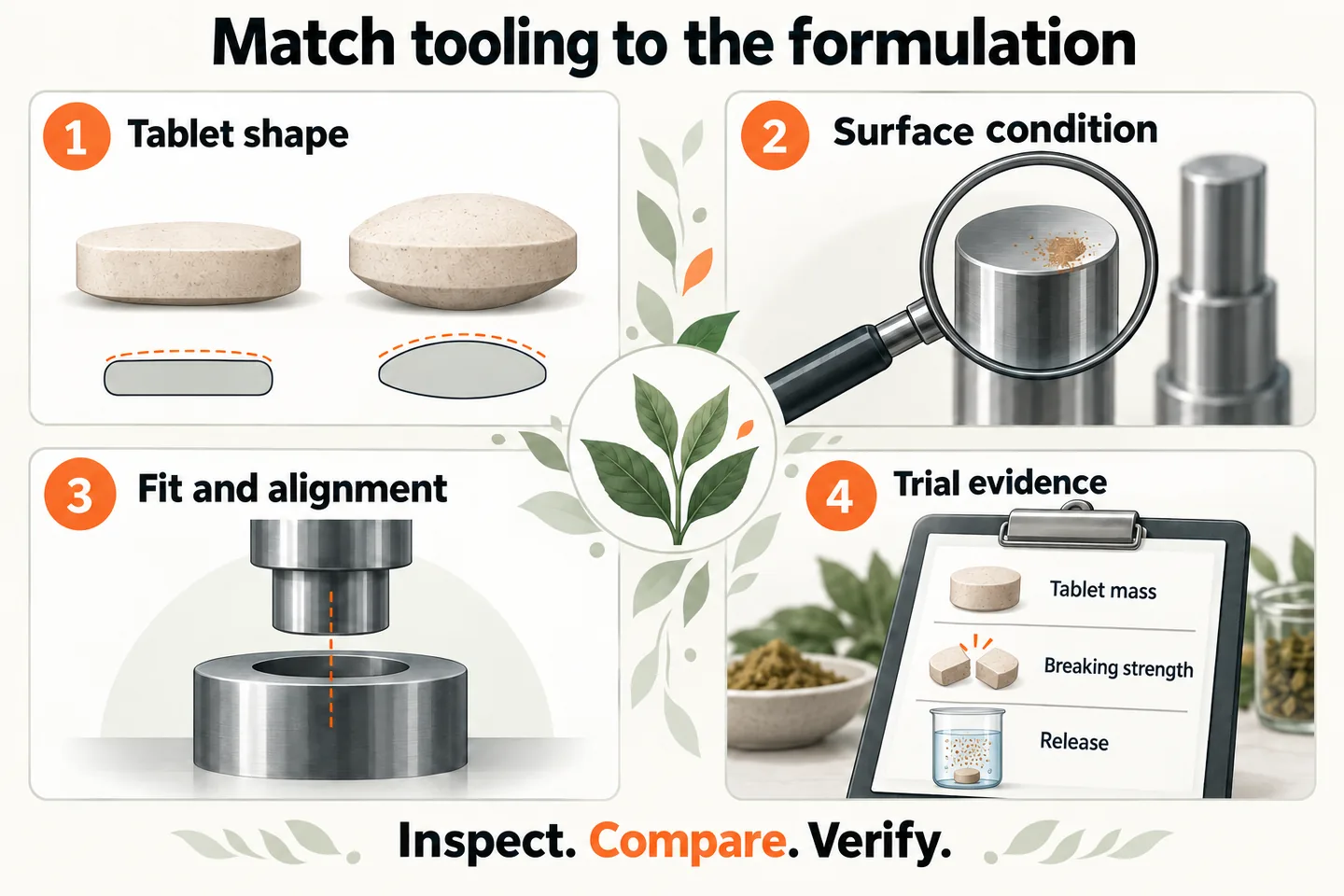
Herbal extract tableting tooling should be selected from the intended tablet geometry, material behavior and equipment requirements. “Botanical” does not by itself specify an abrasive formulation, a coating requirement or a suitable steel grade.
Natoli’s tooling guidance considers formulation properties, wear, toughness, corrosion and manufacturing needs when selecting tooling materials. A harder or more wear-resistant material is not automatically the best answer to every failure mode. Discuss the actual application and observed damage with the tooling supplier. Natoli: Tablet Manufacturing and Tooling FAQs.
- Shape and markings: evaluate cup profile, edges and embossing against the proposed tablet and observed defects.
- Condition: document residue, roughness, corrosion or damage before proposing a treatment.
- Fit and alignment: inspect against the approved drawing, machine requirements and relevant tooling standard.
- Surface and material: compare suitable options using the same formulation and defined trial conditions.
Do not apply a universal 3–5 µm punch-to-die clearance. The required dimensions and tolerances belong to the specific tooling design and equipment specification. A tablet-formulation article is not a substitute for those drawings or for an inspection by qualified personnel.
I Holland describes sticking as a surface interaction influenced by factors including moisture, temperature and the formulation. It also explains why a mirror finish is not an assured solution. A coating or finish should address an observed problem and be assessed through trials. I Holland / Tabletting Science: How to Avoid Sticky Situations.
Before cleaning or inspecting contact surfaces, follow the equipment’s stop and isolation procedures. Record what was found and where it occurred. See the tablet tooling maintenance guide for related inspection and care considerations.
A defect checklist for herbal extract tableting
| Observation | Evidence to collect | Investigation focus |
|---|---|---|
| Weak or friable tablets | Measure relevant strength and friability; record dimensions and preparation history. | Investigate bonding, formulation and compression response. |
| Capping or lamination | Record when separation appears and whether particular stations are affected. | Compare material response, compression sequence and tooling conditions. |
| Sticking or picking | Photograph deposits and affected tablet areas at defined intervals. | Review exposure, formulation and the contact surface together. |
| Tablet-mass variation | Trend mass against time, hopper level and feed interruptions. | Investigate filling and possible segregation as distinct concerns. |
| Mottling or spots | Retain samples and compare color, deposits and ingredient distribution. | Investigate the source rather than assigning every color difference to moisture. |
These are starting questions, not one-to-one diagnoses. Consistent tablet mass does not establish uniform distribution of every relevant constituent. Likewise, acceptable appearance does not establish suitable release or stability. Use the product’s defined sampling and analytical approach for those questions.
An unexpected defect should lead to a documented assessment. Re-drying a production blend, adding lubricant or binder, or regranulating material can change its composition and performance. Such actions need the site’s approved change or rework process; they should not be treated as informal emergency adjustments.
Build a trial record that can be transferred between sites
A useful herbal extract tableting record explains both what was tried and why the result was accepted or rejected. The following is an editorial planning checklist, not a validated manufacturing procedure.
- Question: define the observed defect and proposed explanation.
- Materials: identify the extract, existing carrier, excipients, lots and relevant test methods.
- Comparison: state the baseline, planned changes and possible interactions.
- Equipment: record the press, feeder, tooling set and operating units.
- Quality: define the applicable uniformity, physical, release and stability criteria.
- Decision: record the results, limitations and evidence needed before routine use.
ICH Q8(R2) links pharmaceutical development to understanding material attributes, process parameters and product quality. It provides a framework for deciding what to study, rather than a standard formulation or a guarantee that one successful trial will transfer to production. FDA / ICH Q8(R2): Pharmaceutical Development.
When transferring work between countries or facilities, compare specifications and methods rather than trade names alone. State whether a declared extract amount includes carrier, how analytical results are expressed, and which units describe the operating conditions. Confirm the intended market and product category with the responsible quality team. These details make technical discussions more useful than unsupported claims about regional performance.
Herbal extract tableting FAQs
Are all Chinese herbal extracts high in fiber?
No. A milled herb and an extract are different preparations. Extraction and subsequent processing affect the supplied material, and a dry extract may contain added excipients. Characterize the actual powder rather than inferring fiber content from the plant name.
What moisture content should an herbal extract have before compression?
There is no single value for every formulation. Define the test method, sample condition and relevant performance criteria. Establish an appropriate range from material behavior, process studies and product-quality results, including the effect of holding and transfer.
Is MCC with pregelatinized starch always sufficient?
No. It is a possible combination to evaluate. Excipient grades, extract loading, preparation route and the intended tablet all matter. Check feeding, uniformity, physical quality and release rather than choosing a fixed ratio by default.
Should I increase pressure when herbal tablets cap?
Not automatically. First document the defect and investigate the formulation, filling, compression sequence and tooling. A controlled comparison may support a different setting, but increasing force alone can fail to address the cause.
Will a mirror finish or coating prevent sticking?
It may help a particular formulation, but performance needs confirmation. Examine the material, exposure history and contact surfaces together. Compare appropriate treatments under defined conditions and inspect the resulting tablets and tooling.
Prepare an equipment or tooling enquiry
For a herbal extract tableting project, provide the material description, preparation route, target tablet size, output and observed trial limitations. Include photographs or measured trends where available. Contact TabletPress Shop to discuss equipment questions and rotary press tooling options for evaluation.
Sources and scope
References include official development guidance, original formulation research and manufacturer technical information. Findings apply within their stated scope and do not validate a specific production process. This article makes no clinical claims or claims of measured customer results. Technical review remains appropriate before applying changes. Accessed 23 October 2026.
- EMA: Quality of Herbal Medicinal Products, Revision 3
- FDA: Botanical Drug Development, Guidance for Industry
- JRS Pharma: VIVAPUR Microcrystalline Cellulose Grades
- Kostelanská et al. (2022): Processing Plant Extracts with a Porous Carrier
- I Holland / Tabletting Science: How to Avoid Sticky Situations
- Natoli: Preventing Capping and Other Tablet Defects
- Natoli: Tablet Manufacturing and Tooling FAQs
- FDA / ICH Q8(R2): Pharmaceutical Development