
Tablet dissolution factors span the drug substance, formulation, manufacturing process, test conditions and storage history. When a tablet releases its active ingredient more slowly than expected, increasing compression force or changing a disintegrant may address the wrong cause. Start by identifying which part of the release process has changed.
Quick answer: The main tablet dissolution factors are the test method, drug solubility and ionization, solid form and particle dispersion, excipient behavior, granulation and lubrication, compressed tablet structure, coating design, and storage. Evaluate these against the intended release profile. Faster dissolution is not automatically desirable for a modified-release product.
This guide turns tablet dissolution factors into practical questions for formulation, production and quality teams. It distinguishes equilibrium solubility from physical breakup and measured release, without prescribing a universal formulation, hardness target or process setting.
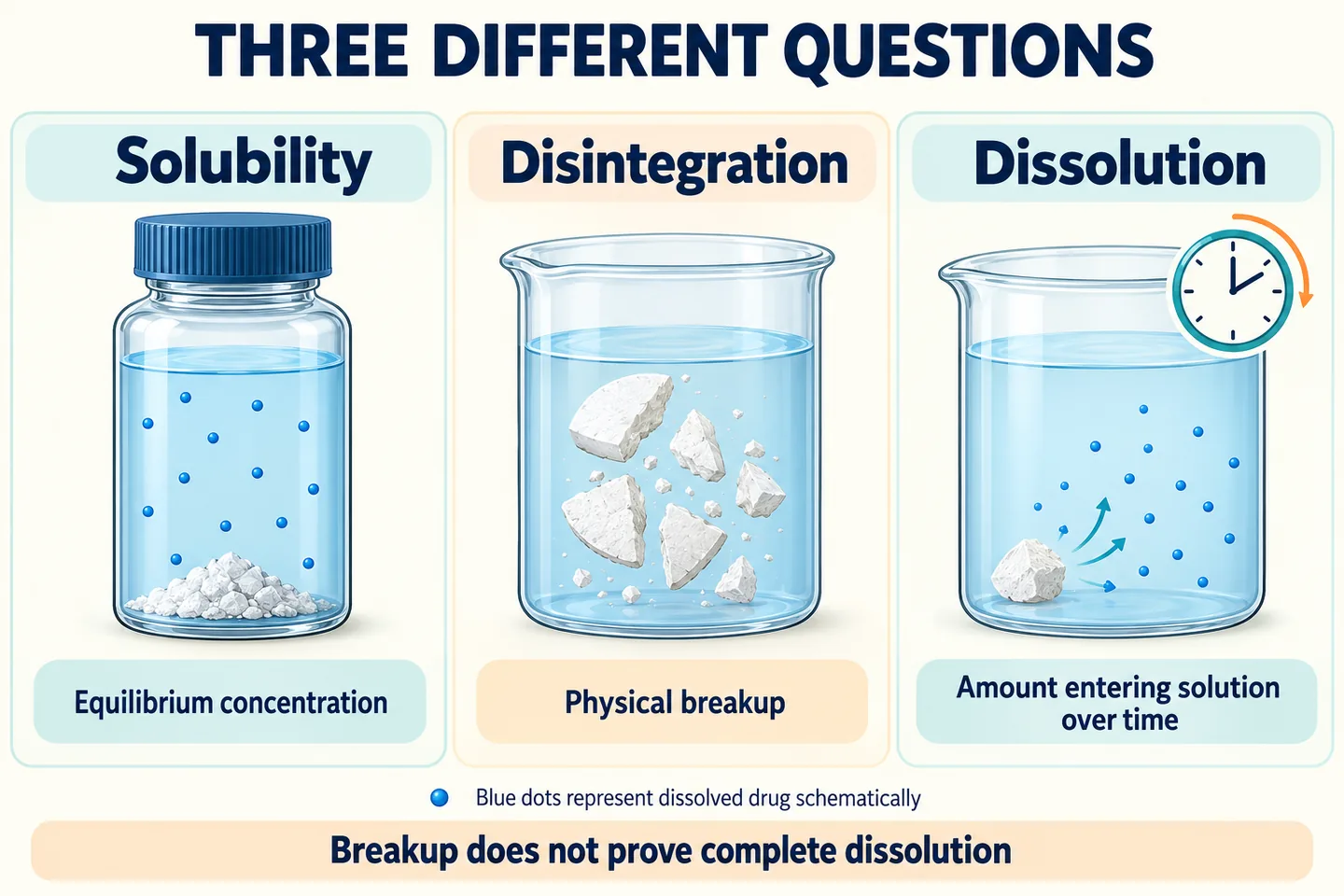
Table of Contents
Solubility, disintegration and dissolution: what changes?
These terms describe different properties. A tablet can break apart quickly while its drug particles dissolve slowly. Conversely, some release systems deliver drug through a matrix or coating without rapidly breaking into fragments. Observing breakup is therefore useful, but it is not a direct measurement of dissolved drug.
| Term | Question it answers | Important qualification |
|---|---|---|
| Solubility | How much drug can be present in solution at equilibrium under specified conditions? | Specify the solid form, medium, pH and temperature. Apparent or transient concentrations need careful interpretation. |
| Disintegration | How does the tablet physically break up in the test? | Fragments may still contain undissolved drug or persistent granules. |
| Dissolution | How much drug enters solution over time under the selected method? | The result depends on the dosage form and the test conditions. |
Intrinsic solubility generally refers to the equilibrium solubility of the un-ionized form under defined conditions. It should not be used interchangeably with every measured concentration from a salt, surfactant system or supersaturated dispersion. A carvedilol solubility study illustrates why pH control, equilibration and solid-phase characterization matter.
Dissolution is also not synonymous with bioavailability. Drug absorption depends on additional properties and physiological conditions. A laboratory profile can support product understanding; a faster curve alone does not establish a better clinical outcome.
1. Confirm the method before changing the product
The first of the tablet dissolution factors to check is the measurement itself. Confirm the intended release type and applicable method, then compare the current test with the reference run. Medium preparation, pH, apparatus setup, agitation, temperature control, sampling and filtration can all deserve investigation when results shift.
The FDA guidance on immediate-release dissolution testing provides a framework for developing dissolution specifications and comparing profiles. Its scope should not be extended automatically to delayed-release or extended-release products.
- Check the method version, medium composition and sampling schedule.
- Review instrument qualification, vessel observations and any documented deviations.
- Confirm that filtration and sample handling do not remove dissolved drug or allow undissolved particles to distort the measurement.
- Compare individual-unit results and the profile shape, not only the average at one time point.
Investigate laboratory causes through the applicable quality procedure. Do not alter the test conditions simply to obtain a passing result. If method development is needed, distinguish that work from routine release testing and document the scientific rationale.
2. Establish solubility, pH response and salt behavior
For an ionizable drug, the relationship between pH and ionization can strongly affect measured solubility. The relevant question is not merely whether the powder dissolves in a beaker of water. Ask whether the selected medium has suitable capacity for the drug amount and whether pH changes during the experiment.
A salt form may improve initial dissolution under some conditions, but conversion or precipitation can change the later profile. Similarly, a pH modifier in the formulation can influence the local environment without producing the same effect in every bulk medium. Record the actual drug form and the conditions used to evaluate it.
Do not classify every drug as highly or poorly soluble using one fixed concentration threshold. Dose, pH range and the purpose of the classification matter. For troubleshooting, a defined solubility assessment is more informative than a broad claim that polar drugs dissolve well and nonpolar drugs do not.
When screening tablet dissolution factors, separate a medium-capacity limitation from restricted access to the drug inside the tablet. Those explanations may lead to different experiments even when the final measured concentration looks similar.
3. Examine solid form, particle size and dispersion
Crystal form, hydration state and amorphous content can affect dissolution behavior. A change in supplier, milling, drying or storage may justify checking whether the material still has the intended solid-state properties. Avoid assigning a universal improvement multiplier to an amorphous material: the result depends on the drug, carrier and test conditions.
Reducing particle size can increase accessible surface area and speed dissolution. It does not necessarily increase equilibrium solubility. In a study comparing micronized and nanosized drugs, the effect depended on particle size, medium and the polymer used. Results for one compound or particle-engineering approach are not a general prediction for another.
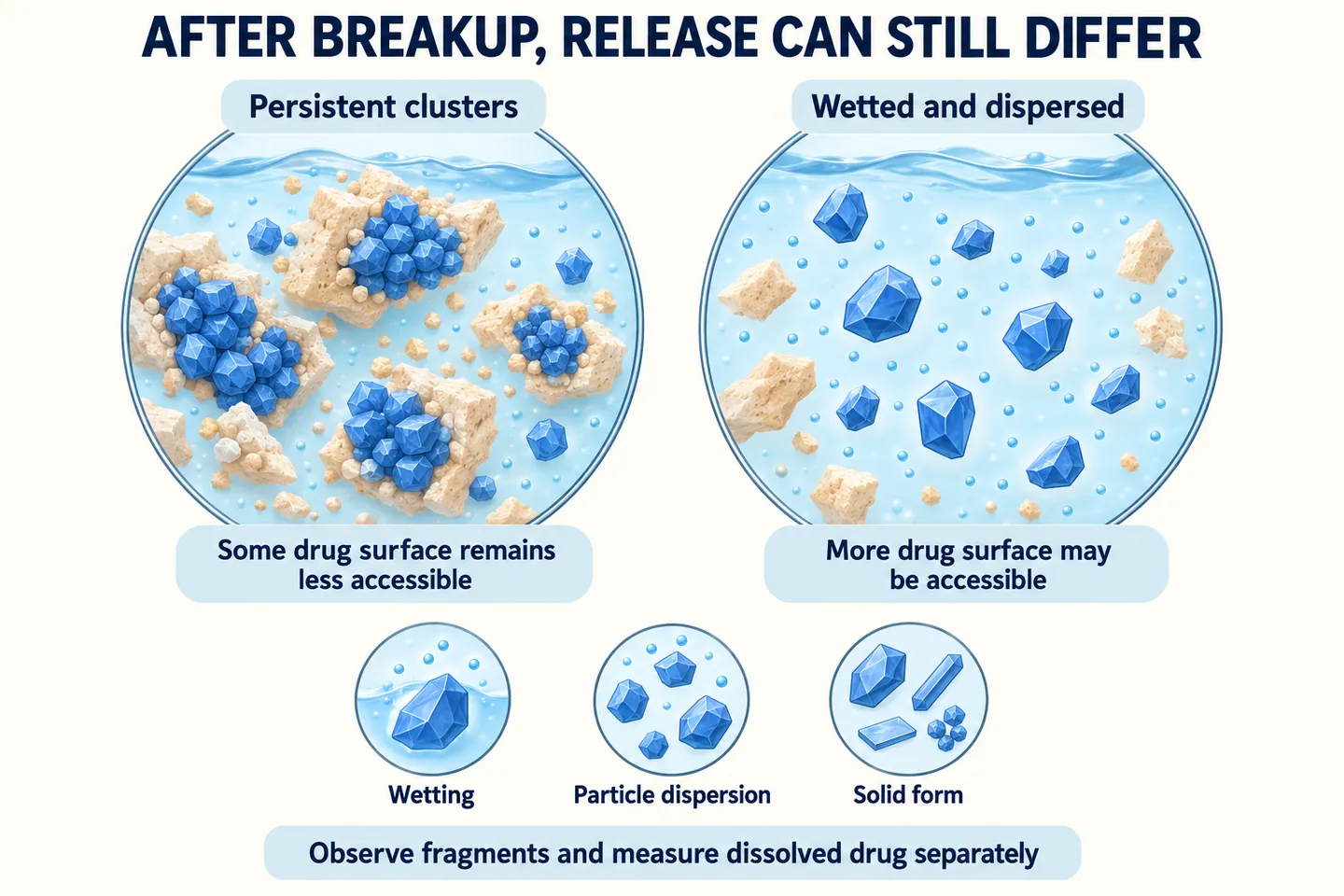
Fine particles can also agglomerate or wet poorly. Measure dispersion under relevant conditions rather than assuming that a smaller dry particle-size result means more exposed drug surface during dissolution. Our guide to tablet fines, disintegration and dissolution explores that narrower issue in more detail.
Amorphous systems need additional attention to physical stability and precipitation. In an experimental study of bicalutamide amorphous solid dispersions, dissolution and crystallization competed. That finding supports checking solid-state changes; it does not mean every amorphous formulation will behave in the same way.
4. Evaluate excipient function within the formulation
Excipient names alone do not predict release. Grade, amount, distribution and interaction with the drug or other ingredients can matter. Among tablet dissolution factors, these formulation effects are often connected: a change that improves mechanical strength may also alter water penetration or the character of the resulting fragments.
Disintegrants, binders and fillers
Sodium starch glycolate, croscarmellose sodium and crospovidone are all commonly used superdisintegrants. Do not rank them using a universal swelling percentage or describe sodium starch glycolate as inherently ineffective. Swelling, water uptake and strain recovery contribute differently depending on the material and formulation.
An experimental study of disintegrant–magnesium stearate interactions found different responses for sodium starch glycolate and potato starch. It illustrates why an excipient should be evaluated in its actual blend and test context rather than selected from a generic ranking.
Binder level and distribution can influence granule persistence after the tablet breaks up. A water-soluble binder is not automatically neutral to dissolution. Likewise, an insoluble filler can influence pore structure and liquid movement even though it does not dissolve readily itself.
Wetting and solubilization aids
Surfactants, complexing agents and other formulation approaches may change wetting or apparent solubility. Their selection requires product-specific compatibility, performance and safety assessment. There is no universal additive percentage that can be transferred to every drug and release system.
For a controlled comparison, change one justified variable or use an appropriate experimental design. Retain the same drug lot and clearly record which excipient grade, quantity or addition stage differs.
5. Review granulation and lubrication history
Direct compression, dry granulation and wet granulation can each produce suitable products. None is consistently the fastest-dissolving route. The relevant tablet dissolution factors include granule structure, binder distribution, moisture history, milling and the way the granules behave after the tablet disintegrates.
Compare granule-size distribution and density with the reference batch. If a tablet breaks apart but releases drug slowly, inspect whether dense or binder-rich granules persist. The tablet granulation quality guide explains how upstream granule properties connect with downstream performance.
Lubrication deserves a separate review. Magnesium stearate grade, level and mixing history can affect compact structure and wetting in a formulation-dependent way. A model study of magnesium stearate in acidic medium observed delayed dissolution under its experimental conditions. That is a reason to investigate, not proof that magnesium stearate is the cause of every slow profile.
Record blender loading, addition order, mixing time and transfer history. Compare retained material where available. A nominally unchanged formula does not establish that the distribution of its components is unchanged.
6. Connect compression with tablet structure
Compression changes particle bonding and the pathways through which liquid enters the compact. Higher force may produce a denser structure, but its effect on dissolution depends on the formulation, deformation behavior and release mechanism. A universal pressure or hardness range cannot describe all products.
In a production-scale study of granule density and product performance, granule density and tablet solid fraction were connected with mechanical and dissolution behavior. Use this as a basis for examining structure and performance together, rather than assuming that a stronger tablet is always a better tablet.
- Compare tablet mass, dimensions and breaking force alongside dissolution.
- Assess friability and visible defects to avoid solving release at the expense of handling strength.
- Record press speed, precompression, main compression and the sampling position within the run.
- Where suitable, evaluate porosity or solid fraction using a justified method and the necessary density data.
The precompression and main compression guide provides additional process context. Equipment settings should support the product’s demonstrated operating range; they cannot replace formulation and release testing.
7. Match coating behavior to the intended release
A protective film coat, enteric coat and extended-release membrane have different purposes. Review polymer identity, grade, application, curing and coating integrity before interpreting the profile. Coating weight gain by itself does not describe every functional property.
Grade names matter. For example, the manufacturer describes EUDRAGIT L 100-55 as an enteric polymer designed for release above pH 5.5. That specification should not be attributed to every polymer in the EUDRAGIT L family, nor treated as a guarantee of the finished tablet’s behavior.
For an immediate-release film-coated product, compare coated and uncoated cores when scientifically appropriate. For a functional coating, evaluate the intended delay or sustained release using the relevant method. Removing the barrier or making release faster can defeat the design rather than improve it.
8. Check storage and packaging history
Tablet dissolution factors can change after manufacture. Moisture uptake or loss, solid-state conversion, changes in a polymer matrix and other physical or chemical processes may alter the release profile. The direction and magnitude depend on the product and its packaging.
A study of amorphous solid-dispersion stability examined how temperature, humidity and polymer content affected recrystallization. It supports a product-specific investigation rather than a single humidity or temperature limit for all tablets.
Compare initial and stored samples in the intended container-closure system. Review package integrity, exposure during handling and any distribution excursions. Keep dissolution, assay and impurity findings distinct: a change in release does not by itself identify chemical degradation, and a passing assay does not prove an unchanged release profile.
For transfers between manufacturing sites or distribution regions, document comparable materials, methods and storage exposures. Country names alone do not explain a profile difference. Use actual transport and stability evidence before attributing a change to climate.
Build an investigation around tablet dissolution factors
Convert the observations into a testable hypothesis. Use the table below to organize possible explanations, then select comparisons that can distinguish between them. These are investigation prompts, not diagnoses or instructions to release a batch.
| Observed pattern | Questions to investigate | Useful comparison |
|---|---|---|
| Slow breakup and slow dissolution | Has water entry, bonding, coating behavior or disintegrant function changed? | Reference versus trial tablets with dimensions, breaking force and breakup observations. |
| Similar breakup, slower dissolution | Are drug particles poorly wetted, aggregated or present in a different solid form? | Fragment or granule behavior, drug particle properties and dissolution profiles. |
| Different results between media | Does pH, ionization, medium capacity or a functional coating explain the difference? | Scientifically justified media comparisons with the product’s release intent documented. |
| Change only after storage | Has moisture exposure, packaging or a physical or chemical stability attribute changed? | Initial and stored samples, package history, solid-state and analytical evidence as appropriate. |
| Large unit-to-unit variation | Is the cause product heterogeneity, variable coating or a test-related issue? | Individual profiles, unit observations and laboratory and production records. |
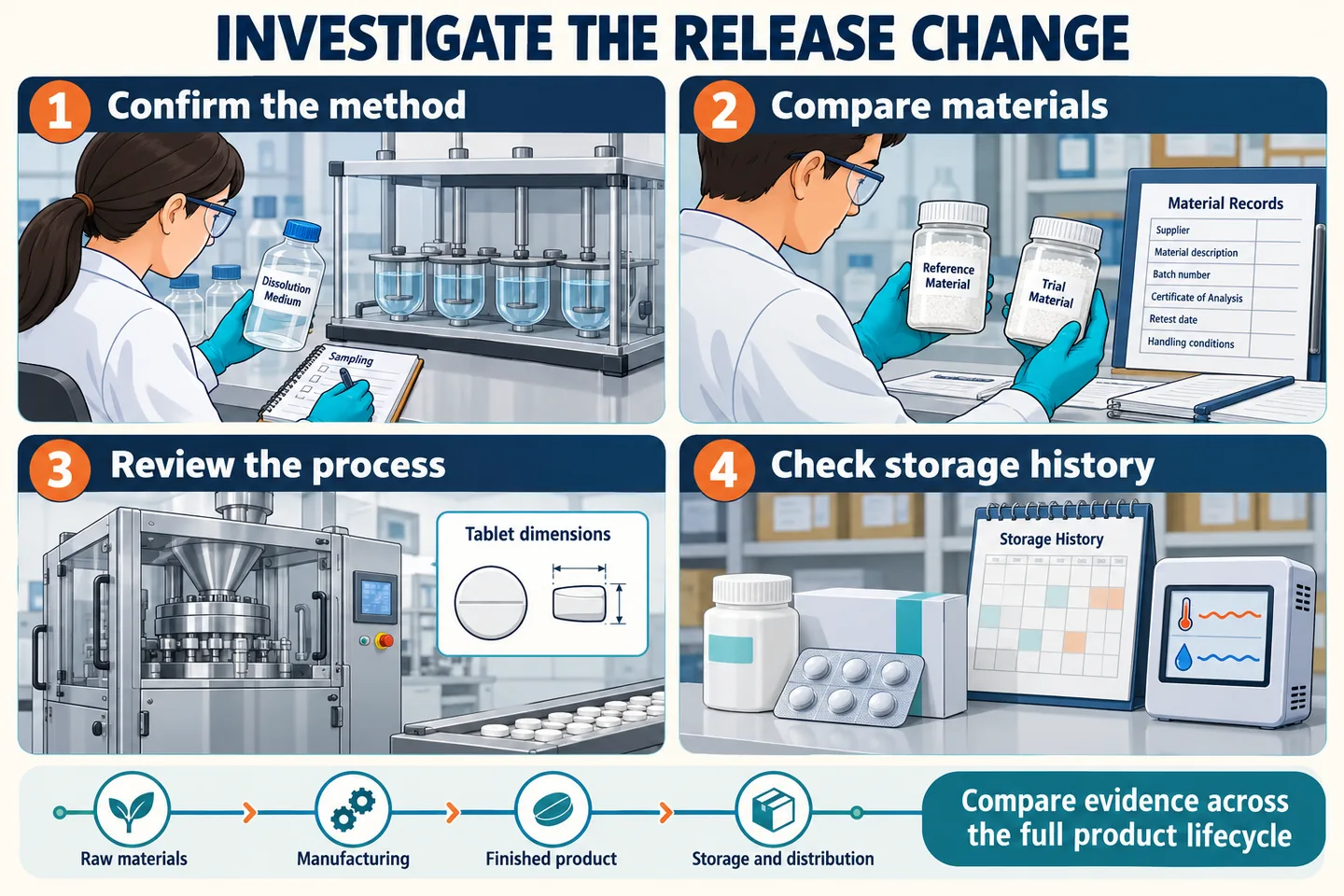
A useful trial record includes the batch and material identifiers, method version, processing history, sample age, packaging, individual results and the hypothesis being tested. Set the comparison criteria before reviewing the outcome. Keep formulation, production and quality teams aligned on what evidence would support or reject the proposed explanation.
Tablet dissolution factors: frequently asked questions
Can a tablet disintegrate quickly but dissolve slowly?
Yes. Breakup can leave drug crystals or granules that dissolve slowly because of limited solubility, poor wetting, aggregation or other barriers. Measure dissolved drug separately from the time taken for the tablet to break apart.
Does micronization always increase solubility?
No. Micronization often targets dissolution rate by increasing surface area. It does not necessarily change equilibrium solubility, and aggregation can reduce the surface exposed to the medium. Nanoparticle and solid-state effects require their own assessment.
Does reducing tablet hardness always improve dissolution?
No. It may change pore structure or breakup, but the effect depends on the formulation and release mechanism. Evaluate dissolution together with mechanical strength and friability. Avoid adopting a universal breaking-force target.
Which superdisintegrant gives the best release?
There is no universal winner. Sodium starch glycolate, croscarmellose sodium and crospovidone can perform differently across formulations, grades and processing conditions. Compare suitable candidates in the intended product rather than relying on a general ranking.
Why can fresh tablets pass while stored tablets change?
Physical changes, moisture history, coating or matrix behavior, and chemical stability may contribute. Compare retained samples and packaging records, then test the proposed mechanism. A storage-related difference does not identify the cause on its own.
Which tablet dissolution factors should be checked first?
Start with the intended release profile, test method and the timing of the change. Then prioritize differences in materials, manufacturing or storage between reference and affected samples. This sequence makes the next experiment easier to interpret.
Plan a tableting trial with clear release requirements
When evaluating a press or tooling configuration, share the formulation’s processing characteristics, tablet geometry, expected throughput and release requirements. A documented trial can help connect machine capability with tablet quality. It cannot establish a universal recipe or guarantee dissolution performance.
Use our pharmaceutical tableting overview for broader planning, or contact the team about a controlled equipment trial. Keep the assessment of tablet dissolution factors linked to product-specific laboratory evidence and the intended release profile.