
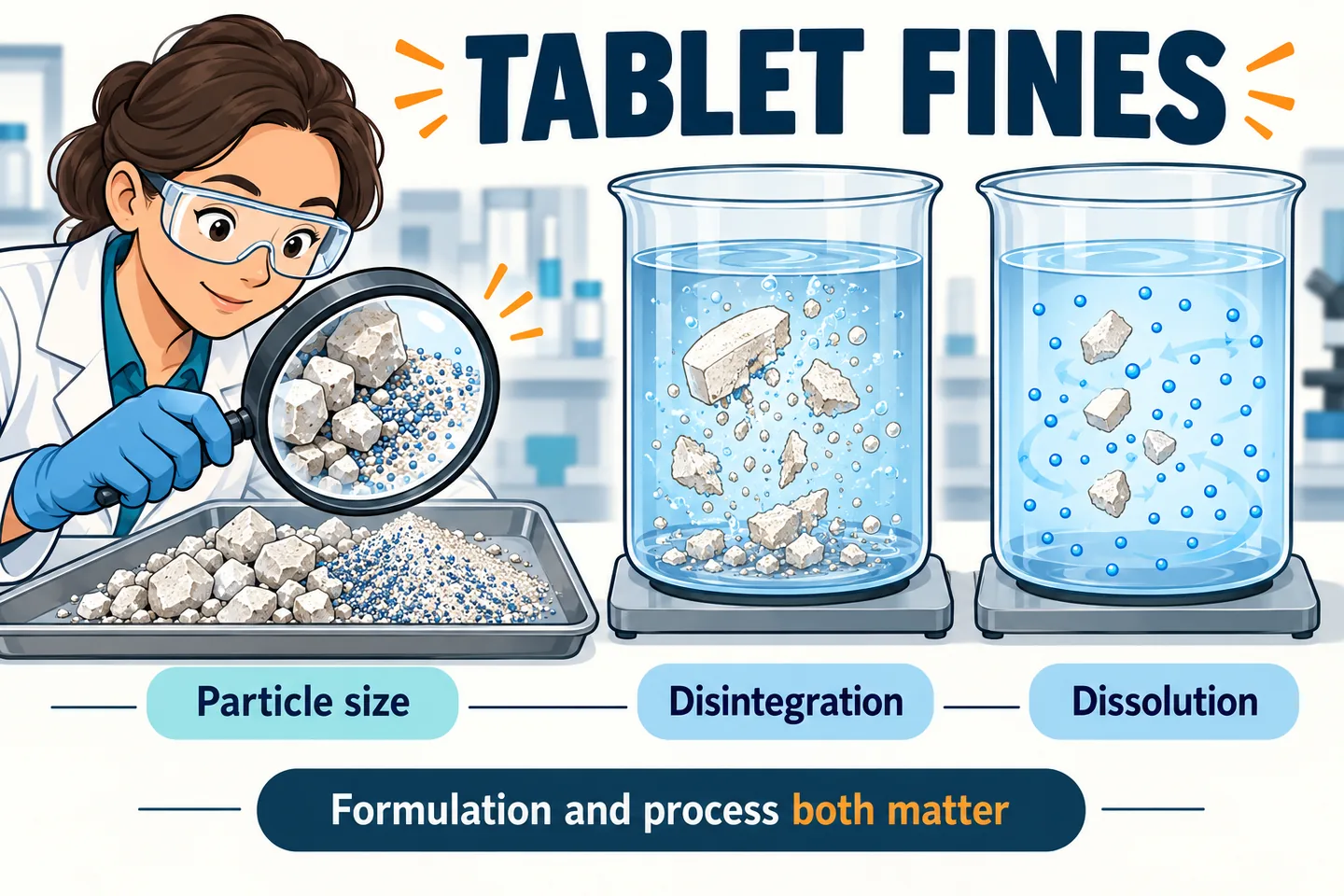
Tablet fines can change how a tablet takes up liquid, breaks apart and releases its active ingredient. However, a higher fine-particle fraction does not automatically mean slower disintegration or failed dissolution. The result depends on what the fines contain, how they wet and disperse, and the structure created during compression.
Quick answer: Fine particles may increase the surface available for dissolution when they are adequately wetted and dispersed. They may also change packing, bonding or agglomeration in ways that restrict liquid access after compression. Measure disintegration and dissolution separately, alongside particle-size distribution and tablet properties. There is no universal fines percentage, hardness limit or direction of effect that applies to every formulation.
This guide uses “tablet fines” to mean the fine fraction in the powder blend or granulation entering the press, rather than dust abraded from finished tablets. It focuses on conventional immediate-release tablets. Modified-release, enteric-coated and orally disintegrating products need their own development targets and test interpretation.
On this page
1. Define tablet fines before judging the amount
Start with an operational definition: the particle-size cutoff, analytical method, reporting basis and sampling point. A result reported as mass passing a sieve is not automatically interchangeable with a laser-diffraction volume distribution. Record the method and sample preparation so that a change in testing is not mistaken for a change in material.
Identify what is present in the fine fraction. It may contain active pharmaceutical ingredient, filler, disintegrant, lubricant, broken granules or a mixture of these. The particle size of the API inside a granule is also different from the granule’s overall size. These distinctions matter when someone proposes milling, screening or changing the granulation process.
For example, one immediate-release tablet study defined fines using a particular size fraction and changed poloxamer concentration. Larger granules, longer disintegration and slower dissolution occurred together as the formulation changed. This is evidence of interacting variables, not proof that removing fines improves release. See the poloxamer quality-by-design case study.
For a practical investigation, compare equivalent samples collected at defined locations: after granulation or milling, after transfer, and near the feed system. Label each sample with its lot, location and time. Our tablet granulation guide provides related questions about the preparation route.
2. Separate disintegration from dissolution
Disintegration describes tablet breakup under specified test conditions. Dissolution measures the active ingredient entering solution over time. A tablet may break into granules that still release drug slowly. Conversely, a soluble component may begin dissolving while the tablet retains part of its structure.
Keep the two observations separate when assessing tablet fines. Record how the tablet breaks up, whether persistent fragments or agglomerates remain, and how the dissolution profile changes. A photograph of breakup cannot establish the amount of dissolved API, while one dissolution value may conceal a change in the early release profile.
ICH Q6A permits replacing dissolution with disintegration only in justified circumstances for appropriate products. It does not make the tests generally interchangeable. The applicable specification and demonstrated product knowledge should determine the testing approach. See FDA / ICH Q6A: Specifications.
The following patterns help organize an investigation. They are starting hypotheses rather than diagnoses or acceptance criteria.
| Observed response | Questions to investigate | Useful comparison |
|---|---|---|
| Slower breakup and slower release | Has liquid access, bonding or disintegrant performance changed? | Matched tablet properties, wetting observations and dissolution profiles. |
| Similar breakup but slower release | Are persistent granules, API properties or wetting limiting release? | Post-breakup residue and API or granule characterization. |
| Faster initial release | Has accessible drug surface increased, and is the response reproducible? | Individual-unit profiles and the full required testing interval. |
| Larger differences between units | Is the variation associated with sampling, composition, filling or testing? | Time-linked samples and individual results rather than averages alone. |
3. Examine the compressed pore network
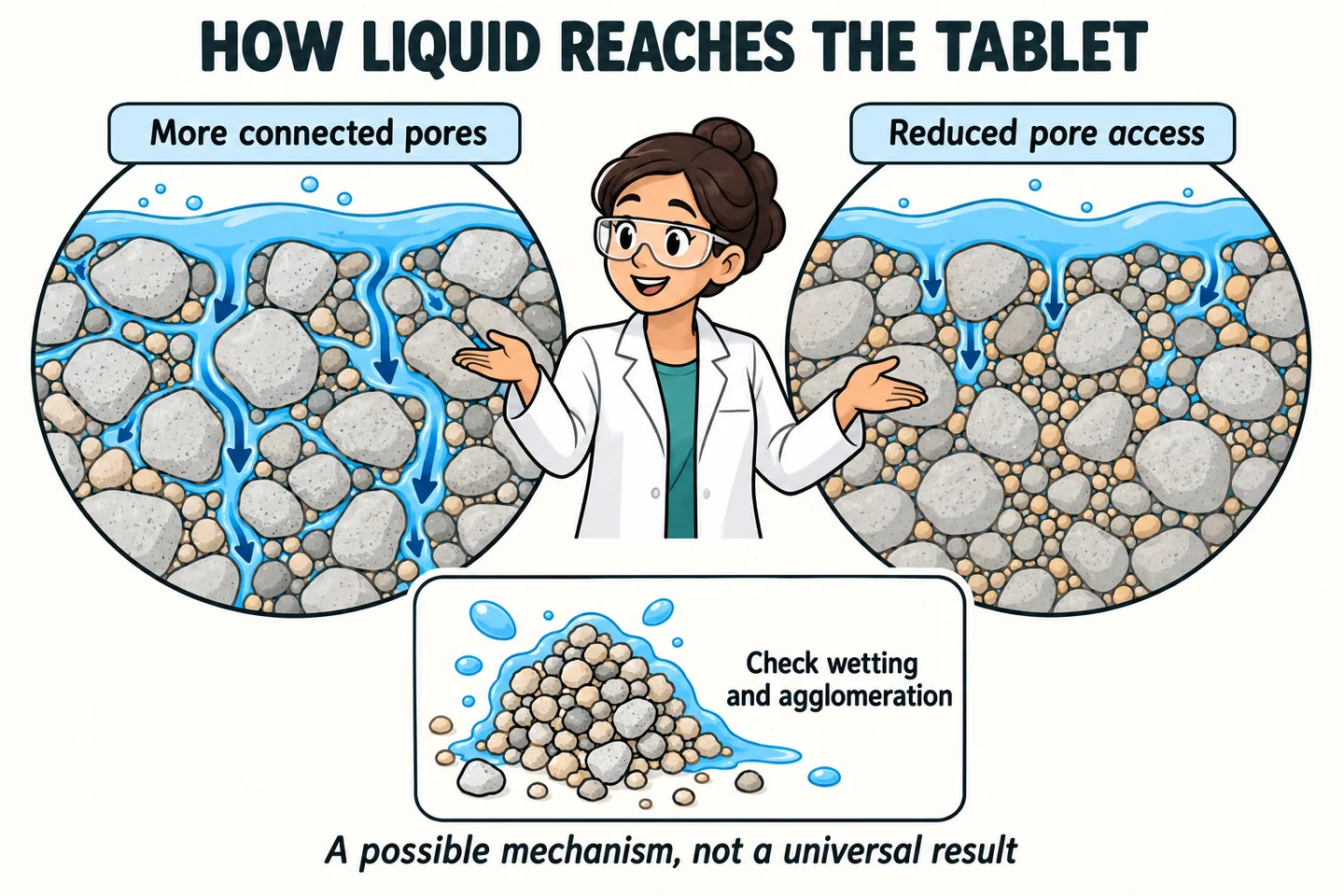
One plausible concern is that fine particles fill spaces between larger particles. Under some formulation and compression conditions, this can produce a tablet structure with reduced access for liquid. However, the final pore network also reflects particle deformation, fragmentation, bonding and recovery. The fines percentage alone does not describe that structure.
Research on microcrystalline-cellulose tablets measured water ingress and swelling and found slower transport in the lower-porosity compacts studied. This supports investigating liquid penetration when disintegration changes. Its experimental porosities and times should not be copied as universal production limits. See Yassin and colleagues: The Disintegration Process in MCC-Based Tablets.
Record tablet mass, dimensions and breaking force alongside compression conditions. Where suitable methods are available, assess solid fraction or porosity. Breaking force, often called hardness, is a mechanical measurement; it is not a direct measurement of connected pores or permeability. A harder tablet should not automatically be described as impermeable.
For tablet fines comparisons, state whether tablets were made at the same force, thickness, solid fraction or mechanical strength. These comparisons answer different questions. If the fine fraction changes compactability, using one nominal force may produce different tablet structures and obscure the explanation for a release change.
4. Check wetting and agglomeration
Reducing API particle size can increase the surface available to the dissolution medium. That benefit depends on access to the surface. Fine particles that remain in poorly wetted clusters may not behave like individually dispersed particles, so a smaller measured size does not guarantee faster release from a finished tablet.
A study of three poorly soluble model drugs examined particle-size reduction together with pH, media and formulation additives. Its findings illustrate why dissolution behavior needs to be evaluated in the relevant system, rather than inferred from particle size alone. See the study of particle-size reduction and biorelevant dissolution.
During a tablet fines investigation, describe visible clumps and residue without assigning a cause prematurely. Compare sample dispersion under the specified analytical method. Check whether the apparent fine fraction changes with sample preparation, because breaking agglomerates during testing may reveal primary particles that were not freely dispersed in the manufacturing material.
Do not add surfactant, increase lubricant or change the dissolution medium simply to obtain a faster result. Any proposed formulation or analytical change needs its own justification. Our powder clumping guide covers related distinctions between an observation, a suspected mechanism and a demonstrated correction.
5. Review the formulation around the fines
A shift in tablet fines may coincide with changes in binder distribution, disintegrant grade or location, lubrication history and moisture. Review those inputs before attributing the entire effect to particle size. Material labeled “the same grade” should still be compared with the relevant supplier specification and lot information.
Water absorption, swelling and tablet breakup are related but distinct responses. In an experimental study of orally disintegrating tablets, the most porous tablets did not invariably disintegrate fastest; wettability and disintegrant mechanism also mattered. That is a useful counterexample to a porosity-only explanation, although the specific ODT results do not establish settings for conventional tablets. See the study of wetting, water absorption and disintegration mechanisms.
A targeted comparison might examine an identified excipient change or a documented mixing difference while holding other inputs consistent. Define the question first. Changing disintegrant, binder, lubricant and compression force at once makes the result harder to interpret, even when the final tablet passes its tests.
Likewise, a smooth tablet face or a sticking observation is not evidence of a sealed “hard shell.” Keep appearance findings in the record, but verify the proposed liquid-access mechanism separately. Use our material, tooling and process guide to structure that wider review.
6. Investigate variation without blaming fines alone
When individual tablets differ, look for patterns before selecting a remedy. Does the change follow a hopper refill, transfer step or period of running? Is it present in one lot, one sample location or one test vessel? Record these links while preserving the samples needed to check alternative explanations.
FDA’s historical inspection guide discusses how particle size, shape and density can affect segregation and dosage-form uniformity. It also describes particle-size differences as potentially relevant to dissolution. These relationships justify checking composition and handling, rather than assuming that an acceptable average particle size ensures consistent performance. See FDA: Oral Solid Dosage Forms, Pre/Post Approval Issues.
For tablet fines, retain individual results where the method requires them and compare the spread as well as the mean. If composition differences are suspected, investigate them with appropriate analytical evidence. Tablet weight alone does not establish content uniformity, and a fine fraction is not necessarily richer or poorer in API without measurement.
Review laboratory and sample-handling factors in parallel with manufacturing factors. Specify the sample age, storage history and test conditions so that like is compared with like. Our granule flowability guide provides additional context for filling observations, but flow measurements do not replace release testing.
7. Verify a correction against the whole product
The aim is reproducible performance within the product’s requirements, not simply the fastest possible breakup. Removing a fine fraction from a formulated blend can alter composition, while reducing compression force may change mechanical integrity. Treat either proposal as a controlled development question rather than a routine adjustment.
A granule-density study found competing requirements between tableting performance and product release as granule and tablet structure changed. Its results support considering mechanical and release attributes together. They do not establish an optimum fine fraction for an unrelated formulation. See The Impact of Granule Density on Tabletting and Pharmaceutical Product Performance.
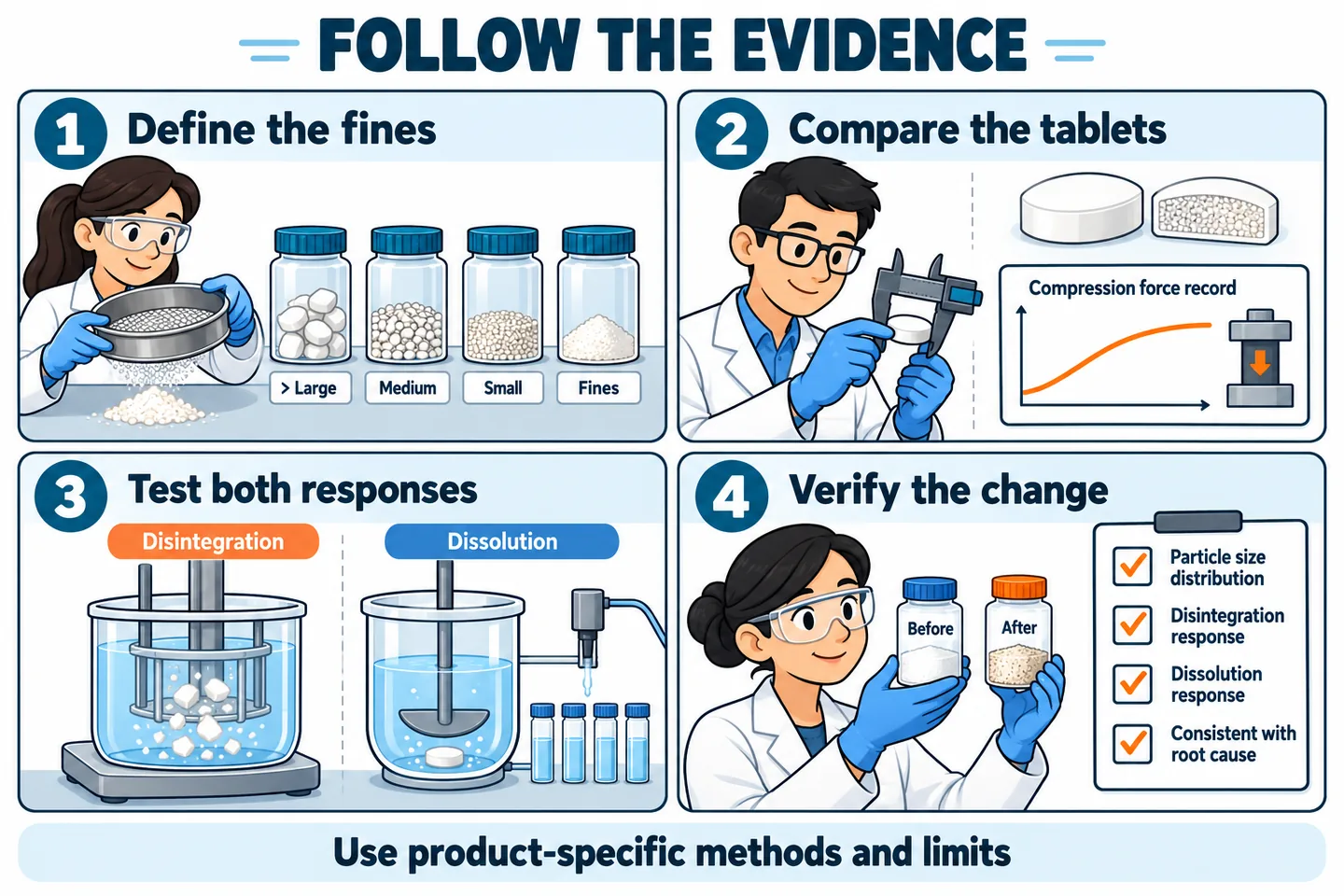
Before a trial, document the baseline, the suspected cause and what result would support or contradict it. Choose a comparison that can distinguish the explanations. A planned factorial study may be appropriate when formulation and compression variables interact; an uncontrolled sequence of adjustments is less informative.
For tablet fines, the verification plan should connect the changed input with relevant material measurements, tablet integrity and the required release tests. Retain results that disagree with the hypothesis. A successful short run is evidence for review, not automatic authorization to change the commercial process or its specification.
Build a useful tablet fines trial record
A clear record makes technical review easier and helps another team repeat the comparison. The following is a suggested investigation worksheet, not a validated protocol.
- Material: formulation revision, ingredient lots, fine-fraction definition, sampling locations, particle-size method and relevant moisture measurements.
- Preparation: granulation or milling history, transfers, mixing sequence and any documented change in processing.
- Compression: press and tooling identification, operating conditions, sample timing, tablet mass and dimensions, and mechanical measurements.
- Release testing: approved method reference, media and apparatus conditions, disintegration observations, dissolution results and sample-storage history.
- Decision: supporting evidence, contradictory findings, unresolved questions, applicable acceptance criteria and the next authorized step.
For transfers between facilities or countries, agree on the particle-size method and cutoff units before comparing tablet fines data. State sieve apertures in micrometres and identify the relevant sieve standard instead of relying on a mesh number alone. Record actual transport and storage conditions rather than assuming they match between sites.
A receiving site may also use different equipment or analytical procedures. Document those differences in the comparison plan and assess their relevance to the product. This article does not claim country-specific installations or production outcomes; a project case study requires real, reviewable project data.
Tablet fines FAQs
Do tablet fines always slow dissolution?
No. The effect depends on composition, accessible drug surface, wetting, tablet structure and the test conditions. Smaller drug particles may dissolve faster when dispersed, while a change in the compact or agglomeration can limit access. Test the actual formulation rather than assigning one direction of effect.
What percentage of fines is too high?
There is no universal percentage for all tablets. Define the fine-fraction cutoff and measurement method, then establish a justified range from development and performance evidence. A value from another product or a different particle-size method is not automatically transferable.
Does higher tablet hardness prove slower disintegration?
No. Breaking force does not directly describe wetting, connected pores or disintegrant action. Compare mechanical properties and release performance under defined conditions. Avoid using hardness as a substitute for the required disintegration or dissolution tests.
Can a disintegration pass replace dissolution testing?
Only when the applicable product requirements and supporting justification allow it. A tablet breaking apart does not itself establish how much API has dissolved. Follow the approved testing approach and any relevant regulatory requirements.
Should operators screen out the fine fraction?
Not as an improvised correction to a formulated batch. Screening may change composition or remove functional ingredients. Any proposed fractionation, rework or process change needs an appropriate assessment, authorization and verification plan.
What evidence should accompany a troubleshooting enquiry?
Provide the observed release change, material and sampling history, particle-size method, press and tooling details, tablet measurements and individual test results where available. Clearly separate confirmed observations from suspected causes so the discussion starts from evidence.
Discuss the material and press setup together
If tablet fines are changing during preparation or feeding, review the material path before selecting equipment adjustments. Our granule strength guide discusses related attrition and handling questions. A press can control compression conditions, but equipment selection alone does not establish acceptable drug release.
Contact TabletPress Shop with the material characteristics, tablet drawing, intended output and relevant trial evidence. We can use those details to discuss tablet-press and tooling requirements alongside the formulation team’s product-specific work.
Sources and scope
The sources linked throughout this article include original formulation studies and FDA/ICH guidance. Laboratory findings are specific to the systems studied. The proposed investigation questions are an editorial synthesis, not a manufacturing recipe or a guarantee of performance. Sources checked 26 October 2026.
- Poloxamer in immediate-release tablets: quality-by-design case study.
- FDA / ICH Q6A: Specifications.
- Yassin et al.: Disintegration of MCC-based tablets.
- Particle-size reduction and biorelevant dissolution of poorly soluble drugs.
- Wetting, water absorption and disintegration mechanisms.
- FDA: Oral Solid Dosage Forms, Pre/Post Approval Issues.
- Granule density, tableting and pharmaceutical product performance.
2 thoughts on “Tablet Fines: 7 Checks for Better Drug Release”