
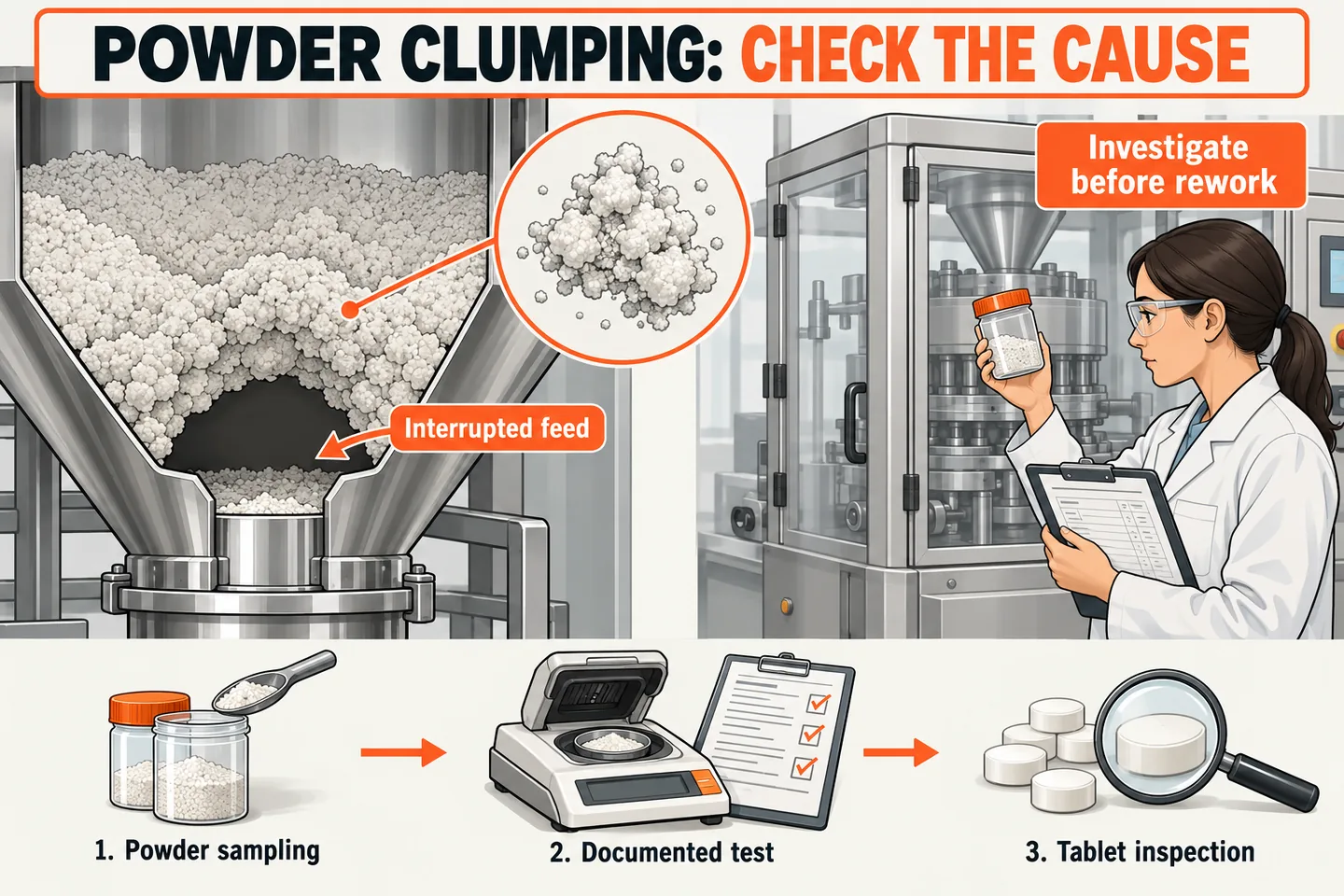
Powder clumping can interrupt tablet-press feeding, change die filling and complicate tablet-quality investigations. Breaking a lump apart may restore its appearance, but it does not explain why the particles joined together or establish whether the material is suitable for further processing.
Quick answer: Treat unexpected clumps as a material or process change. Check moisture, electrostatic charging, fine particles, mixing history and storage conditions. Compare clumps with surrounding powder using defined tests. Use any screening, milling or formulation adjustment only through an approved procedure, then verify feeding, tablet weight, strength and composition where relevant.
This guide explains the main mechanisms behind unwanted agglomeration and offers seven practical checks for an investigation. It applies to direct-compression blends and other tableting intermediates. Acceptance criteria and corrective actions must fit the formulation, equipment and intended product; a useful diagnostic sequence is more transferable than a fixed operating recipe.
On this page
What powder clumping means in tablet production
Powder clumping is an informal term for particles gathering into unwanted larger units. Some clusters are loose and readily dispersed. Others become stronger during storage, exposure to moisture or consolidation. Caking usually describes a powder bed developing greater strength or forming persistent lumps or crusts over time. These descriptions overlap, so record what is actually observed.
Cohesion is attraction between particles; adhesion is attraction to another surface, such as a hopper wall or punch face. The mechanisms can coexist, but a powder sticking to metal is not necessarily evidence that all visible clumps formed through static electricity. Likewise, a hopper bridge can arise from cohesive bulk behavior without one large, hard lump blocking its outlet.
| Material state | What to establish |
|---|---|
| Unexpected loose clusters | When and where they formed, their composition and how they behave under a defined dispersion test. |
| Persistent lumps or a surface crust | Exposure to moisture, temperature, storage time and consolidation; whether the material has changed. |
| Intentionally produced granules | Whether size, moisture and mechanical properties meet the established granulation process requirements. |
Controlled granulation deliberately forms agglomerates to obtain useful processing properties. It should not be confused with uncontrolled caking in a finished blend. Direct compression can also work successfully with a suitable formulation; skipping granulation does not make powder clumping inevitable.
Why powder clumps: mechanisms to investigate
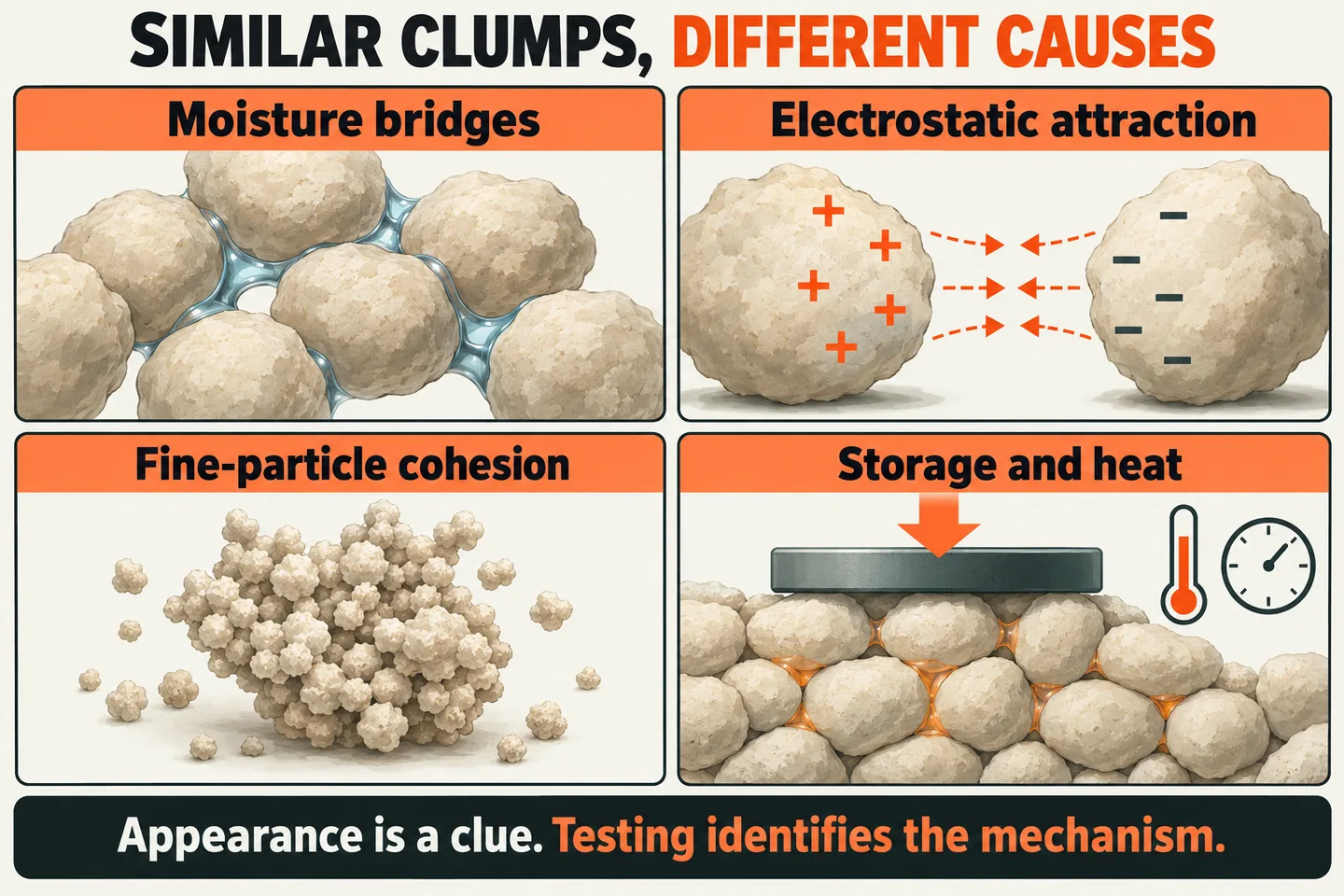
Several causes can produce similar-looking material, and more than one may operate at once. The following categories are investigation points, not a ranking of prevalence. Freeman Technology’s experimental caking work distinguishes thermal, chemical and mechanical contributions and shows why the conditions experienced by a powder matter.
Moisture uptake and liquid bridges
Adsorbed water can change surface interactions, and liquid bridges can hold neighboring particles together. Local wetting may arise from humid air, condensation, packaging damage or an upstream processing step. Soluble components may also form stronger bridges after dissolution and drying. Compare the clump and surrounding powder instead of relying on the average moisture result from one bulk sample.
Electrostatic charging during handling
Contact and separation during mixing, conveying or transfer can charge particles and equipment surfaces. Electrostatic forces may contribute to agglomeration or wall adhesion, but a dry cluster that breaks easily is not a diagnostic test for static. In a study of four pharmaceutical powders, humidity affected charging differently across materials. Raising room humidity therefore needs material-specific evaluation, including the possibility of moisture-related caking.
Fine particles and surface interactions
As particles become smaller, surface forces can become more important relative to their weight. A fine-rich fraction may therefore behave cohesively even when visible moisture and electrostatic charge are not the main drivers. Check particle-size distribution and the location where fines appear. Aggressive breakup or repeated milling can create additional fines, so a smaller visible lump is not automatically an improved feed material.
Material grade and surface properties
An excipient name alone does not predict clumping. Lactose, starches, cellulose-based materials and extract powders differ by grade, particle size, morphology, solid state and processing history. A new supplier or grade can change behavior even when the ingredient name is unchanged. Compare the current lot with an acceptable reference and review relevant supplier data.
Mixing, additive distribution and lubrication
Uneven distribution of a low-level ingredient or a poorly dispersed cohesive component can leave localized clusters. However, insufficient lubricant is not a general explanation for particles sticking together. Lubricants mainly serve a friction-reduction role, while glidants are used to modify flow. Their effects depend on the material and blending conditions; simply increasing either additive can introduce new problems.
A study of lubricants blended with lactose and placebo granules found that lubricant choice and concentration affected measured flow behavior. Those results support formulation-specific testing, not a universal extra-lubricant remedy. Our tablet sticking and lubricant guide discusses related considerations.
Temperature changes and mechanical history
Heat-sensitive or amorphous components may become more prone to adhesion under particular conditions. Mixing or milling can change temperature as well as particle surfaces and size. Record those changes rather than assuming that long mixing always causes thermal softening. Jenike & Johanson’s caking discussion also describes moisture redistribution during cooling and temperature-dependent contact bonding.
Storage time, consolidation and exposure
Material may flow acceptably after blending and behave differently after waiting in a container or hopper. Storage load, hold time, temperature cycling and exposure to ambient air can change particle contacts. Compare the actual time and conditions experienced by each sample. A room humidity reading taken only after the problem appears cannot reconstruct the complete storage history.
How powder clumping can affect tablet quality
The consequence depends on clump size, strength, composition and how the feed system handles it. Inconsistent flow may alter the amount of material reaching a die, while localized compositional differences may affect dose uniformity. These are risks to investigate, not proof that every visible cluster produces defective tablets.
| Observation | Possible connection | Evidence to review |
|---|---|---|
| Interrupted feed or variable tablet weight | Bridging, uneven discharge or changing die fill. | Hopper behavior, feed conditions, fill settings and time-matched tablet-weight data. |
| Variable tablet strength, capping or lamination | A change in packing, air release or bonding may contribute. | Material properties, compression settings and tablet tests; investigate other causes too. |
| Sticking, picking or damaged tablet edges | Local material differences may coincide with surface defects. | Moisture, lubrication, punch condition, formulation and when the defects appear. |
| Content-uniformity concerns | Clumps may contain a different proportion of ingredients. | Representative blend or fraction testing and finished-unit results where applicable. |
| Tooling wear or abnormal loading | Material condition may be one contributing factor. | Tool inspection, alignment, abrasiveness, operating loads and maintenance records. |
An experimental rotary die-filling study linked filling performance to several powder attributes, including cohesion, particle size and flow behavior. Separately, research on thirty blends assessed material properties together with turret and paddle speeds. The practical implication is to examine the powder and the machine conditions together, rather than treating a single observation as the root cause.
Do not infer a fixed percentage of capacity loss, tool-life reduction or weight deviation from the presence of clumps. Calculate the actual change from comparable production records. Tablet weight also cannot, by itself, establish content uniformity unless the applicable method and product requirements support that use.
7 practical checks for powder clumping control
1. Record where the change first appears
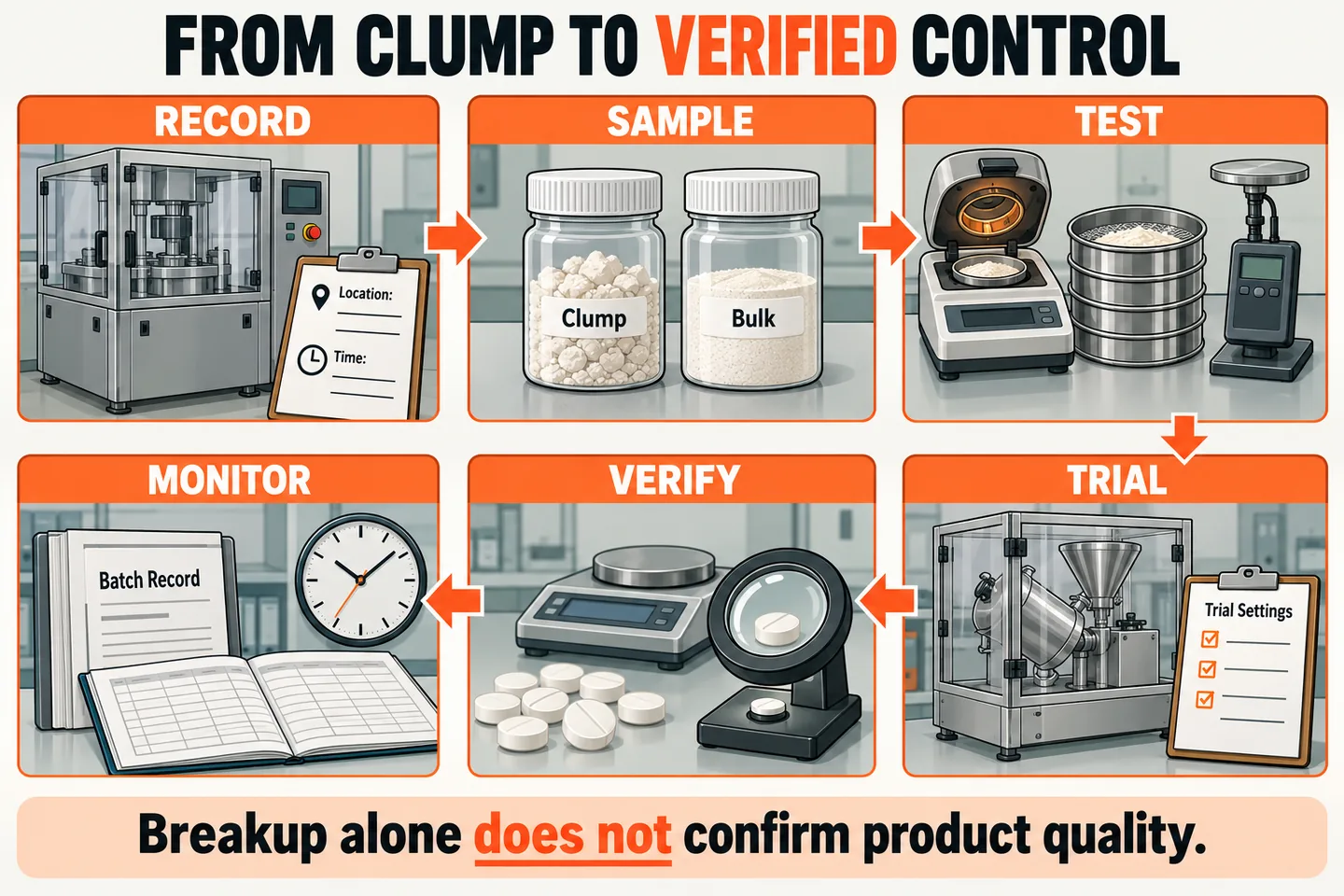
Map the material path from dispensing through blending, transfer, holding and feeding. Identify the first location with visible clusters and the last location that appears normal. Record batch identity, time, container, ambient conditions, material temperature and recent process changes. Photographs with a scale can document size, but they do not identify the bonding mechanism.
If flow interruptions or quality deviations occur, follow the site’s response procedure and assess the affected material before continuing. Equipment access and cleaning require the machine’s isolation procedure. Striking a hopper or reaching into a running feed system can conceal the original problem and create additional risks.
2. Preserve representative clump and bulk samples
Take samples under a defined plan using suitable tools and containers. Preserve intact clumps separately from surrounding powder, while retaining a representative bulk sample. Label the locations and collection times. Avoid grinding every sample immediately: doing so removes evidence about the original structure and may mix a localized defect into the rest of the material.
Decide whether sampling should cover the top, middle and bottom of a container or different points during discharge. The plan depends on the suspected mechanism and process. Uncontrolled handling can change moisture, charge or particle-size results, so document storage, transport and the delay before testing.
3. Test the suspected mechanism
For powder clumping associated with moisture, use a suitable moisture method and interpret it for the formulation. Loss on drying is not automatically specific to water; method selection matters. Compare intact clumps, adjacent powder and an acceptable reference. Review exposure records and, where useful, moisture-sorption or controlled-conditioning data.
For electrostatic concerns, use an appropriate charge-measurement approach and assess the actual transfer/contact conditions. For fines, use a defined size-analysis method and dispersion procedure. A measurement that breaks every agglomerate before analysis answers a different question from one intended to preserve clusters. Record both the method and its purpose.
Where caking develops during a hold, a controlled time-consolidation test may be informative. Jenike & Johanson describes measuring unconfined yield strength after defined storage conditions. A flow screening number alone does not identify the cause; our granule flowability guide provides related investigation points.
4. Review moisture, mixing and hold controls
Compare actual records with the intended process: ingredient sequence, blending time, speed, fill level, additive incorporation, transfer route and permitted hold. Look for a changed liner, cleaning residue, damaged closure, warmer incoming material or a longer queue before compression. Keep the investigation specific to observed changes rather than assigning blame to one ingredient family.
When a change is justified, define what it is expected to improve and what could worsen. More drying may alter material behavior; more humidity may promote moisture uptake; more mixing may redistribute a lubricant without solving caking. Set trial conditions with the responsible formulation and process team.
5. Evaluate deagglomeration before using it as rework
Screening or milling may be appropriate for a defined material and process, but breakup is not proof of recovered quality. Establish whether the operation is already part of the approved process or needs a documented evaluation. Check equipment suitability, screen condition, material recovery and the effect on size distribution, temperature and ingredient distribution.
Do not force unidentified hard objects through a screen. An abnormal lump may require investigation for contamination or a material change. Likewise, removing a coarse fraction from a blend can remove ingredients unevenly. Compare retained and passing material where relevant, reconcile the mass, and avoid returning material solely because it now looks free-flowing.
6. Confirm the result at the tablet press
Evaluate powder clumping control under representative feeding and compression conditions. Record turret speed, feeder settings, fill conditions and any adjustments alongside the material results. Assess tablet weight, thickness, strength, friability, appearance and disintegration or dissolution as applicable. Include composition testing where the investigation indicates a risk.
Compare accepted output, rejects and stoppage time over a meaningful run. A short trial at lower speed may help diagnose a feeding problem, but it does not demonstrate equivalent performance at the intended production rate. Tooling inspection remains part of the investigation; the tablet tooling maintenance guide covers related checks.
7. Monitor recurrence and document the decision
Record the evidence, material disposition, authorized changes and verification results. Follow subsequent batches and relevant hold periods, including restarts after a pause. If clusters recur, compare the new evidence with the original hypothesis instead of repeating breakup as an undocumented routine.
For pharmaceutical processes, FDA’s process-validation guidance provides a framework for establishing and maintaining evidence that a process performs as intended. A successful trial is part of that evidence; ongoing monitoring helps determine whether the change remains effective.
Use appearance as a clue, not a diagnosis
| Initial clue | Possible explanations | Useful next comparison |
|---|---|---|
| Dry, light clusters that disperse readily | Electrostatic attraction, fine-particle cohesion or weak agglomeration. | Charge, size distribution and behavior after a defined conditioning/dispersion procedure. |
| Sticky or damp material | Moisture uptake, local wetting or temperature-sensitive components. | Moisture results from clumps and bulk, plus exposure and temperature records. |
| A few localized lumps | Ingredient agglomerates, uneven exposure or mixing, or abnormal material. | Location, composition, batch history and surrounding powder. |
| Crust or stronger lumps after storage | Time-dependent caking under load, humidity or temperature changes. | Comparable hold tests using documented conditions. |
| Clusters recurring after milling | An unresolved bonding mechanism or an unsuitable breakup process. | Before/after size and moisture, process temperature and recurrence during the planned hold. |
Several clues may appear together. Keep observations separate from conclusions in the batch record. For example, ‘dry clusters found after transfer’ is an observation; ‘static caused the defect’ is a hypothesis that needs supporting evidence.
Transfer powder clumping controls between sites
For projects in different countries, compare measured site and transport conditions rather than assigning a process setting by location. Packaging, exposure during transfer, shipping history, air conditioning and hold time may differ between facilities even in the same city. Country names alone do not define a humidity specification or a suitable material-handling method.
As an illustrative scenario, two facilities could receive the same blend but use different liners and hold periods. Compare those conditions and harmonize sampling and test methods before concluding that one press causes the problem. This is a planning example, not a reported customer case. Agree which product requirements and method versions apply at the receiving site.
Frequently asked questions about powder clumping
Is powder clumping always caused by static electricity?
No. Electrostatic forces can contribute, but moisture bridges, fine-particle cohesion, material properties and storage history can produce similar-looking clusters. Dryness or easy breakup does not confirm static. Use suitable tests and compare the conditions before and after the point where the material changed.
Can I sieve clumps out and continue tableting?
Only when the material and operation are covered by an appropriate procedure and the quality impact has been assessed. Sieving may alter ingredient distribution or leave the underlying cause unchanged. Investigate abnormal retained material, reconcile recovery and verify the relevant blend and tablet properties before disposition.
What humidity prevents powder clumping?
There is no universal value. Humidity affects moisture uptake and electrostatic behavior differently across materials. Define conditions from product stability, moisture sensitivity and processing evidence. Evaluate the material over its actual exposure and hold time instead of copying a room setting from an unrelated formulation.
Does adding magnesium stearate solve powder clumping?
It is not a general remedy. Magnesium stearate is used primarily as a lubricant, and its effect depends on concentration, distribution and blending history. Changing it can affect tablet properties. First identify the likely mechanism, then assess any formulation change with appropriate downstream testing.
Are granules just another form of unwanted clump?
Granules are deliberately produced agglomerates with properties controlled for the process. Unwanted clumps form outside that intended control. The distinction depends on how the material was made and whether it meets defined requirements, not simply whether particles are joined together.
Discuss your material and equipment requirements
Prepare a brief with the formulation type, particle-size and moisture data, photographs, where clumps first appear, current process settings and the relevant tablet results. Include storage and transport conditions when comparing sites. Our difficult-powder formulation guide can help organize development questions.
If a controlled granulation route is under consideration, review the GK-25 Dry Granulator and ZL300 Rotary Granulator as starting points for a suitability discussion. Their role needs confirmation through material trials and process requirements. Contact us with your project brief.
Sources and further reading
The linked research and technical discussions support the mechanisms and investigation methods described here. Study conditions are not universal production settings or acceptance limits.
- Freeman Technology: Experimental investigations into powder caking mechanisms
- Jenike & Johanson: Temperature and the caking of your product
- Powder tribo-charging study (2020): Sensitivity to relative humidity
- Lubricant study (2013): Effects on pharmaceutical powder flowability
- Zakhvatayeva et al. (2018): Experimental rotary die filling study
- Van Snick et al. (2018): Blend properties and die filling during tableting
- Jenike & Johanson: Measuring caking using unconfined yield strength
- FDA: Process Validation, General Principles and Practices