
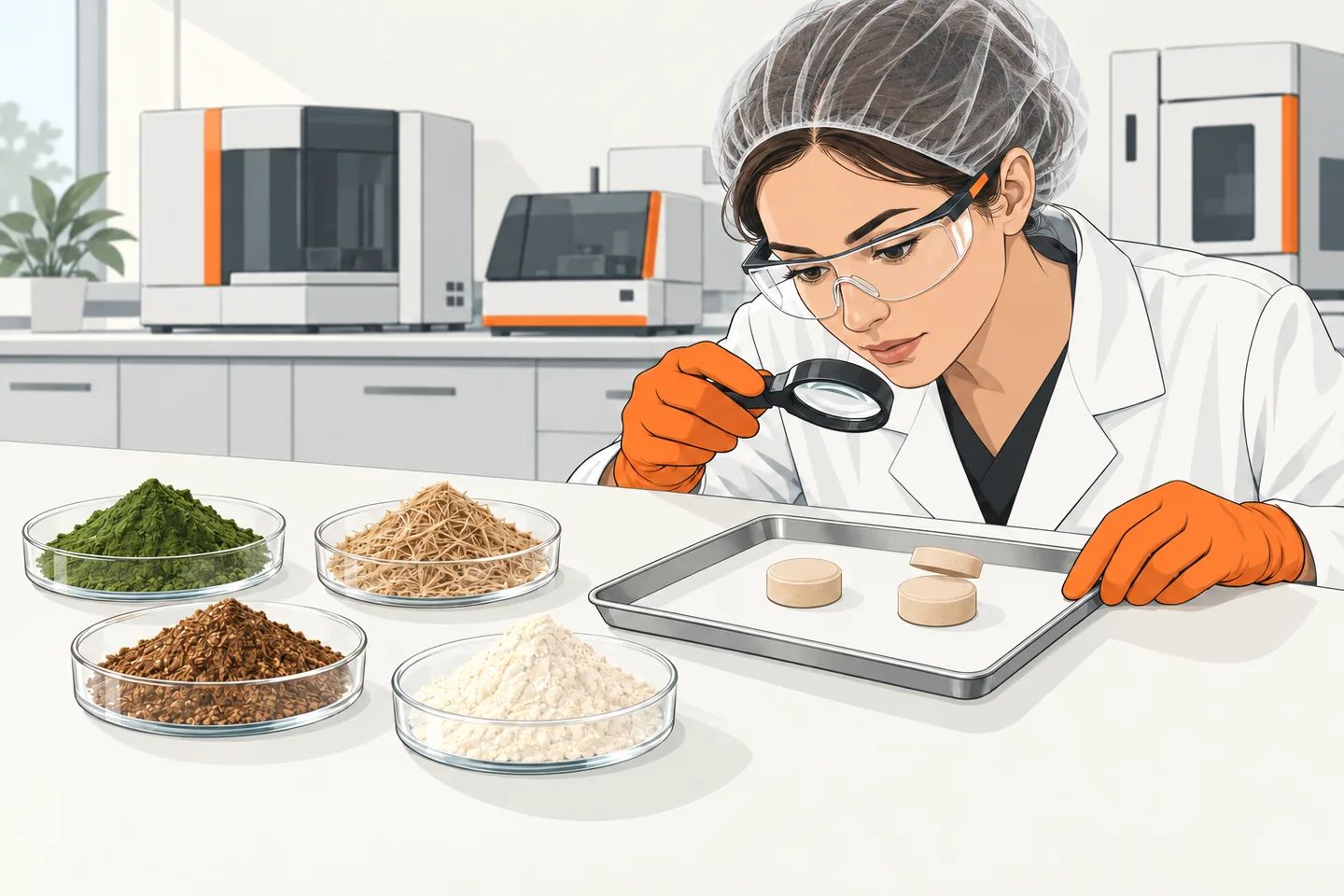
Tablet formulation for difficult powders starts with evidence about the material, not a universal recipe. Algae, plant proteins, fibrous ingredients and oil-rich powders can behave differently under compression. Capping, lamination and weak tablets may reflect the blend, processing history, press settings, tooling condition or a combination of these factors.
Quick answer: Identify the defect, characterize the powder, compare suitable binders and process routes, then test compression and ejection behavior. Confirm strength, friability, disintegration and accepted output together. A harder tablet or a lower machine speed alone does not establish a better process.
This guide provides seven practical checks for nutraceutical and botanical tablet development. It is a framework for controlled trials, not a validated manufacturing formula. Set product acceptance criteria before testing and have the final formulation reviewed against its intended use and market requirements.
On this page
1. Define the defect before changing the tablet formulation
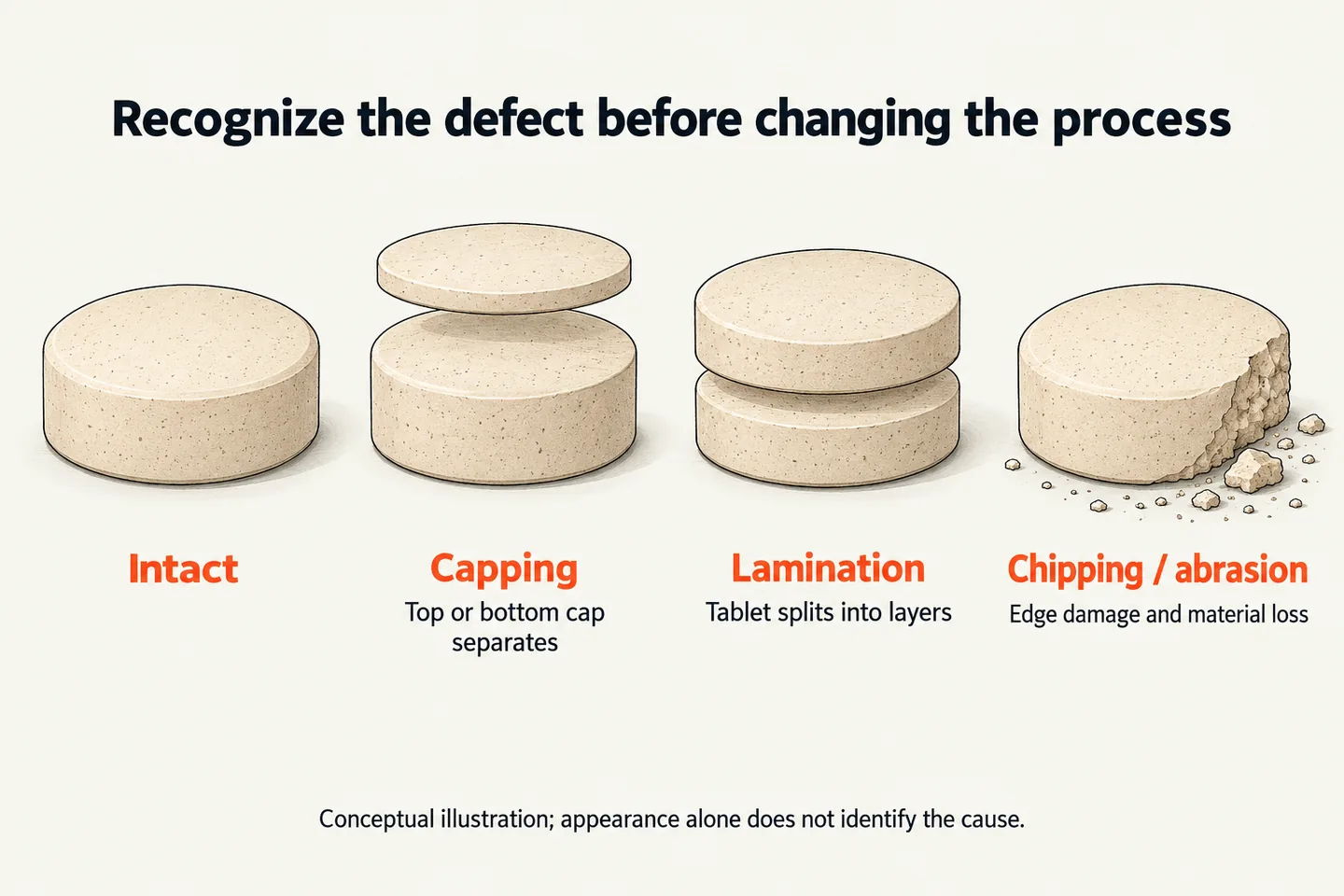
Capping is separation of the upper or lower crown from the tablet body. Lamination is separation into two or more layers. Chipping and abrasion involve material loss from edges or surfaces. A tablet can look intact at ejection yet reveal weakness during later handling or testing. KORSCH / MEDELPHARM: tablet defect troubleshooting.
Record when the problem appears: immediately at ejection, after dedusting, during a breaking-force test or after storage. Keep labeled samples and photographs from each condition. Avoid assigning every horizontal crack to trapped air, or every soft tablet to inadequate compression.
| Observation | Questions to investigate | Useful comparison |
|---|---|---|
| Top or bottom cap separates | Does it depend on press speed, compression profile or a specific tooling station? | Same blend and tooling, controlled press-setting trials |
| Tablet splits into layers | Do compression stress, ejection behavior or bonding differ between trials? | Defect count alongside strength and ejection data |
| Weak tablets or excessive material loss | Did binder grade, moisture, lubricant mixing or granulation change? | Matched tablet geometry and documented test methods |
| Tablet weight varies during a run | Is feed consistent? Is the blend segregating or changing in the hopper? | Beginning, middle and end-of-run samples |
The table is a screening aid rather than a diagnosis. Inspect the equipment as well: I Holland reports a capping and delamination case associated with unexpected die bore wear. That example illustrates why material changes should not replace a tooling inspection. I Holland: capping and die bore wear.
2. Characterize the actual powder lot
Ingredient names are a starting point, not a reliable ranking of compression difficulty. Ask for the supplier grade, processing method and lot information. A defatted seed powder and a whole-seed powder are different development inputs; so are a fine protein isolate and an agglomerated blend.
| Material family | Examples | What to document |
|---|---|---|
| Algal ingredients | Chlorella, spirulina, DHA-rich algal powders | Drying method, carriers, particle size, density and lipid content |
| Oil-rich seed ingredients | Flax, chia, hemp and sesame powders | Whole or defatted grade, residual oil and storage history |
| Fibrous cereal ingredients | Bran, germ and cereal blends | Particle shape, coarse fraction, density and moisture |
| Protein and lightweight botanical powders | Pea or soy protein, mushroom and freeze-dried powders | Grade, agglomeration, flow, water uptake and compression response |
These groups overlap. Kelp is a macroalga, while fungal spores are not oilseeds. A classification is useful only if it leads to measurements that explain the behavior of the supplied powder.
Prepare a simple material record covering particle-size distribution, bulk and tapped density, the moisture test method, flow observations and small-scale compaction results. Keep the sampling and test conditions consistent when comparing lots. Our granule flowability guide provides a companion checklist for feeding and flow problems.
Direct compression should remain an option where the blend supports it. A published study produced Moringa–spirulina composite tablets by direct powder compression after formulation and process optimization. Its results apply to the studied blend and conditions; they do not establish a recipe for pure spirulina, chlorella or another supplier grade. Original study: Moringa and spirulina complex tablets.
3. Build the tablet formulation around ingredient roles
A practical tablet formulation assigns each excipient a clear job. Adding several binders at once can make it harder to understand which change helped. Start with a documented baseline and compare a small number of justified alternatives.
| Ingredient or function | Reason to consider it | What to check |
|---|---|---|
| Microcrystalline cellulose (MCC) | Binder/filler option for compression development | Grade, flow, density, moisture and allowable inclusion |
| Lactose or another suitable filler | Adjust tablet composition and processing behavior | Grade, compatibility and product-label requirements |
| Povidone (PVP) or an appropriate cellulose binder | Support particle bonding in a suitable process | Binder grade, addition method, granule quality and disintegration |
| Lubricant | Reduce die-wall friction during ejection | Ejection behavior, blend history and tablet performance |
| Disintegrant, where appropriate | Support the intended tablet breakup behavior | Performance after compression and storage |
MCC grades differ in particle size, bulk density and moisture specifications. Consequently, a percentage alone does not describe their function in a blend. JRS lists distinct grades for different processing needs. JRS Pharma: microcrystalline cellulose grades.
PVP K30 is a soluble binder used in wet-granulation development. HPMC is also grade-dependent, and some grades are intended for modified-release matrices. Neither name guarantees suitable wetting, adequate strength or the desired breakup time in an oily formulation. BASF: Kollidon 30 technical information; Ashland: binder selection and manufacturing routes.
For lubrication, compare concentration together with addition order, mixing time and mixing intensity. Excessive lubrication can weaken bonding in susceptible systems, while insufficient lubrication can increase ejection difficulty. Research also shows that lubricants influence powder flow, so assess both processing and tablet quality. Original study: lubricants and powder flowability. See our tablet sticking and lubricant guide for related troubleshooting.
Avoid treating fixed excipient percentages as production specifications. For a high-ingredient-load product, define the available excipient space first. If the target composition does not pass the required tests, revisit the material grade, process, tablet size or product brief instead of assuming more compression will compensate.
4. Compare direct compression, dry granulation and wet granulation
Process selection is part of tablet formulation. A useful comparison asks what the additional operation is expected to improve and what new variability it introduces. Granulation is a development option, not an automatic remedy.
| Route | When to investigate it | Main development question |
|---|---|---|
| Direct compression | The blend can feed, remain uniform and form acceptable tablets | Can it meet the quality criteria at the intended operating conditions? |
| Dry granulation | A liquid-addition and drying step is undesirable | Do compacted and milled granules retain suitable tableting behavior? |
| Wet granulation | A binder-liquid process may improve granule formation | Can wetting, drying and sizing be controlled without harming product performance? |
Dry granulation forms compacts that are subsequently sized, without adding a granulating liquid. Wet granulation adds a liquid step and usually requires drying. Moisture and heat sensitivity, available equipment and the properties of the resulting granules all matter. GEA: comparison of granulation technologies.
Compare more than the appearance of the granules. Record material recovery, fines, flow, tablet defects and the time needed to produce acceptable output. Include the work of cleaning, drying and intermediate storage in the process comparison.
If dry granulation is a candidate, review the GK-25 Dry Granulator as an equipment option for discussion. For a process requiring granule sizing, the YK Oscillating Granulator may be relevant. Equipment selection still requires confirmation with the actual material and process brief.
5. Match compression and ejection to the blend
Precompression can help consolidate a powder bed, but a fixed fraction of the main force is not a universal setting. Natoli notes that suitable precompression varies with the material and that excessive precompression can contribute to capping. Main force and turret speed also require controlled evaluation. Natoli: preventing tablet capping.
Compare several suitable compression conditions within the approved operating range. Record force or pressure, tooling geometry and press speed together. The same rotational speed on different presses does not necessarily provide the same compression history.
Where the test method supports it, compare tensile strength against compaction pressure for a consistent tablet geometry. A strength plateau or decline can be a reason to investigate rather than keep raising force. Review the ejection signal and inspect tablets after mechanical testing. KORSCH / MEDELPHARM: tablet defect troubleshooting.
For this tablet formulation check, retain a reference condition and change a defined variable at a time during initial screening. If several variables interact, use a planned experimental design with a qualified formulation team. Follow the machine and tooling instructions for adjustment and inspection.
6. Establish a moisture and stability window
There is no single residual-moisture target or drying temperature that suits every botanical, protein or oil-rich blend. Specify the measurement method, sample location and timing. Loss on drying and a water-specific method such as Karl Fischer do not necessarily measure the same thing.
Moisture content and water activity are different measurements. Moisture content describes the amount of water; water activity describes its thermodynamic availability. They provide different information for texture, processing and stability assessment. A percentage of moisture alone does not establish microbiological suitability. METER: moisture content and water activity.
For wet-granulated material, record product temperature and drying endpoint rather than relying only on the dryer setting. Compare samples after a consistent equilibration period. Include packaged stability and the intended storage conditions in the development plan.
Do not add glycerol or sorbitol simply to promise stronger high-load tablets. Such changes may affect water uptake, taste, processing or the declared composition. Any proposed plasticizer or humectant requires its own compatibility and stability checks, plus a review of the product requirements.
7. Verify tablet formulation with a documented yield trial
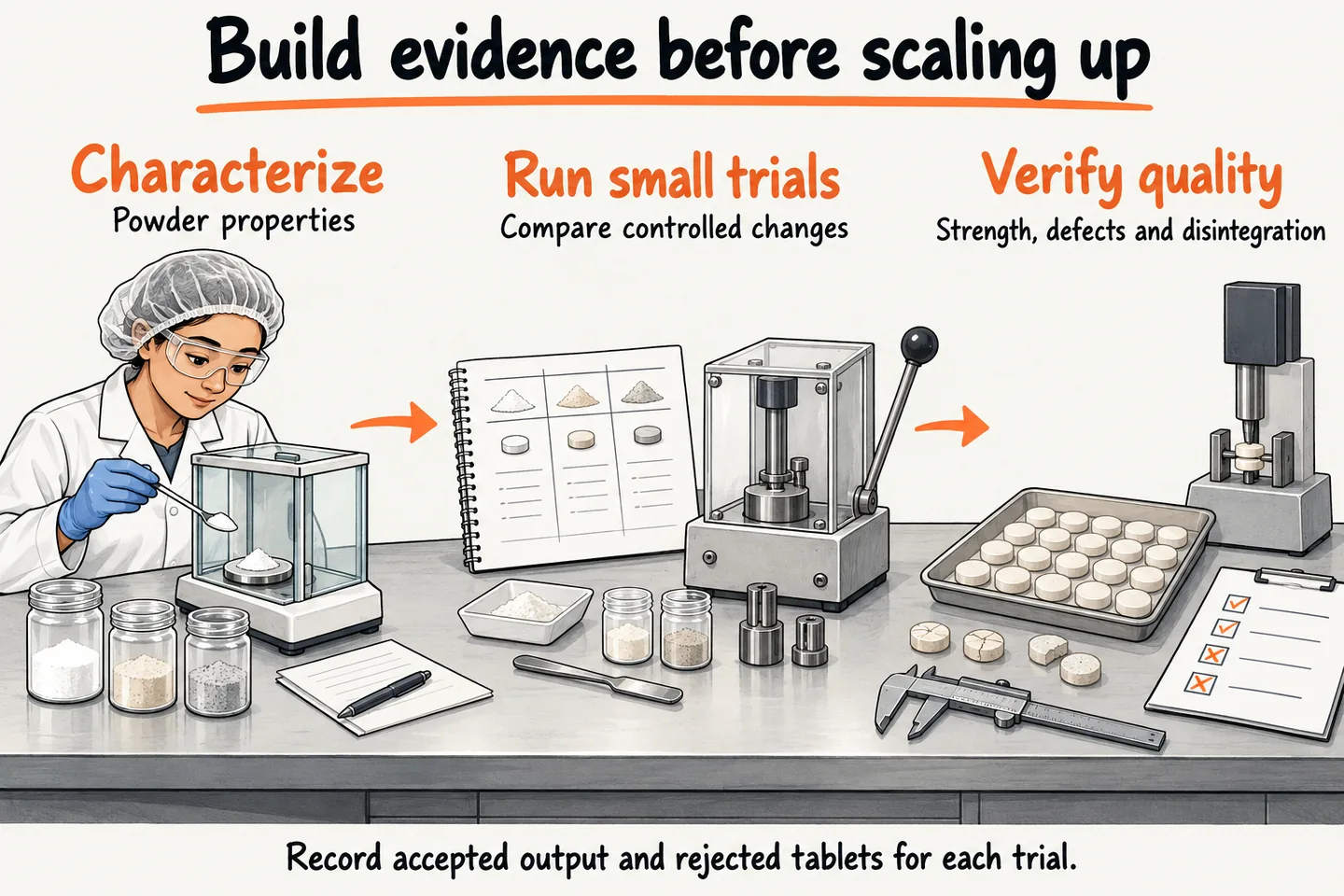
A useful tablet formulation trial starts with an agreed definition of an acceptable tablet. Specify the required checks, sampling plan and test methods before comparing results. Strength, thickness, mass variation, friability and disintegration should be considered alongside appearance; include additional tests required by the product brief.
| Trial record | Minimum information to retain |
|---|---|
| Input | Material lots, formula revision, weighed quantities and test methods |
| Processing | Mixing sequence, granulation route, moisture result and press settings |
| Quality | Sample timing, measured results and categorized defects |
| Output | Accepted count, rejected count, sampling removals and material losses |
| Decision | Which criteria passed, unresolved issues and the next comparison |
For a defined trial population, report tablet acceptance rate (%) = accepted tablets ÷ total tablets assessed × 100. State how acceptance was determined and how many tablets were assessed. A small inspection sample should not be presented as a measured whole-batch yield.
Separately report mass yield (%) = accepted finished-tablet mass ÷ material mass charged to the defined process × 100. Define the process boundary and use a consistent mass basis, especially when liquid is added and removed. Reconcile startup rejects, dust, retained samples and unprocessed material separately.
Repeat promising conditions and check another representative material lot before drawing a scale-up conclusion. A pilot result becomes more useful when the record explains the operating window and remaining uncertainties, rather than reporting only the best-looking sample.
For a transfer between countries or sites, record actual room humidity, material conditioning, storage and transport exposure. Confirm the destination product requirements. Geography alone does not determine a formulation, and results from one site should not be described as a successful installation elsewhere without project evidence.
Tablet formulation questions
Can algae and protein powders be directly compressed?
Some blends can, but suitability depends on the supplied grade, composition, flow and compaction behavior. The cited Moringa–spirulina study supports testing direct compression as an option; it does not prove that all algae or protein powders behave alike.
Should I increase compression force when tablets split?
Not automatically. First identify the failure and compare the compression response. Review tooling, precompression, speed and ejection as well as the blend. An operating change should be judged against the full quality criteria, not strength alone.
Is there a universal binder percentage for difficult powders?
No. Binder grade, material properties, ingredient loading and the manufacturing route interact. Use supplier information to select candidates, then establish the tablet formulation through documented trials and product testing.
Does a harder tablet mean a higher-quality product?
Not by itself. The tablet must also meet the required appearance, mass, friability, disintegration and other product-specific criteria. Evaluate the complete acceptance profile before claiming improved yield.
Prepare a practical equipment brief
To discuss equipment for your tablet formulation, send the material grade, target tablet size and mass, intended output, proposed process route and photographs of any defects. Include available powder and trial data. Contact TabletPress.shop to review the equipment brief, or browse the Resources & Knowledge Hub for related guidance.
Evidence note: This article combines published technical sources with a proposed trial-recording framework. It does not report TabletPress.shop production trials or verified customer yield improvements. Illustrations are AI-generated educational cartoons, not equipment specifications or customer photographs.