
Granule strength control helps turn an operator’s impression of loose or hard granules into repeatable manufacturing decisions. It matters because granules must tolerate handling, feed the press consistently and still form tablets with the required properties. A single hardness value or a favorable flow result cannot establish all three.
Quick answer: Standardize the sampling and test methods first. Measure mechanical strength or friability alongside particle size, moisture and bulk flow behavior. Establish limits for the actual formulation, then verify tablet quality and press performance. Hausner ratio describes powder-bed packing behavior; it is not a direct measurement of individual granule hardness.
This guide provides seven practical checks for a granule control plan. It explains which measurements answer which questions, how to investigate changes, and what to record before adjusting wet or dry granulation. Use it to prepare development work and site procedures, with acceptance criteria agreed for the product.
On this page
1. Define what granule strength means in your process
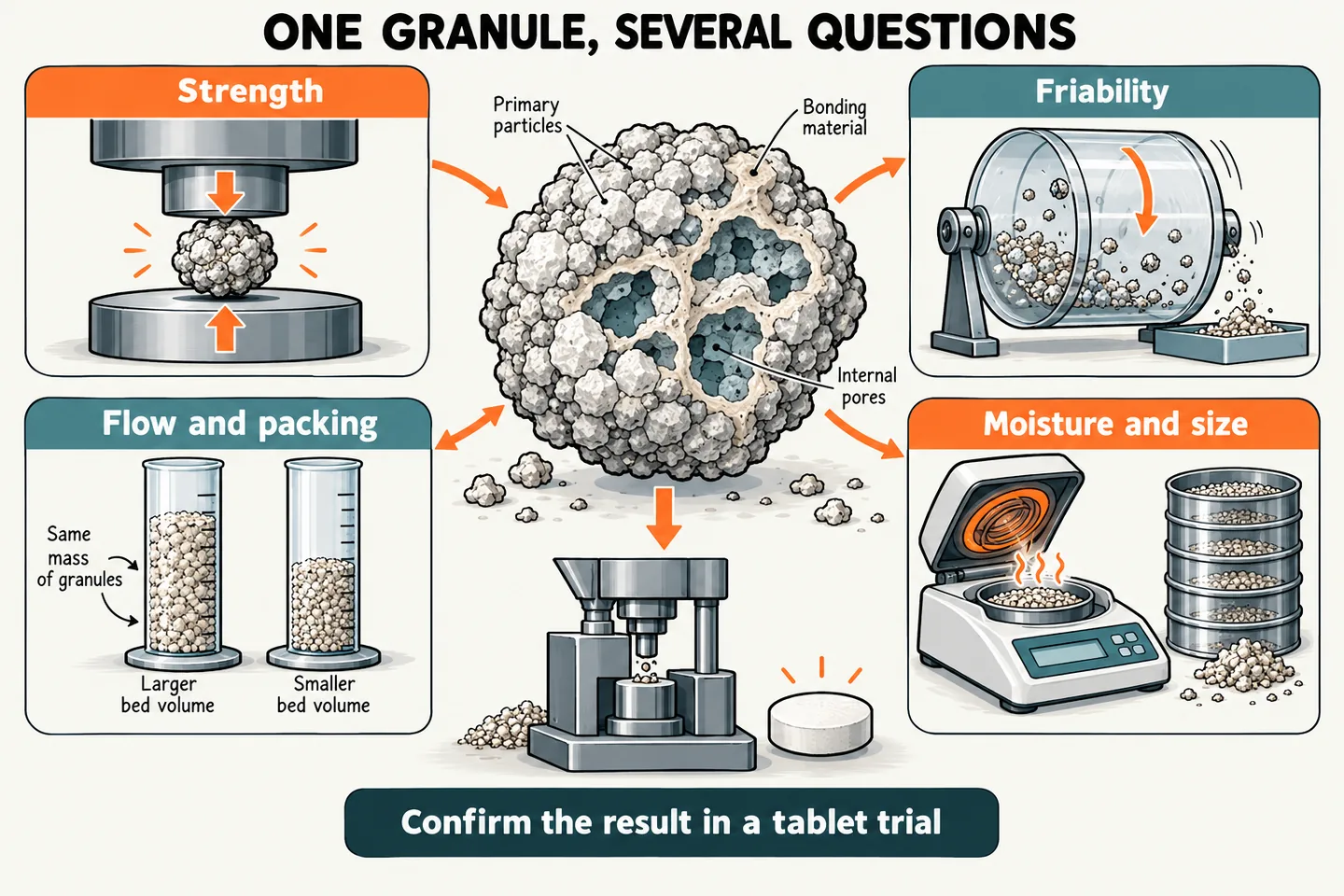
The workshop term “granule tightness” can mix several distinct properties: mechanical resistance, internal porosity, bulk packing, moisture and particle size. Replace that broad description with a measurable question. Are granules breaking during transfer, resisting deformation in the die, or simply flowing inconsistently into the feed system?
Granule strength generally concerns resistance to deformation or failure under a specified mechanical test. Granule friability concerns the tendency to generate smaller particles under a defined handling or abrasion challenge. Bulk density measures the mass occupying a bed volume, including spaces between particles. These properties can interact, but they are not interchangeable.
| Property | Question it helps answer | What it cannot establish alone |
|---|---|---|
| Single-granule mechanical response | How does a selected granule deform or fail under the chosen load? | Whole-batch flow or finished-tablet performance. |
| Granule friability | How much breakdown occurs under this particular test? | A universal manufacturing pass/fail decision. |
| Bulk/tapped density and Hausner ratio | How does a powder bed settle under defined conditions? | Individual granule hardness or internal porosity. |
| Size distribution and moisture | Has the material state changed between process stages? | Which adjustment will improve the final tablet. |
Start with the production problem and select the measurements that can distinguish likely causes. For example, increased fines after conveying suggests a different investigation from unchanged granules accompanied by unstable feeder operation. Standardization makes these comparisons credible; it does not mean assigning every product the same target.
2. Use Hausner ratio as a flow screening measurement
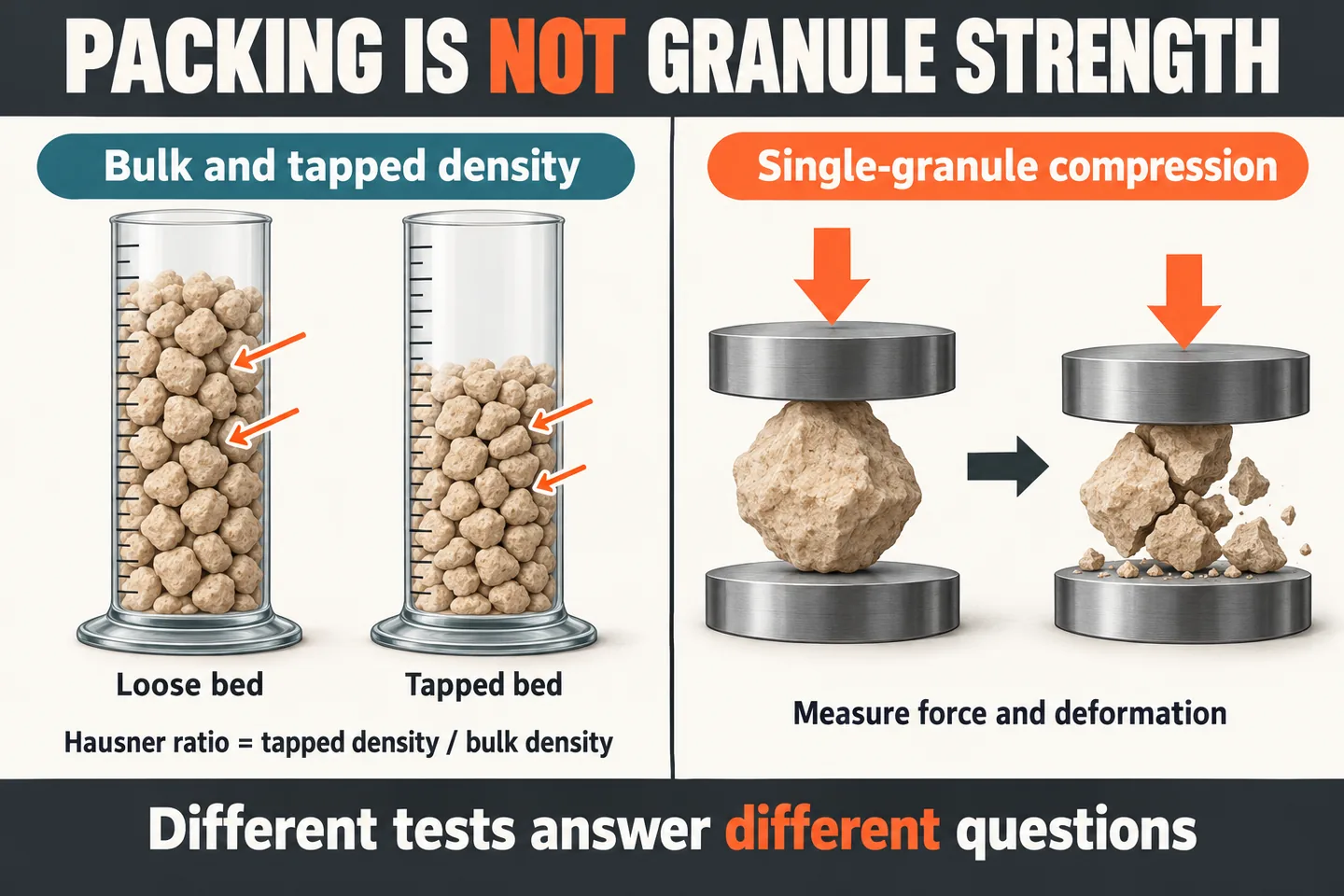
Hausner ratio is calculated as tapped density divided by bulk density. Carr’s compressibility index is 100 × (tapped density − bulk density) / tapped density. Both use a powder bed’s response to settling. A published granulation study reports Hausner ratio separately from particle size and friability, illustrating why these measurements serve different purposes. See the granule-characterization methods.
For a hypothetical sample with bulk density 0.50 g/mL and tapped density 0.60 g/mL, Hausner ratio is 1.20 and Carr’s index is about 16.7%. This is a calculation example, not a recommended specification. The result does not reveal the force needed to break an individual granule.
Do not label a ratio of 1.20–1.35 as a universal optimum for high-speed tableting. A higher ratio means a greater relative change between the measured bulk and tapped densities; it does not prove that the particles are softer or contain more internal pores. Powder behavior is multifaceted, as the official USP Powder Flow chapter preview emphasizes.
Keep sample preparation, cylinder or vessel, sample quantity, filling method and tapping procedure consistent. Use the applicable method and endpoint rather than changing them until a desired number appears. Follow a screening result with a process-relevant flow or feeding assessment. Our granule flowability guide outlines additional investigation points.
3. Standardize granule strength and friability testing
A proposed granule strength range such as 2–4 kgf has little meaning without the size fraction, particle geometry, loading method and failure definition. Kilogram-force is a force unit, not a density or material-hardness unit. For clarity, 1 kgf is approximately 9.81 N. Converting the unit does not make the range transferable to another material.
For single-granule testing, define the sampled size fraction, conditioning, instrument, loading rate, contact geometry and number of particles. Retain the distribution of results and the observed failure behavior. Irregular granules can give variable responses; report what was actually measured rather than presenting a force reading as an intrinsic material strength.
Research using dry-granulated model particles found that single-specimen plasticity measurements did not simply predict deformation during confined powder compression. The practical lesson is to connect the test with tablet trials, rather than assuming that one mechanical result predicts performance in a press. Read the single-granule and tabletability study.
Granule friability results are also method-dependent. Specify initial size fraction and mass, apparatus, challenge time or revolutions, any beads or other stress media, final sieve cutoff and mass-recovery procedure. Published binder research describes these details when measuring granule breakdown. Its test conditions are a study method, not a universal acceptance limit. See the binder study’s granule evaluation method.
A site should therefore not adopt 3–8% as a general acceptable friability range without supporting evidence. Nor should it apply a finished-tablet friability criterion directly to granules. Choose a repeatable challenge that helps discriminate material behavior relevant to handling, then relate the result to fines generation and tablet quality.
4. Set limits from product performance and process data
Useful granule strength limits need a defined purpose. They may support development screening, an in-process decision or an approved intermediate specification. These uses require different evidence and authority. Record the intended use so that a convenient laboratory reference does not silently become a batch-release rule.
Build a reference dataset from material made and tested under documented conditions. Link granule results to press feeding, weight variation, tablet strength, friability and disintegration or dissolution as applicable. Include ingredient uniformity where relevant. A range based only on visually acceptable granules leaves the downstream relationship untested.
Distinguish a specification from a statistical control limit. A specification reflects agreed product or process requirements. A control limit describes the variation of a suitably characterized process. A process can be statistically stable and still fail a specification; a result within specification can also signal a developing trend.
| Control-plan field | What the procedure should define |
|---|---|
| Material and stage | Formulation/version, lot identification and exact sampling location. |
| Method | Instrument, sample preparation, conditions, units and calculation. |
| Sampling | Representative locations, timing, sample handling and replicate plan. |
| Decision limits | Product-specific basis, intended use and approved acceptance criteria. |
| Response | Who reviews a deviation, what is held or investigated, and how changes are authorized. |
| Verification | Finished-tablet tests, press observations and follow-up monitoring. |
ICH Q8(R2) describes control strategies grounded in product, formulation and process understanding, including controls of materials and intermediates. That supports a documented connection between granule attributes and final quality rather than a collection of generic target numbers. Read the pharmaceutical-development guidance.
5. Adjust wet and dry granulation through controlled trials
Investigate a change in granule strength before selecting a corrective action. Confirm that the apparent shift is not caused by different sampling, moisture conditioning or test settings. Then compare the batch record, ingredient lots and equipment conditions with the reference. A trial should test a stated explanation and include downstream checks.
Wet granulation: separate the endpoint from drying
For granules that break down readily, examine binder type and distribution, liquid addition, wet massing and drying history. Binder concentration, binder quantity and total liquid addition are separate variables. Increasing one may alter several material properties, so record the actual change and evaluate its effects on sizing, moisture and tablet performance.
Do not automatically shorten drying to make granules less brittle, or increase drying temperature to make hard granules easier to compress. Either change may alter residual moisture, stability or sticking behavior. Use an established endpoint and evaluate any proposed adjustment against the formulation’s requirements.
Likewise, a larger mill screen is not a general method for softening granules. A screen change mainly changes the sizing operation and may retain larger particles. Compare the resulting distribution and mechanical response. Excipient substitutions also need formulation work: lactose, sorbitol, microcrystalline cellulose and starch grades cannot be reduced to universal “loosening” or “tightening” additives.
Dry granulation: connect settings with ribbon and granule properties
For roller compaction, record roll force or specific compaction force, gap, roll speed, feeding conditions and milling settings where available. Assess the resulting ribbons and granules. A change intended to reduce fines can also alter density, fragmentation or the ability to form tablets.
Hydraulic pressure in bar is machine-specific. It is not interchangeable with specific compaction force or the pressure experienced by the powder. A study of two formulations used different compactor control parameters and a calibrated relationship to compare them. This is why a blanket instruction to reduce 120 bar to 70–90 bar is not a transferable control rule. See the roller-compaction methods.
Use the machine’s documented control scheme and permitted operating range. Avoid independent speed and feed changes that fight the equipment’s control loop. A joint Freeman Technology and Gerteis study illustrates how several settings influence granule properties in a particular formulation. Read the process-parameter study overview.
6. Check tablet performance and tooling together
Granules that survive handling may still form weak tablets if bonding during compression is inadequate. Conversely, a blend with acceptable laboratory flow can fill inconsistently at the intended speed. Evaluate granule strength control alongside the actual press, feeder, tooling geometry and operating conditions.
Record compaction conditions, tablet thickness, breaking force or appropriately calculated tensile strength, friability, and release performance where required. Observe ejection and note when capping or lamination appears. Compare accepted output as well as reject rate, so a slower run is not mistaken for an equivalent improvement at production speed.
Fines may enter tooling clearances and contribute to wear or binding, but tooling damage also depends on material abrasiveness, lubrication, alignment, steel, surface condition, maintenance and applied loads. Granule strength should not be treated as the sole explanation for tooling loss.
Keep supplier claims tied to documentation. Heat-treatment records, steel specifications, dimensional inspection and application trials are more useful than a promise of wear-free operation. Granule control should support tooling selection and maintenance, not replace them. See our tablet tooling maintenance guide for related checks.
7. Make the granule strength SOP repeatable across shifts
A standard operating procedure should make the same material reasonably comparable between operators and days. Define how the sample is collected and divided, how long it may be stored, how instruments are checked, and how results are calculated and reviewed. Include representative photographs when they help identify a failure mode.
A hand-squeeze observation may provide context during wet-massing development, but it is not a quantitative release test for dried granules. The outcome depends on the operator, moisture, force and sample quantity. Use appropriate handling controls and a defined observation method if this check is retained; do not let it override instrument data or an approved procedure.
Train operators with the same reference material and compare results using the approved method. Investigate meaningful disagreement before changing process settings. Record unusual recovery losses, incomplete tests and sampling difficulties rather than discarding inconvenient measurements. Standardization depends on preserving what happened, not only the final average.
A practical deviation-review sequence
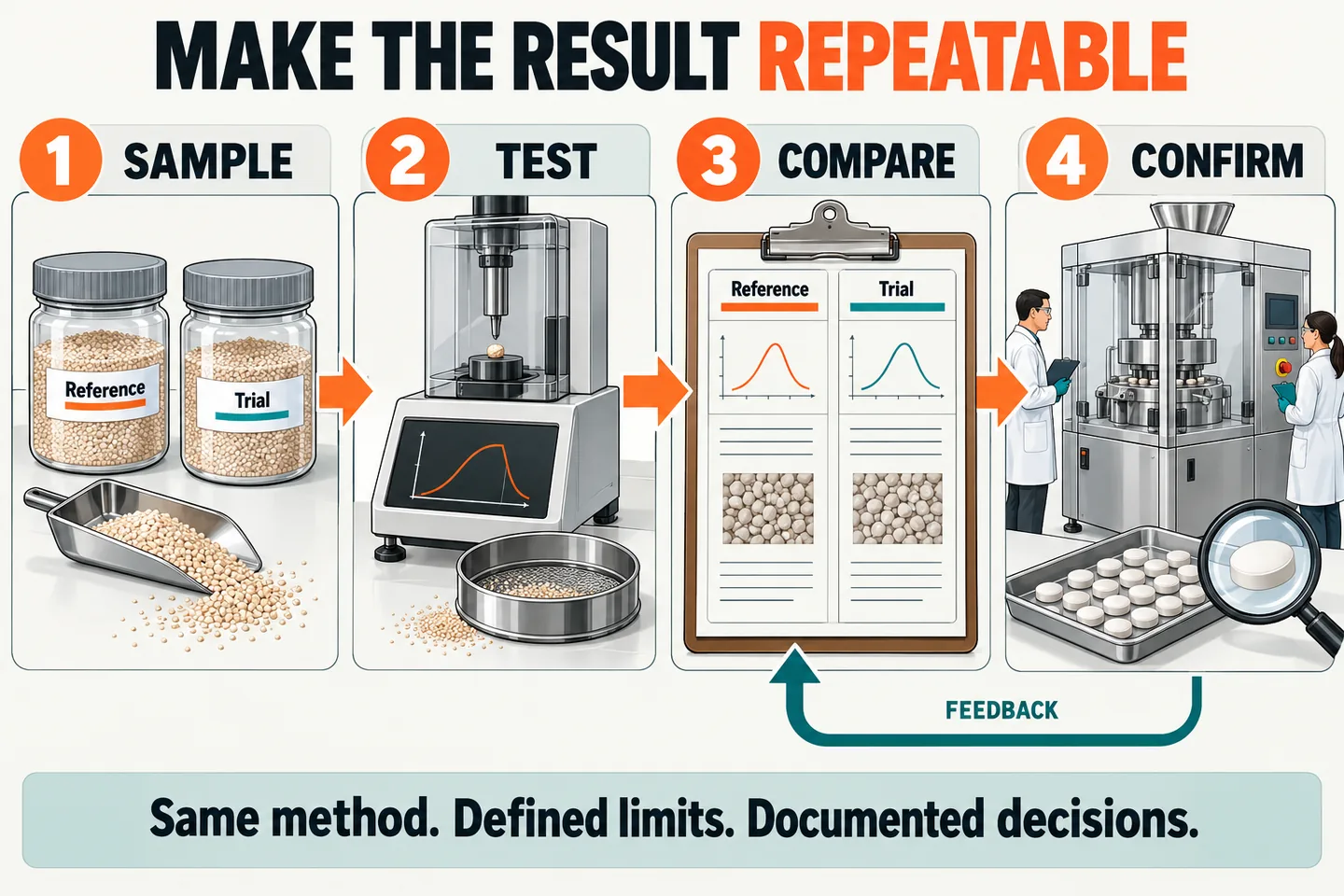
First verify sample identity, instrument status and test execution. Next compare moisture and size distribution with the baseline, then locate where the change appears in the process. If a material shift is supported, propose a controlled trial with defined responses. Document the disposition and verify the outcome on relevant tablet tests.
Trend the agreed attributes across batches and review changes in raw material grade, supplier, equipment or scale. For pharmaceutical production, this connects with the lifecycle approach in FDA’s process-validation guidance. A successful adjustment during one run supplies evidence; continued monitoring determines whether the process remains consistent.
Transfer the control method between sites and countries
For an international project, compare actual site conditions rather than assigning a recipe by country. Room humidity, sample shipping, container closure and hold time can affect the material being tested. Two laboratories also need compatible sample preparation, instruments, units and endpoints before their results can be compared.
For example, two sites could report different friability values because they use different sieve cutoffs or stress media. That discrepancy calls for a method comparison before concluding that one site’s granules are weaker. This is an illustrative scenario, not a reported customer case.
Prepare a transfer brief with method versions, representative samples, equipment configuration and product acceptance criteria. Where pharmacopoeial methods apply, identify the edition and local requirements used by each site. Agree how equivalence will be evaluated instead of assuming that identical test names or machine settings produce interchangeable results.
Granule strength troubleshooting: choose the next check
| Observation | Check before adjusting | Evidence to compare |
|---|---|---|
| More fines after transfer | Granule breakdown, conveying conditions and sample representativeness. | Matched samples at defined locations using the same sizing method. |
| Higher Hausner ratio | Bulk/tapped-density procedure, moisture, size and bed behavior. | Repeatable density results and relevant feeding performance. |
| Hard granules but weak tablets | Deformation, fragmentation, lubrication and compaction conditions. | Tabletability response and finished-tablet tests. |
| Slower disintegration | Formulation, granule/tablet structure and processing changes. | Disintegration or dissolution under the approved method. |
| Tooling wear or rising ejection load | Abrasiveness, lubrication, alignment, tool condition and press settings. | Inspection records and material/operating history. |
Frequently asked questions about granule strength
Is there a universal hardness range for pharmaceutical granules?
No. A useful range depends on the formulation, granule size, test geometry and loading procedure, as well as the process it supports. Report force in a defined unit and distinguish breaking force from calculated strength. Set limits using a suitable method and downstream performance data.
Does a low Hausner ratio mean granules are hard?
No. Hausner ratio compares tapped and bulk density of a powder bed. A low value indicates relatively little change between those measurements under the test conditions. It does not directly measure individual particle hardness, resistance to breakage or internal pore volume.
What granule friability percentage is acceptable?
A percentage becomes meaningful only with its test method and product context. The apparatus, challenge intensity, initial size fraction and final cutoff affect the result. Establish a justified range for the intended use; do not copy a number from an unrelated formulation or a finished-tablet test.
Can stronger granules reduce tablet quality?
They can, depending on how the granules deform, fragment and bond during compression. Resistance to handling damage and the ability to form a tablet are different requirements. Confirm tablet strength, friability and release behavior rather than treating maximum granule strength as the objective.
Should machine settings be changed after one abnormal result?
Follow the site’s response procedure. Check sample identity, test execution and related material data, and assess product impact before adjusting the process. Repeating a test without a defined investigation or changing several settings at once can hide the explanation rather than resolve it.
Discuss your granule control and equipment requirements
For a useful technical discussion, share the formulation type, granulation route, current test methods, size and moisture data, observed defect and target tablet. Include the press and tooling configuration, operating conditions and an acceptable reference batch where available.
Review the GK-25 Dry Granulator for a dry-granulation discussion and Rotary Press Tooling for compatibility questions. Suitability needs confirmation for the actual material and machine. Contact us with your project brief, or use the difficult-powder formulation checklist to organize the trial.
Sources and further reading
Research findings below relate to the materials and methods studied. They support a measurement-based control strategy, not universal operating limits.
- USP General Chapter <1174>: Powder Flow (official preview)
- Portier et al. (2021): MCC variability during continuous granulation and drying
- Single-granule study (2025): Plasticity of dry-granulated particles and tabletability
- Binder study (2021): Critical binder attributes in twin-screw wet granulation
- Marinko et al. (2025): Roller compaction and dissolution in two formulations
- Freeman Technology and Gerteis: Roller compactor settings and granule properties
- Natoli: Granulation, powder preparation and tooling options (PDF)
- ICH Q8(R2): Pharmaceutical Development
- FDA: Process Validation, General Principles and Practices