
Shaped tablet compression brings tablet geometry, powder behavior and machine setup into the same investigation. Oval, oblong, rounded triangular and other non-round tablets may develop weight variation, capping, chipped edges or damaged surface detail. The shape can contribute to these problems, but it does not establish their cause on its own.
Quick answer: Identify the defect, find where it first appears, and compare it by time and punch station. Then investigate die filling, compression response, tooling condition and ejection. Check the tablet drawing and keyed-tool orientation before changing settings. Verify any proposed correction against the product’s quality requirements; more compression force is not a universal remedy.
This guide explains eight practical checks for shaped tablet compression. The order is a troubleshooting sequence, not a ranking by frequency. No production dataset is available here to support a claim that one defect accounts for a particular percentage of failures. The guidance supports technical review and operator training rather than replacing the press manual or an approved manufacturing procedure.

On this page
What changes when a tablet is not round?
“Shaped” or “non-round” describes the outline seen from above. The profile describes features such as cup depth, curvature and the sideband. Engraving, scores and edge details add further variables. An oval tablet can be symmetrical; it is inaccurate to describe every non-round tablet as inherently asymmetric or every shaped die as having unfillable corners.
For shaped tablet compression, review the complete drawing with the tooling supplier: outline, dimensions, profile, land, scores, engraving, key position and the press interface. I Holland discusses how design details influence both tooling strength and manufacturing behavior. Its guidance supports reviewing the complete design rather than selecting a silhouette in isolation. See I Holland: Why Good Tablet Design Matters.
Start with a shared defect vocabulary. Capping is separation of a top or bottom portion; lamination is separation into layers. Chipping removes material from an edge. Picking is localized material loss associated with punch-face detail. These appearances may overlap, so retain photographs and representative samples before assigning a root cause.
| Observation | First useful comparison | Evidence to retain |
|---|---|---|
| Weight varies | Time trend versus repeating punch station | Individual weights, sample time and press conditions |
| Cap or layer separates | At ejection versus after handling | Fracture location, compression record and sample history |
| Edge is missing | Top edge, bottom edge or both | Photos and observations along the discharge path |
| Surface detail is damaged | Tablet face versus the matching punch | Residue location and when it first appears |
| Thin edge or unusual thickness | Drawing versus measured sample | Dimensions, orientation and tooling identification |
1. Investigate inconsistent die filling and tablet weight
Weight variation in shaped tablet compression should first be separated into patterns. Does the spread increase after a hopper refill, at higher turret speed, or at a particular station? A changing average across the run is a different clue from one station repeatedly producing a lighter tablet. Keep individual results as well as averages so the pattern remains visible.
Review powder flow, particle-size distribution, agglomerates, bulk-density changes and segregation alongside the feeding system. Check feeder supply, fill settings, scraper condition and relevant punch or cam dimensions through the approved setup procedure. Geometry can make filling more demanding, but the phrase “dead corner” is not a sufficient diagnosis without evidence of incomplete filling.
Research on direct-compression blends examined how material properties, feeder settings and press design interact with tablet weight variability. The practical implication is to test the actual blend and equipment combination, not copy a feeder-to-turret speed ratio from another product. See the original study on tablet weight variability across press scales. Our granule flowability guide covers related material checks.
Define the permitted adjustment and sampling plan before a trial. Record individual tablet mass and the relevant press trend at comparable conditions. Compression-force feedback may assist control when its relationship with weight is established, but it does not replace direct quality checks. Similar tablet weights alone also do not establish uniform active-ingredient content.
2. Separate capping, lamination and other cracks
For shaped tablet compression, document whether a cap detaches, a horizontal layer separates, or a crack begins at a score or narrow section. Check fresh samples and samples after the handling stage where damage is first noticed. A tablet that looks intact at the outlet may reveal weakness during dedusting, coating or later testing.
Potential contributors include the formulation’s bonding and recovery behavior, trapped air, the amount and condition of fines, lubrication, tooling geometry and the compression cycle. Natoli discusses capping as a problem involving material preparation, tooling and press conditions. This supports a structured comparison rather than assuming that every crack is caused by insufficient precompression. See Natoli: Preventing Tablet Capping.
Review precompression, main compression and press speed together within the approved operating range. Depending on the formulation, a change in compression history may help or may expose another problem. Increasing main force can fail to improve a weak compact and can exceed tooling limits. Use the precompression and main compression guide to frame the comparison.
Track tablet mass, thickness, breaking force, visible fracture and relevant product tests for each condition. Preserve the sample timing and handling history. If the evidence points toward geometry, ask the tooling supplier to assess the drawing and permitted loads rather than improvising a new cup profile on the production floor.
3. Locate the source of chipped corners and edges
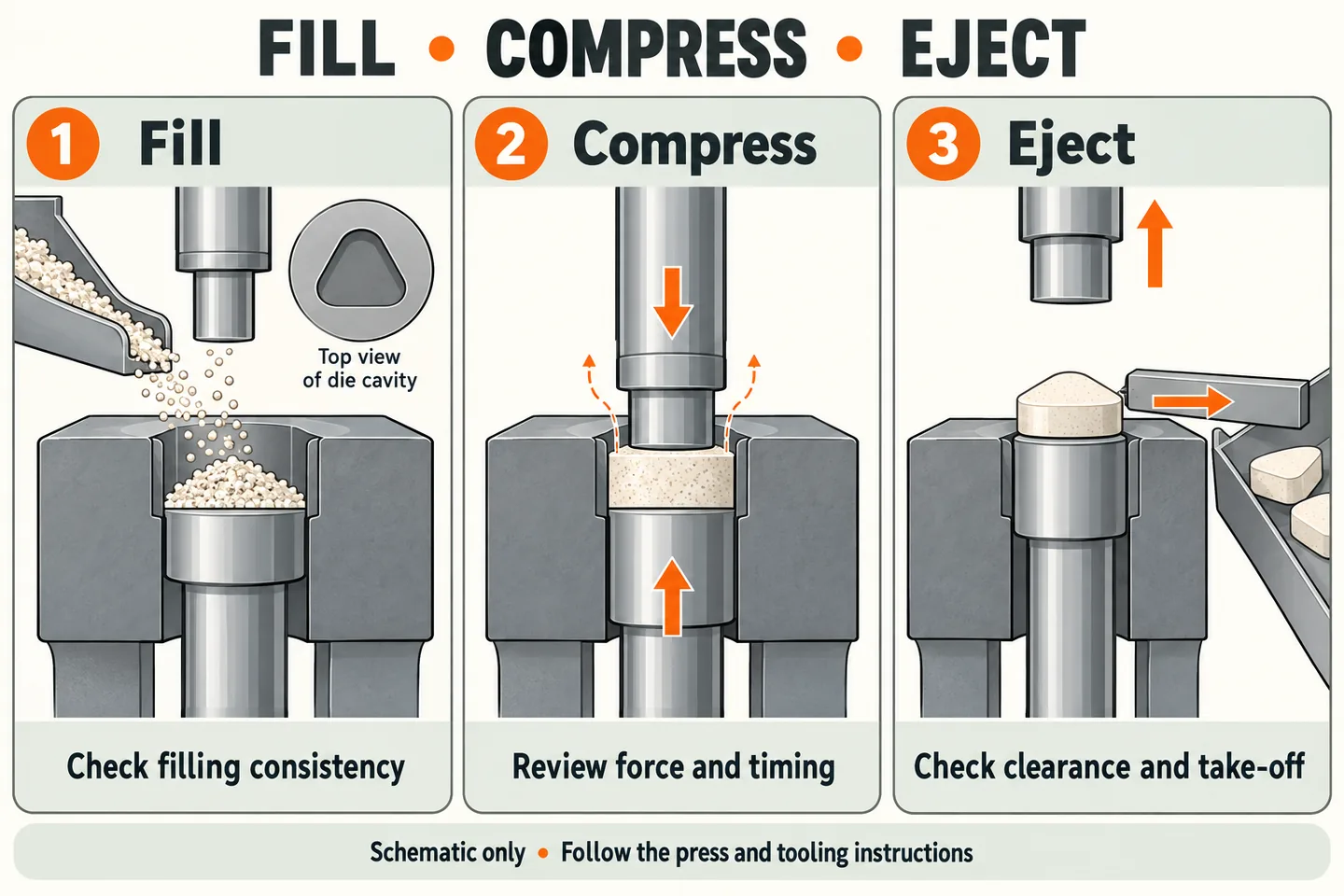
Chipping is not exclusive to non-round tablets. However, a narrow section, abrupt transition or exposed corner may deserve particular attention. Identify the first point at which material is lost: leaving the die, contacting the take-off bar, entering the chute, passing through the deduster, or undergoing later handling. Samples collected only at the end of the line can hide that distinction.
Natoli’s ejection guide distinguishes top-edge, bottom-edge and combined edge damage, and discusses take-off position, lower-punch ejection height and discharge alignment. Treat these as inspection areas, not universal adjustment instructions. The correct setup depends on the specific press and tooling. See Natoli: Troubleshooting Tablet Defects at Ejection.
Compare tablet orientation with the approved tool drawing, including the keying arrangement that controls non-round punch rotation. Confirm that the installed set and machine interfaces match the intended configuration. Adjustment or inspection inside the press must follow its stopping and isolation procedure. A recurring contact mark is a reason to investigate, not to keep running until it wears away.
If handling is satisfactory but edges remain weak, review formulation, compaction response and geometry together. Research on round convex tablets found relationships between profile choices and chipping or capping in its studied system; it supports evaluating geometry, but does not provide a universal design rule for every shaped tablet. See the original tablet-shape study.
4. Distinguish sticking from picking around tablet detail
In shaped tablet compression, sticking may appear as broader material adhesion on the punch face, while picking often damages specific letters, numbers or other recessed details. Photograph the tablet and its matching punch before cleaning, where the procedure permits. A recurring defect in the same feature can reveal more than a general description such as “rough surface.”
Review the formulation’s moisture and temperature history, adhesive components, lubrication, and the punch surface condition. Neither a single moisture limit nor a generic surface-roughness value establishes suitability for every product. Compare observations across the run to determine whether buildup starts immediately or develops as operating conditions change.
I Holland describes the role of embossing design and open letter features in reducing picking opportunities. Its production-efficiency discussion also distinguishes general punch-face sticking from adhesion around detail. See I Holland: Improving Production Efficiency, Part 1. Proposed design, coating or surface-treatment changes should be reviewed for compatibility with cleaning, tool life and the required tablet identification.
Do not add lubricant or repeatedly polish a punch without assessing the consequences. A change that improves release may affect bonding or product performance, while uncontrolled polishing can alter detail. Use a documented comparison and review the tablet sticking and lubricant selection guide for additional questions to investigate.
5. Check thin edges, burrs and flashing against the drawing
Flashing usually describes a thin projection around the tablet perimeter. First distinguish a compacted fringe from loose powder adhering to an otherwise intact edge. Then compare the finding with the drawing and the condition of the matching punch and die. Record whether it occurs around the whole outline or at one repeatable location.
Excessive or uneven clearance, worn edges, alignment problems and the compression conditions are possible investigation areas. The formulation and particle properties can influence the appearance as well. A visible fringe does not, by itself, prove excessive force or identify which component is outside its specification.
For shaped tablet compression, the land and edge profile should be intentional design features. A supplier review can assess whether the existing dimensions and service condition remain appropriate. Avoid treating hand-ground edges or improvised clearance changes as routine corrections. After an approved repair or replacement, verify the tool and the resulting tablet against their respective requirements.
6. Measure thickness and strength consistently
In shaped tablet compression, a curved tablet is not expected to have the same geometric thickness at every point. Measure the dimensions defined by the drawing at repeatable locations. Comparing a central thickness on one sample with an edge thickness on another can create an apparent process problem that is actually a measurement inconsistency.
Use consistent tablet orientation and a suitable, documented breaking-force method. The measured force depends on geometry and loading arrangement, so a result for an oval tablet cannot automatically be compared with a differently shaped tablet as if both were the same object. Do not apply a simple round-tablet tensile-strength equation to a complex shape without a justified method.
If thickness or strength varies unexpectedly, compare tablet mass, tooling working dimensions, setup, material condition and compression records. A whole-tablet breaking-force result does not map local density inside the tablet. Suspected weak regions or unusual fracture patterns may require a more focused development investigation rather than a change to the average target alone.
The acceptance decision should include the relevant quality attributes, such as friability, disintegration or dissolution where applicable. A higher breaking-force value is not automatically a better product. Keep the test method, orientation, sample age and storage conditions consistent when comparing trial results.
7. Treat retained or recompressed tablets as an abnormal event
During shaped tablet compression, if a tablet remains in a die, fails to clear the take-off area, or is suspected of being compressed again, follow the equipment’s stop and investigation procedure. Do not continue feeding material to see whether the obstruction clears. Preserve relevant alarms and samples, and have the responsible team assess the affected production interval.
Inspect ejection, take-off, punch movement and discharge components through the approved procedure. Record the station, tool identification and any evidence of contact or damage. A thick or unusual sample alone does not prove double compression; the machine history and examination need to support that conclusion.
Also distinguish this event from coating twinning, where tablets adhere to each other during coating. I Holland discusses twinning in relation to tablet profile and surface contact during that later process. See its production-efficiency discussion. These are different events and call for different investigations. There is no basis here to claim a universally higher retained-tablet rate for all non-round shapes.
8. Review repeated tooling wear or punch-tip damage
Tooling damage is an equipment finding, not simply another tablet appearance defect. In shaped tablet compression, review damage location, approved loads, punch guidance, key condition, alignment, steel or coating selection, and the formulation’s relevant characteristics. Do not assume that visible wear proves metal contamination in the powder.
Ask the supplier to compare the damaged component with its drawing and service history. Natoli describes tooling and design support as application-specific, with the final tablet configuration informing the tooling selection. See Natoli: Tablet Compression Tooling and Design Support. A tougher steel, harder steel or different coating addresses a particular engineering trade-off; none should be presented as a guaranteed cure.
If a tool chips or fractures, stop and follow the site’s equipment and product assessment process, including accounting for fragments and the affected production. Do not reinstall a component solely because it has been polished smooth. Our punch tip chipping guide and tooling maintenance guide provide related inspection topics.
Build an evidence-based shaped tablet compression trial
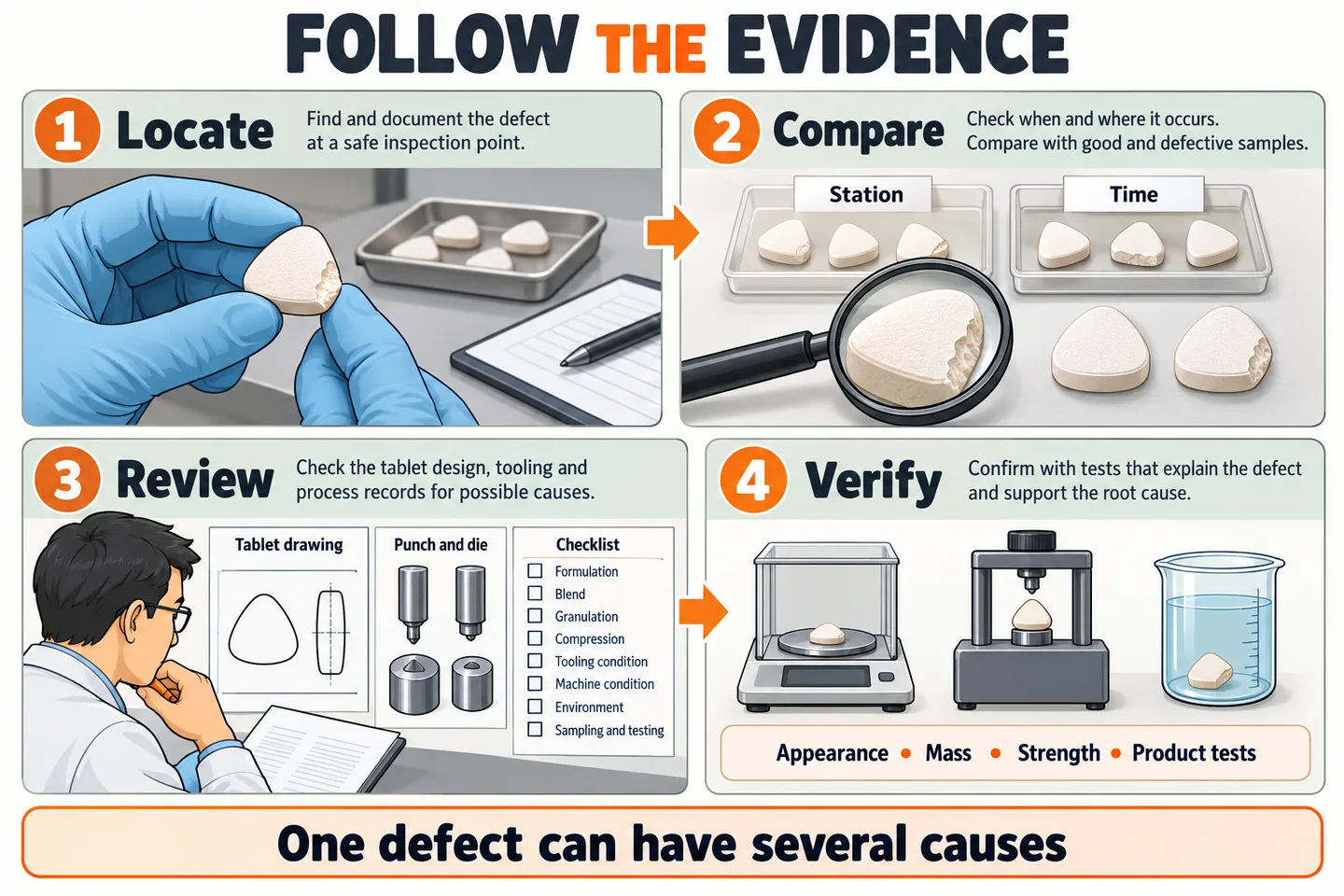
A useful trial begins with a stated observation and a testable explanation. For example: “lower-edge damage first appears at discharge” is more useful than “the tablet shape is unsuitable.” Compare a baseline with a planned change, using consistent sampling and measurements. When several variables interact, use an appropriately designed study rather than a sequence of undocumented adjustments.
- Record the formulation and lot, press configuration, tool-set identification and current drawing revision.
- Document when and where the defect occurs, with representative acceptable and defective samples.
- Set the permitted changes, operating limits, sampling points and stop criteria before starting.
- Check the relevant appearance, mass, dimensions, strength and product-performance requirements.
- Record contradictory evidence as well as improvements, and identify what still requires review.
ICH Q8(R2) provides a development framework for understanding the relationship between material attributes, processing and product quality. See FDA / ICH Q8(R2): Pharmaceutical Development. Use that framework to justify what is measured and why. A brief improvement in appearance is not enough to establish that a change is suitable for routine manufacture.
For shaped tablet compression transferred between facilities or countries, compare the actual material grades, environmental exposure, tooling drawings, press interfaces and test methods. Confirm units and drawing conventions explicitly. Assess the receiving site’s temperature and humidity controls, transport exposure and material storage history instead of assuming that conditions match the original facility.
Shaped tablet compression FAQs
Are oval tablets always harder to manufacture than round tablets?
No. Difficulty depends on the full geometry, formulation and equipment combination. Some non-round designs run satisfactorily, while a round tablet with a deep profile or demanding material can be difficult. Evaluate the design and production evidence together.
Will increasing compression force stop chipping or capping?
Not reliably. More force may leave the cause unresolved, change product performance or exceed the permitted tool load. First separate bonding, air release, geometry and ejection issues, then evaluate a justified adjustment with relevant quality checks.
How should I investigate picking on an embossed tablet?
Compare the damaged tablet detail with residue on the corresponding punch. Record when buildup starts, review material and surface conditions, and discuss the engraving with the tooling supplier. A coating change alone does not establish that the underlying issue is solved.
Can round and non-round tablets use the same strength limits?
Do not assume so. Geometry, orientation and the measurement method affect the result. Establish suitable product-specific acceptance criteria and compare like-for-like tests. Breaking force is one quality measure, not a substitute for all performance requirements.
What information helps a supplier review a shaped tablet problem?
Provide the drawing revision, tool-set and press identification, defect photographs, material information, operating history and measured results. Explain where the defect first appears and which changes have already been tried. Separate confirmed observations from suspected causes.
Prepare a focused tooling and equipment enquiry
For a shaped tablet compression review, share the intended tablet outline and profile, relevant material challenges, target output and available trial evidence. Our rotary press tooling and single-punch tooling pages identify the main tooling categories. Compatibility and operating limits need confirmation for the particular application.
Read the related pharmaceutical tableting guide for the wider material, tooling and process discussion. Contact TabletPress Shop to discuss your requirements. This article provides an investigation framework; it does not promise a fixed reduction in rejects or prescribe a universal manufacturing recipe.
Sources and scope
The linked sources include tooling manufacturers, original research and pharmaceutical development guidance. Their findings have different scopes; manufacturer recommendations and research on a particular formulation should not be treated as universal limits. Sources checked on 26 October 2026. Illustrations are conceptual and do not specify machine adjustments.