
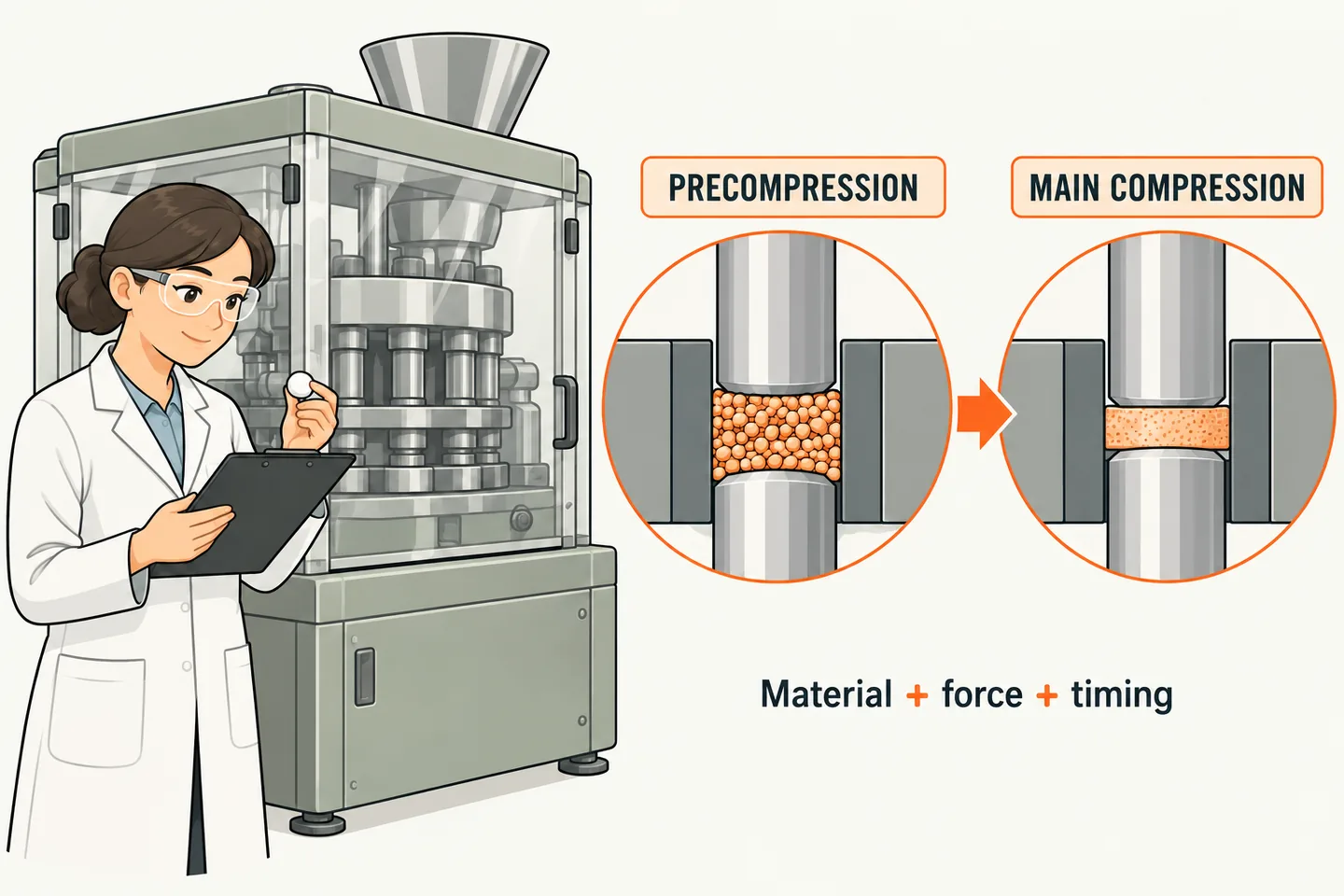
Tablet precompression prepares a powder bed for the main compression event. It can support particle rearrangement and air removal, but its value depends on the formulation, tooling and compression profile. Treating it as a fixed percentage of main force can overlook the reasons a tablet caps, laminates or becomes weak.
Quick answer: Precompression and main compression should be developed together. Check the material, distinguish dwell time from the interval between stages, and compare controlled force and speed trials. Judge the outcome using tablet mass, strength, defects and required product tests, rather than hardness alone.
This guide explains seven practical checks for process development and troubleshooting. It provides a way to investigate a problem, not a universal operating recipe. Use the limits and adjustment procedures specified for the actual press and tooling.
On this page
1. Define what tablet precompression should achieve
A filled die contains particles and air-filled voids. As the bed consolidates, air needs a route out. In a susceptible formulation, trapped air can contribute to defects during unloading and ejection. Precompression may help address this before the next compression event.
In a celecoxib study, adding precompression reduced the unusually large in-die recovery associated with air entrapment and improved tablet strength under the studied conditions. This is evidence for a mechanism, not proof that every crack has the same cause. Vreeman and Sun (2022): air entrapment during tablet compression.
Give the tablet precompression trial a specific objective: fewer capped tablets, less lamination at a target output, or a more consistent strength response. Record the starting defect rate before changing settings. If defects already meet the agreed criteria, additional force is not automatically useful.
| Stage | Role to investigate | What it does not establish |
|---|---|---|
| Precompression | Initial consolidation, air release and a changed loading history | A universal setting or a guarantee of defect-free tablets |
| Main compression | Further densification and development of the required compact | That the highest force produces the best tablet |
| Unloading and ejection | Recovery and release of the compact from the die | That a tablet intact at ejection will remain intact during handling |
Precompression can influence bonding and final strength; describing it as having no role in strength would be misleading. Equally, not every formulation or press requires a separate precompression stage. Establish its benefit through a comparison appropriate to the machine.
2. Separate dwell time from the interval between stages
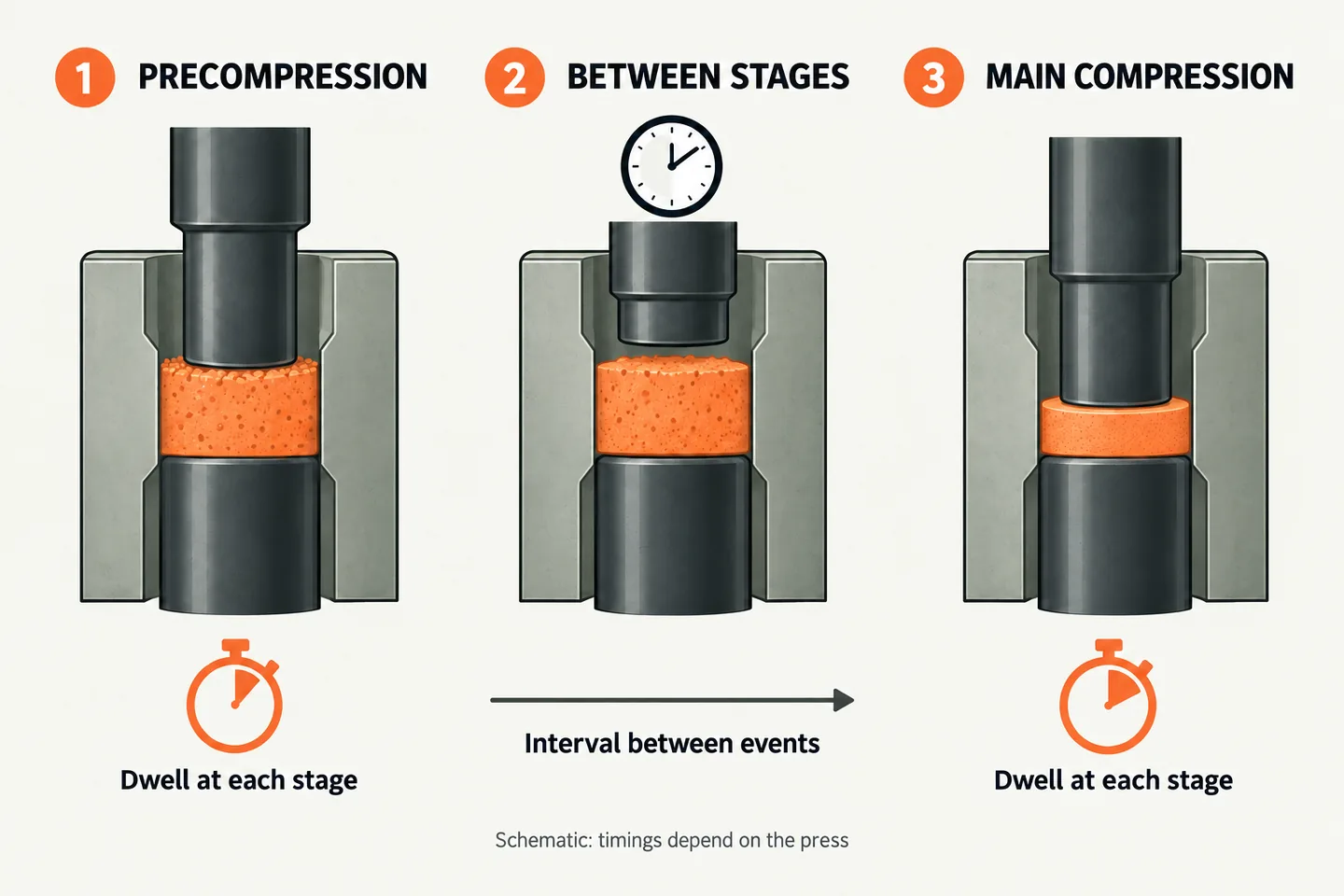
Dwell time usually describes the period around maximum compression, often associated with punch-head-flat contact on a rotary press. Confirm the definition used by the equipment or data system. It is different from total loading time and from travel between compression stations.
The interstage interval describes time separating the precompression and main compression events. State its endpoints: roller center to roller center, or the end of one loading event to the start of the next. Those measurements are not interchangeable.
After the first load decreases, the compact can recover elastically and its internal stress can evolve. The force does not necessarily fall instantly to zero. Punch separation, residual contact and the loading profile depend on the press. Use measured force and displacement traces when available.
A published model-formulation case found that releasing precompression before main compression helped mitigate capping, whereas maintaining the load between stages did not. The separation also needed sufficient duration in that experiment. This supports checking the full compression history, rather than assuming that more continuous loading is always beneficial. Original case study (2020): precompression and capping.
Do not turn that result into a universal minimum interval. Likewise, a longer interval does not necessarily erase all consolidation or make tablets lighter. Material response must be checked at the conditions being compared.
3. Understand what changing turret speed actually changes
For a fixed angle between roller centers and constant turret speed, the center-to-center travel time can be calculated. This is a geometric estimate, not a direct measurement of the unloaded interval.
Center-to-center time in seconds = Δθ ÷ (6 × N), where Δθ is the angular separation in degrees and N is turret speed in revolutions per minute (rpm).
| Illustrative geometry | Turret speed | Calculated center-to-center time |
|---|---|---|
| 60° between roller centers | 30 rpm | 0.333 seconds, approximately 333 ms |
| Same 60° separation | 60 rpm | 0.167 seconds, approximately 167 ms |
These are arithmetic examples, not recommended press settings. The loading and unloading contact zones occupy part of that travel. To find the interval between actual loading events, identify their boundaries on a force-time record or obtain the machine-specific geometry.
Increasing turret speed also changes filling opportunity and the rate and duration of compression. A speed trial therefore changes several conditions together. If quality improves at a lower speed, the result alone does not identify which timing feature caused the improvement.
Speed is not the only possible design lever. Peeters and colleagues studied a press with an air-compensator arrangement that could extend dwell independently of tableting speed. The results concerned an ibuprofen formulation and a specific machine configuration. Peeters et al. (2018): extended dwell time in ibuprofen tableting.
For tablet precompression scale-up, record the press model, punch-head geometry, speed and force profile together. Matching rpm between two machines is insufficient to demonstrate equivalent compaction conditions.
4. Compare precompression and main force without a fixed ratio
A tablet precompression force of 10% of main force is sometimes used as a starting heuristic. Natoli explicitly notes that it does not suit every material and that excessive precompression can increase capping. Establish a working range for the formulation instead of treating that ratio as a specification. Natoli: preventing capping and other tablet defects.
Avoid the explanation that high precompression always “uses up all plasticity.” Previous loading can change the response to subsequent compression, but the mechanism and direction of the effect vary. A strength decline calls for investigation of the compression history, blend and tooling.
Record force and tooling dimensions in compatible units. Force in kN is not pressure in MPa. Nominal compaction pressure is force divided by projected punch-tip area. For example, 10 kN over 100 mm² equals 100 MPa. This is a unit-conversion example, not a process recommendation or a map of local stress.
Where instrumentation permits, compare in-die recovery as well as the finished tablets. A 2024 study developed a precompression optimization approach using elastic-recovery measurements to investigate lamination associated with trapped air. Such measurements add evidence; they do not replace product testing. Original study (2024): optimizing precompression using elastic recovery.
Keep both compression stations within their specified limits. A claim that tablet precompression automatically extends tooling life is not justified without service and load data. Inspect punches and dies as part of the tablet tooling maintenance routine.
5. Diagnose defects before adjusting tablet precompression
Use the following table to organize observations. Each row proposes a comparison, not a diagnosis. Photograph defects, identify the sampling point and note whether the issue affects all stations or a recurring subset.
| Observation | Investigate | Useful controlled comparison |
|---|---|---|
| Capping or lamination | Air removal, recovery, loading profile, tooling condition | Change one justified force setting; compare defects and strength at matched mass |
| Weak or friable tablets | Blend history, bonding response, compression profile | Measure strength and material loss across defined conditions |
| Variable tablet mass | Die filling, feed consistency, metering and control settings | Check sampled mass against feed and dosing records |
| Sticking or picking | Powder moisture, temperature, punch surfaces and formulation | Compare time into the run, tooling condition and material records |
| Chipped edges or ejection damage | Punch-tip/die condition, ejection behavior and handling | Inspect tooling and samples before and after downstream handling |
Tablet mass is primarily a filling and metering question. Densifying a retained quantity of powder changes its volume, not its mass. Do not assume that recovery between stages directly causes weight variation. First examine powder delivery, dosing and any material loss.
On some presses, compression force provides an indirect signal for automatic weight regulation. KORSCH describes establishing the force-to-weight relationship and adjusting the dosing cam in response. A force signal still needs a valid setup and actual mass checks; it is not an independent weighing measurement. KORSCH: press force control and multi-tip tooling. See the granule flowability guide for feeding-related checks.
For PVP-containing blends, sticking alone does not prove that precompression has squeezed binder out of the particles. Moisture, temperature, surface condition and the formulation deserve investigation. A study of MCC compaction examined moisture migration and proposed a contribution to sticking at the punch interface; it did not establish that mechanism for every binder system. Koumbogle et al. (2023): moisture behavior during tableting. Our tablet sticking and lubricant guide covers related formulation questions.
6. Run a documented comparison with clear acceptance criteria
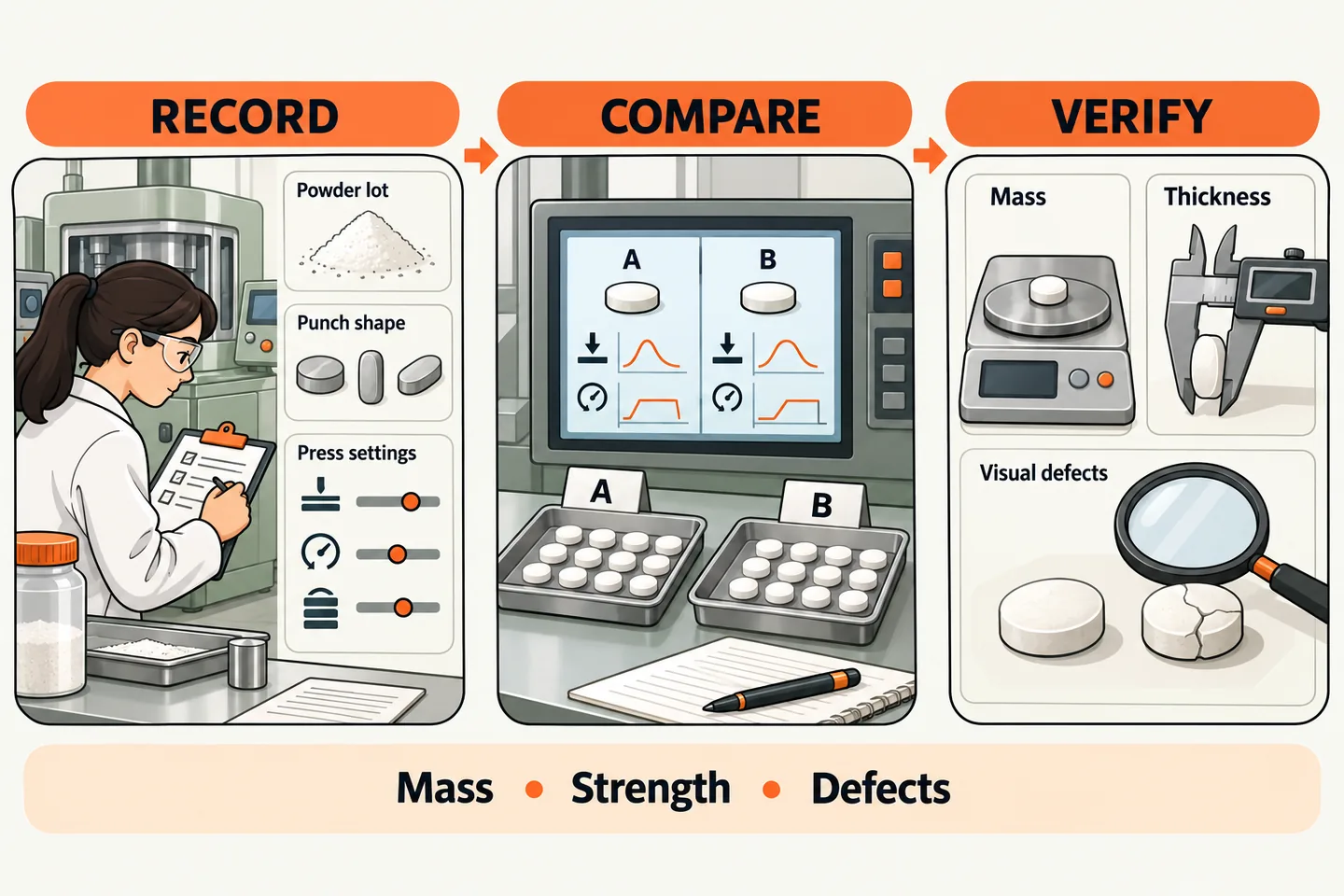
A tablet precompression trial is easier to interpret when the baseline is reproducible. The following is a suggested planning structure, not a validated design of experiments. Choose settings and sample sizes with the responsible process team.
| Step | Keep track of | Decision to make |
|---|---|---|
| Establish baseline | Blend lot, tooling, mass target, forces, speed and sample timing | Can the starting condition be repeated? |
| Screen precompression | Defined force changes with other settings held as consistently as possible | Is the response large and repeatable enough to investigate? |
| Check main compression | Strength, thickness, defects and ejection behavior | Does the candidate condition meet the complete quality brief? |
| Compare speed | Actual mass, force profile, output and time into the run | Does the candidate remain suitable at the intended output? |
| Repeat and extend | Baseline repeat, additional lots or representative run duration | Is the apparent benefit robust to normal variation? |
Agree on the measurements before running the comparison: tablet mass and variation, thickness, breaking force or appropriate tensile strength, friability, visual defects and required disintegration or dissolution testing. Keep sample conditioning and test timing consistent. A hardness increase by itself is an incomplete result.
Label sample containers with the condition and collection time. Separate a startup observation from behavior later in the run. If a candidate setting changes the mass, bring that difference into the interpretation rather than crediting the entire strength change to precompression.
For accepted output, record the number inspected and the number rejected under a stated defect definition. Compare results over a suitable run duration. If several settings interact, move from initial screening to a planned experimental design instead of selecting an apparent winner from isolated samples.
7. Prepare a transferable machine and material brief
Before transferring a tablet precompression process, document the material grade and lot, granulation route, tablet geometry, tooling standard, target mass, quality criteria and observed defect. Attach the tested settings with their units and the sampling method.
Ask the equipment supplier to confirm whether the proposed configuration has a dedicated precompression station, its force range, available instrumentation and relevant punch/roller geometry. The phrase “double-pressing rotary press” alone does not establish that its layout matches the precompression sequence discussed here.
The ZPW29 / ZPW31 rotary press and rotary press tooling pages can support an equipment enquiry. Confirm the exact configuration and compatibility before applying this process guide. The difficult-powder tablet formulation guide provides a companion framework for material development.
For a cross-site or international project, include local temperature and humidity records, the available material grades and the test methods used at each location. These are useful transfer inputs; country names alone do not explain a compression result. Send your machine and material brief to discuss the information needed for an equipment review.
Tablet precompression FAQ
What is the difference between precompression and main compression?
Tablet precompression is an earlier consolidation event that may help prepare the powder bed for subsequent loading. Main compression provides further compaction toward the required tablet properties. Their effects overlap, so evaluate the complete loading history rather than assigning all strength development to one stage.
What precompression-to-main-compression ratio should I use?
There is no universal ratio. Select a justified trial range for the formulation and equipment, then compare tablet quality. A percentage alone does not describe the tooling area, loading rate or material response.
Does a slower turret speed always improve tablet quality?
No. It changes several aspects of the process, including filling and compression timing. Any benefit must be demonstrated against the required quality and output criteria. A slower speed does not automatically make the interstage interval optimal.
Can precompression fix inconsistent tablet weight?
It is not a direct substitute for stable die filling and metering. Investigate feed behavior and dosing first. If the press uses force-based weight control, confirm its setup with measured tablet masses.
How should I report dwell time and stage separation?
State the measurement definition, units, machine and operating speed. Distinguish time near maximum load from roller-center travel time and from the interval between loading events. Include a measured force-time trace when available.
Technical sources and scope
The studies below concern particular formulations and equipment. Their findings support investigation; they do not validate a setting for a different product. The trial checklist and arithmetic examples in this guide are explanatory tools, not claims of production results.
- Vreeman and Sun (2022): air entrapment during tablet compression
- Original case study (2020): precompression and capping
- Peeters et al. (2018): extended dwell time in ibuprofen tableting
- Natoli: preventing capping and other tablet defects
- KORSCH: press force control and multi-tip tooling
- Koumbogle et al. (2023): moisture behavior during tableting
- Original study (2024): optimizing precompression using elastic recovery