
Tablet granulation changes how a powder blend flows, packs into a die and bonds during compression. These changes can influence tablet strength, friability, sticking and weight variation. However, a granule that flows well does not necessarily form a strong tablet, and a harder granule is not automatically a better one.
Quick answer: Select a granulation route for the actual formulation, then evaluate granule strength, moisture, particle size distribution and blend uniformity together. Confirm the result with compression trials and finished-tablet tests. Neither wet nor dry granulation is universally superior, and tooling changes cannot compensate for every upstream problem.
This tablet granulation guide turns common manufacturing observations into seven practical checks. It is intended for development and troubleshooting discussions, with product-specific acceptance criteria set before trials. The diagrams explain mechanisms; they do not represent experimental results or validated operating settings.
On this page
1. Choose the tablet granulation route by formulation
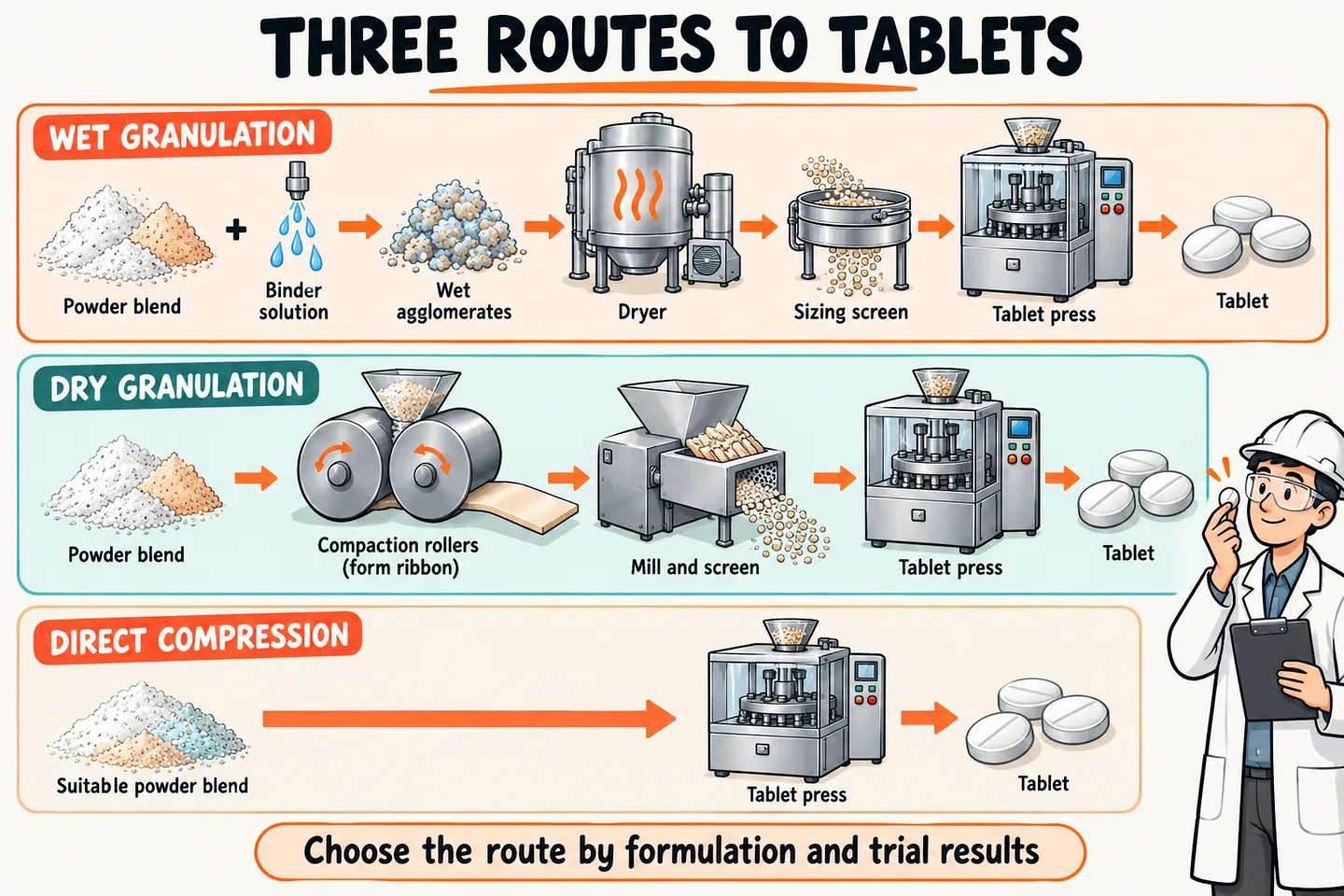
Granulation brings smaller particles together into larger agglomerates. Wet granulation uses a liquid phase, often with a binder, followed by drying and sizing. Dry granulation densifies a powder without adding a granulating liquid; roller compaction typically produces ribbons that are then milled. Direct compression skips granulation when the blend already has suitable processing properties.
The useful question is what the formulation needs: more reliable feeding, less segregation, better bonding, or a combination. Moisture sensitivity, heat sensitivity, excipient behavior and the intended release profile also matter. Granulation can help manage flow and segregation, but the final test is performance on the intended press. GEA discusses this link between granulation and compression.
| Route | When to investigate it | What still needs confirmation |
|---|---|---|
| Wet granulation | Poorly flowing blends or formulations that benefit from binder-assisted agglomeration. | Liquid compatibility, drying endpoint, granule strength and tablet performance. |
| Dry granulation | A route without added granulating liquid or a subsequent drying stage. | Ribbon consistency, milling response, fines and tabletability after compaction. |
| Direct compression | Blends with suitable flow, uniformity and bonding behavior. | Segregation during handling and consistent filling at the intended speed. |
Avoid selecting wet granulation simply because a tablet is weak, or rejecting dry granulation because capping has occurred. In a study of 30 materials, high-shear wet granulation produced different changes in tabletability across the material library. That result supports formulation-specific evaluation rather than a general claim that wet granules always compress better. Read the material-library study.
2. Check granule strength, porosity and bonding
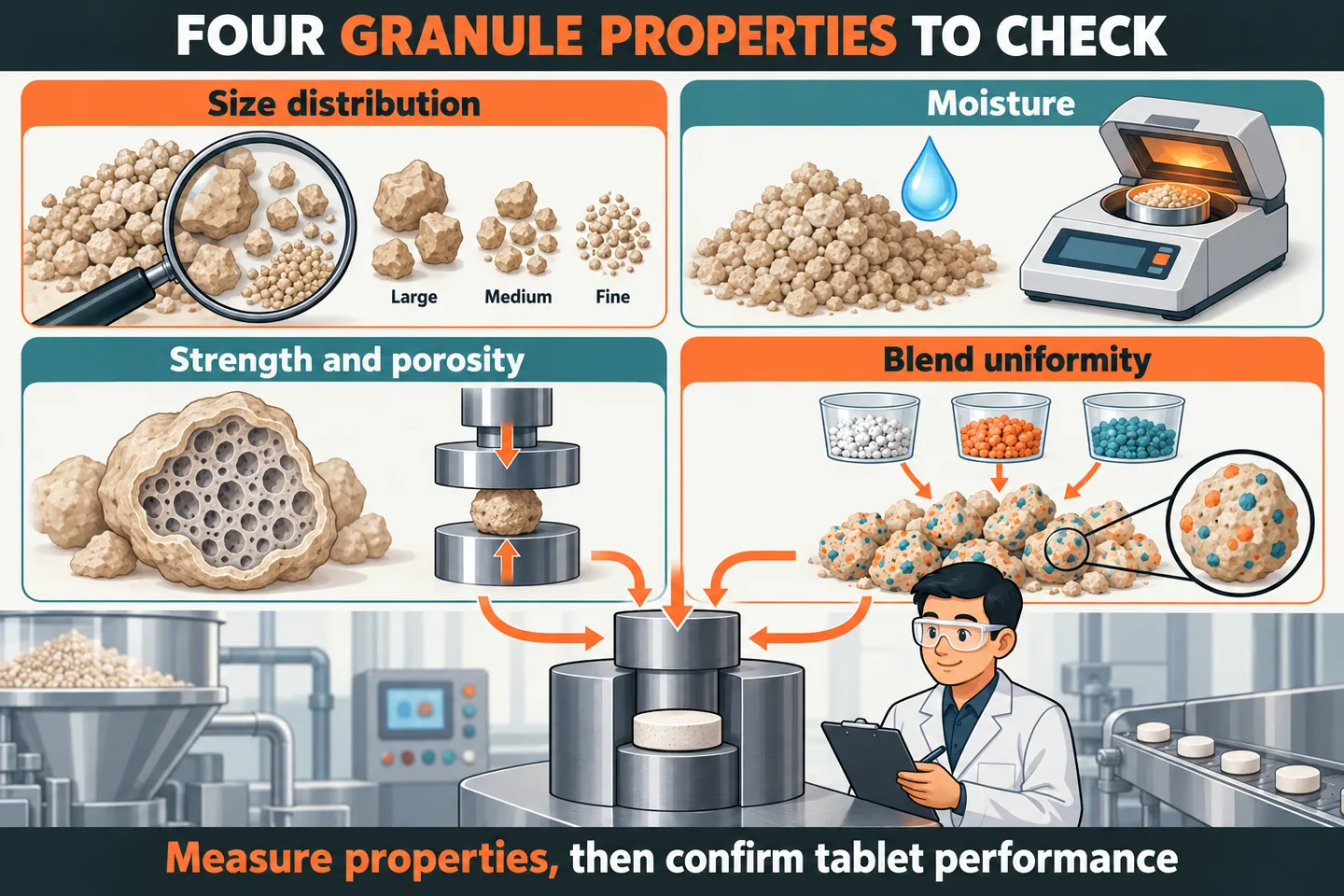
Granules need to survive transfer and feeding while still forming adequate bonds in the die. Very friable granules may break down during conveying and generate fines. Strong, dense granules may resist deformation or fragmentation under some conditions. Neither behavior can be judged reliably from appearance alone.
Separate three terms when discussing results. Compressibility describes densification under pressure. Compactibility relates tablet strength to its solid fraction or porosity. Tabletability relates tablet tensile strength to compaction pressure. A change that improves packing can leave bonding unchanged or make it less favorable.
For tablet granulation trials, compare an acceptable reference with the proposed process using the same tablet geometry and relevant compression conditions. Record breaking force, dimensions and, where the method is appropriate, tensile strength. Also check friability and disintegration or dissolution. A higher breaking force alone does not demonstrate a better product.
A hydralazine formulation study found that wet massing conditions influenced compaction behavior and tablet strength. Separate research on roller compaction examined material-dependent tabletability changes after dry granulation. These studies offer reasons to measure the response, not settings that can be transferred directly to another formulation. Wet granulation study; dry granulation study.
3. Establish a formulation-specific moisture window
Residual moisture can affect interparticle bonding, flow, surface adhesion and stability. Excess moisture may contribute to sticking in susceptible blends. Excessive drying may also change compaction behavior. The appropriate endpoint depends on the ingredients and the measurement method; there is no universal moisture percentage for all tablet granulation processes.
Use a defined sampling procedure and a suitable method. Loss on drying measures mass lost under stated test conditions and may include volatile components other than water. Karl Fischer analysis measures water through a specific chemical method. Record the method and conditions rather than comparing numbers from unlike tests as if they were interchangeable.
Measure representative samples after drying and again at the point of use when storage or transfer could change moisture. Include container closure, hold time and room conditions in the trial record. Research on in-line near-infrared monitoring highlights the connection between granulation/drying moisture and downstream quality. See the fluid-bed moisture-monitoring study.
If sticking develops, compare the measured moisture with an acceptable batch before extending drying. Also examine formulation adhesion, lubricant distribution, product temperature and punch condition. Drying a batch further without evidence may shift the problem rather than resolve it. Our tablet sticking guide explains the separate roles of formulation and surface checks.
4. Control milling, fines and particle size distribution
Sizing influences the fractions entering the feed system. Large agglomerates, elongated particles or an excessive fine fraction may affect filling and handling in different ways. Screen aperture alone does not define the final distribution: rotor design, speed, feed rate and the condition of the incoming material also influence the result.
Track the distribution with a consistent sieve or particle-size method. Define what counts as fines and oversize for this formulation, report the fractions, and compare samples before and after transfer. A single mean particle size can hide a change in either tail of the distribution.
A narrower distribution is not always the best target. A controlled mixture of sizes may pack differently from a narrowly screened fraction. Removing fines can also alter composition if ingredients are unevenly distributed across size fractions. Evaluate flow, uniformity and compaction together before changing screens or recycling material.
For tablet granulation troubleshooting, treat a rise in fines as a clue. Compare mill settings, granule friability and handling history, then verify the effect at the press. Excess fines can also enter tooling clearances and contribute to operational problems. Natoli discusses powder preparation and tooling interactions. For additional flow tests, see our granule flowability guide.
5. Verify blend uniformity separately from tablet weight
Tablet weight and ingredient uniformity answer different questions. Tablets can have similar weights while containing different proportions of an active ingredient. Conversely, a compositionally uniform blend can produce variable tablet weights when die filling becomes unstable. A weight check alone cannot establish content uniformity.
Review mixing order, binder distribution, lubricant addition and any external phase added after granulation. Samples should represent the relevant process locations and times, not only the most accessible surface of a container. Examine changes across discharge and transfer as well as within the mixer.
Use an appropriate analytical method when ingredient distribution matters to the product specification. Keep sampling tools, sample size and sampling locations consistent so that an apparent process change is not just a sampling difference. If segregation is suspected, investigate the transfer path and size fractions before increasing blending time.
6. Match granules to compression and tooling conditions
The same granules can behave differently when filling time, feeder action and compression conditions change. At higher speed, available filling and compression time may decrease depending on the machine design. A blend that performs acceptably during a slow trial therefore needs confirmation at its intended operating conditions.
Review precompression where available, main compression, dwell time, tablet thickness and ejection behavior together. Identify whether capping appears during ejection, immediately after compression or later in handling. This timing helps structure the investigation but does not prove a single cause.
Inspect punch tips, die bores, alignment and cleaning condition using the equipment supplier’s procedures. Surface treatments or tablet-shape changes may be worth evaluating for a defined problem, but a mirror finish does not guarantee freedom from sticking. Likewise, bidirectional compression depends on the press and tooling system; changing to a vaguely described special punch is not a universal solution.
When comparing tablet granulation routes, hold relevant press settings and tooling geometry consistent initially. Then investigate the workable operating range for promising candidates. Report accepted output and quality together so that a lower reject rate achieved only at a much lower speed remains visible.
7. Confirm improvements with a controlled trial
Define the defect and acceptance criteria first. Preserve a baseline record with the raw material lots, batch history and current settings. For an initial investigation, compare one justified change at a time; use a designed experiment when interactions need to be studied. Do not combine several unrecorded changes and attribute the outcome to granulation alone.
| Trial record | Useful information to retain |
|---|---|
| Material and granulation | Ingredient lots, route, binder details, liquid addition or roll settings, relevant processing time. |
| Drying and sizing | Sampling point, moisture method, hold time, screen and mill settings, size fractions. |
| Blending and transfer | Addition sequence, mixing conditions, container/transfer route and representative sampling plan. |
| Compression | Press and tooling identification, speed, feeder settings, force/pressure data, thickness and ejection observations. |
| Finished tablets | Weight distribution, ingredient uniformity where applicable, strength, friability, release testing and defect counts. |
Use consistent definitions for each defect and record the number inspected alongside the number rejected. Retain photographs and representative samples according to site procedures. An improvement should remain credible across relevant sampling points and repeat runs, not just in a small sample selected after an adjustment.
For pharmaceutical manufacturing, carry successful changes through the applicable quality system and validation process. FDA’s process-validation guidance describes a lifecycle approach involving process design, qualification and continued verification. A development trial contributes evidence but does not by itself establish a validated commercial process. Read the FDA guidance.
Read changes across the process, not only the final sample
Consider a trial in which the dryer-discharge sample matches the reference, but the press-feed sample contains more fines. That pattern makes transfer or handling worth investigating before changing the granulation liquid. If both samples have shifted, examine upstream material and process records as well. This is an example of diagnostic reasoning, not a reported production case.
For tablet granulation, use matched sampling points to make the comparison useful: after drying, after sizing, and at the press feed where appropriate. Record the elapsed time and handling between them. A sample taken immediately after drying cannot explain a later moisture result without information about storage, container closure and exposure.
Also separate a stable average from a stable process. An acceptable average tablet weight can coexist with wider variation, and an acceptable mean breaking force can hide a group of weak tablets. Retain individual results or a suitable distribution summary, alongside the sampling interval and operating state. Check startup, steady running and other relevant transitions rather than relying only on a convenient short run. The purpose is to establish where the result changes and which follow-up test can distinguish the competing explanations.
Tablet granulation troubleshooting: connect symptoms to checks
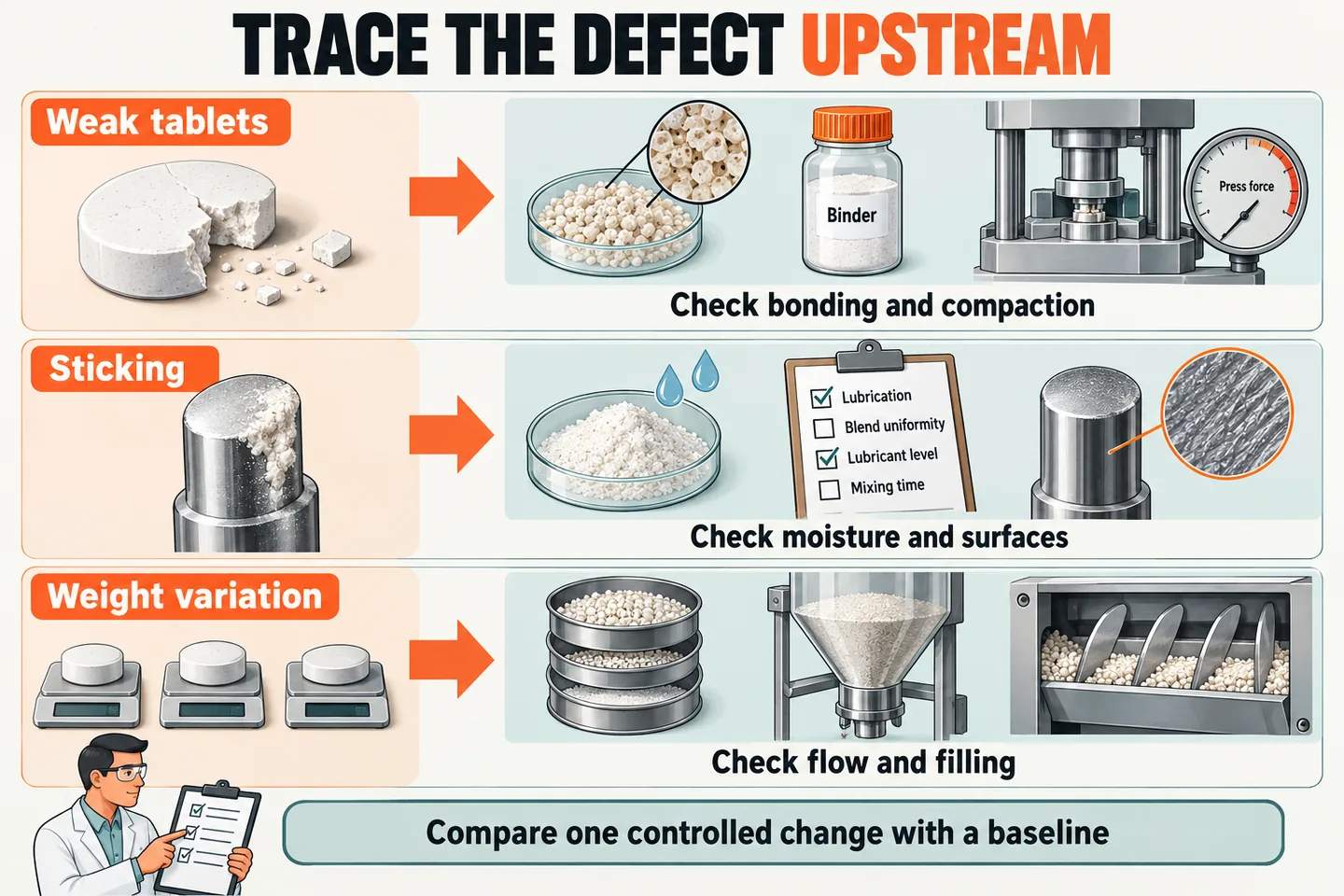
Use the table as an investigation map. The same visible defect can have several causes, so compare measurements with an acceptable batch before choosing a corrective action.
| Observed problem | Upstream checks | Press and product checks |
|---|---|---|
| Weak or friable tablets | Granule strength, binder distribution, moisture and lubrication history. | Compaction response, tablet dimensions, friability and release performance. |
| Capping or lamination | Fines, granule bonding, moisture and handling changes. | Deaeration, compression/decompression behavior, speed, ejection and tooling condition. |
| Sticking or picking | Moisture, adhesive ingredients, fines and lubricant distribution. | Punch surface, embossing, product temperature and buildup pattern. |
| Weight variation | Size distribution, segregation, bulk behavior and hopper discharge. | Feeder consistency, filling time, fill settings and weight sampling. |
| Unexpected content variation | Mixing, binder distribution, size-fraction composition and transfer segregation. | Analytical/sampling method and within-run content-uniformity results. |
Transfer the process between climates and production sites
For an international project, describe the measured receiving-site conditions rather than assuming performance from the country name. Relevant factors include room humidity and temperature, packaging during shipment, material hold time, utilities and the actual transfer system. Raw material grades and test methods also need comparison.
A practical transfer brief should identify which granule attributes must be reproduced and how they will be measured. Match the intended tablet geometry and quality tests, then compare the available granulator, dryer, mill and press. Identical nominal settings on different machines do not necessarily produce the same material history.
Document discrepancies before a trial and agree how success will be assessed. This makes the granulation and compression discussion useful across sites without inventing a country-specific recipe or promising that a process will transfer unchanged.
Frequently asked questions about tablet granulation
Does wet granulation always produce stronger tablets?
No. Wet granulation may improve flow or help distribute a binder, but its effect on tablet strength depends on the materials and processing conditions. Dense or strong granules can behave differently during subsequent compression. Compare tabletability and finished-tablet performance instead of assuming an improvement from the route alone.
Can dry granulation be used for high-speed tablet production?
It can be a candidate when the formulation and resulting granules meet feeding and compaction requirements. Dry granulation does not automatically cause capping. Evaluate ribbon and granule properties, lubrication, filling, compression and ejection at the intended speed.
What is the ideal moisture content for tablet granulation?
There is no single suitable value for every formulation. Establish a moisture window using a defined test method and evidence for flow, sticking, strength, release behavior and stability. Record where and when the sample was taken, because drying, storage and handling may change the result.
Should all fines be removed before compression?
Not automatically. Excess fines can create handling problems, but removing every fine particle may change packing or composition. Define and measure the fine fraction, then evaluate the effect of any screening or recycling change on uniformity and tablet quality.
Can better tooling correct a granulation problem?
Appropriate tooling may help with a specific surface, geometry or ejection issue. It cannot by itself establish uniform ingredients, a suitable moisture endpoint or adequate granule bonding. Investigate the material and machine together, and confirm each proposed change through trials.
Plan a granulation and tableting trial
Share the material description, current route, observed defect, moisture and size data, target tablet geometry and expected output. Include an acceptable reference batch when available. These details make an equipment discussion more useful than asking for a machine based only on hourly capacity.
For route-specific discussions, review the GK-25 Dry Granulator for roll-based dry processing and the YK Oscillating Granulator for screening moist material. Their suitability requires material trials and confirmation of the complete process. Use our contact page to discuss your application, or read the difficult-powder formulation guide for a wider development checklist.
Sources and further reading
The studies below examine particular materials and equipment. Their results support the questions in this guide; they are not universal manufacturing limits.
- GEA: Pharmaceutical granulation and downstream compression
- Wang et al. (2022): Tabletability changes after high-shear wet granulation
- Hydralazine study (2023): Wet granulation parameters and tablet strength
- Roll compaction study (2023): Tabletability change classification
- In-line NIR study (2013): Moisture monitoring in fluid-bed granulation
- Natoli: Granulation, powder preparation and tooling options (PDF)
- FDA: Process Validation, General Principles and Practices