
Pharmaceutical tableting works best when material behavior, punch-and-die design, and compression conditions are evaluated together. Sticking, capping, weak tablets and rapid tooling wear may look like separate production problems, yet a change intended to improve one can expose another.
Quick answer: Start with the observed defect and the actual formulation. Check corrosion risk, sticking, elastic recovery, liquid loading, abrasion and moisture sensitivity. Select tooling and process trials from that evidence, then verify the relevant tablet quality attributes. A drug name, coating label or single press setting cannot establish the right combination.
This guide turns six common material challenges into a practical investigation framework for formulation, production and tooling teams. It does not prescribe a manufacturing recipe: changes should follow product-specific development evidence, equipment limits and the site’s approved procedures.
On this page
What pharmaceutical tableting needs to balance
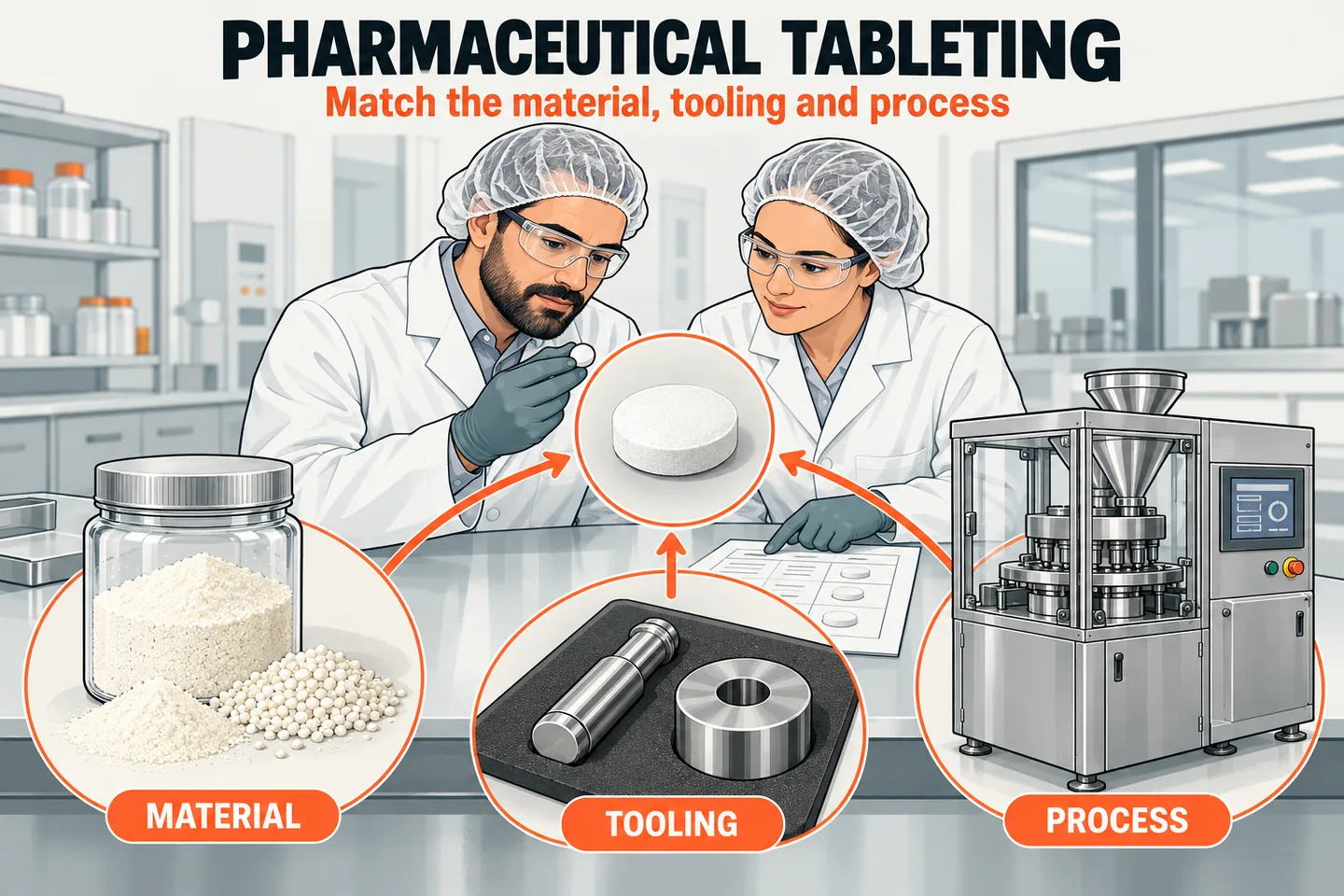
In this article, material means the complete blend or granulate reaching the feeder, including its processing and storage history. Tooling means the punches and dies, their geometry, substrate, surface treatment and condition. Process includes preparation, feeding, compression, ejection and environmental exposure.
ICH Q8(R2) describes pharmaceutical development in terms of relationships between material attributes, process parameters and product quality. That is a useful basis for investigating a tableting problem: select the attributes that matter for the product, then determine which inputs affect them. FDA / ICH Q8(R2): Pharmaceutical Development.
Do not classify a blend as corrosive, abrasive or difficult to compact solely because it contains a particular active ingredient. The grade, particle properties, excipients, moisture history and manufacturing route can change the behavior of the finished formulation. Supplier data are a starting point; production evidence should identify the problem being addressed.
- Define the observation: for example, powder accumulating around an embossed letter, rather than simply “bad tablets.”
- Identify the scope: one punch station, one material lot, the beginning of the run, or a trend over time.
- Record the baseline: approved formulation revision, tooling set, machine configuration, environmental conditions and measured quality results.
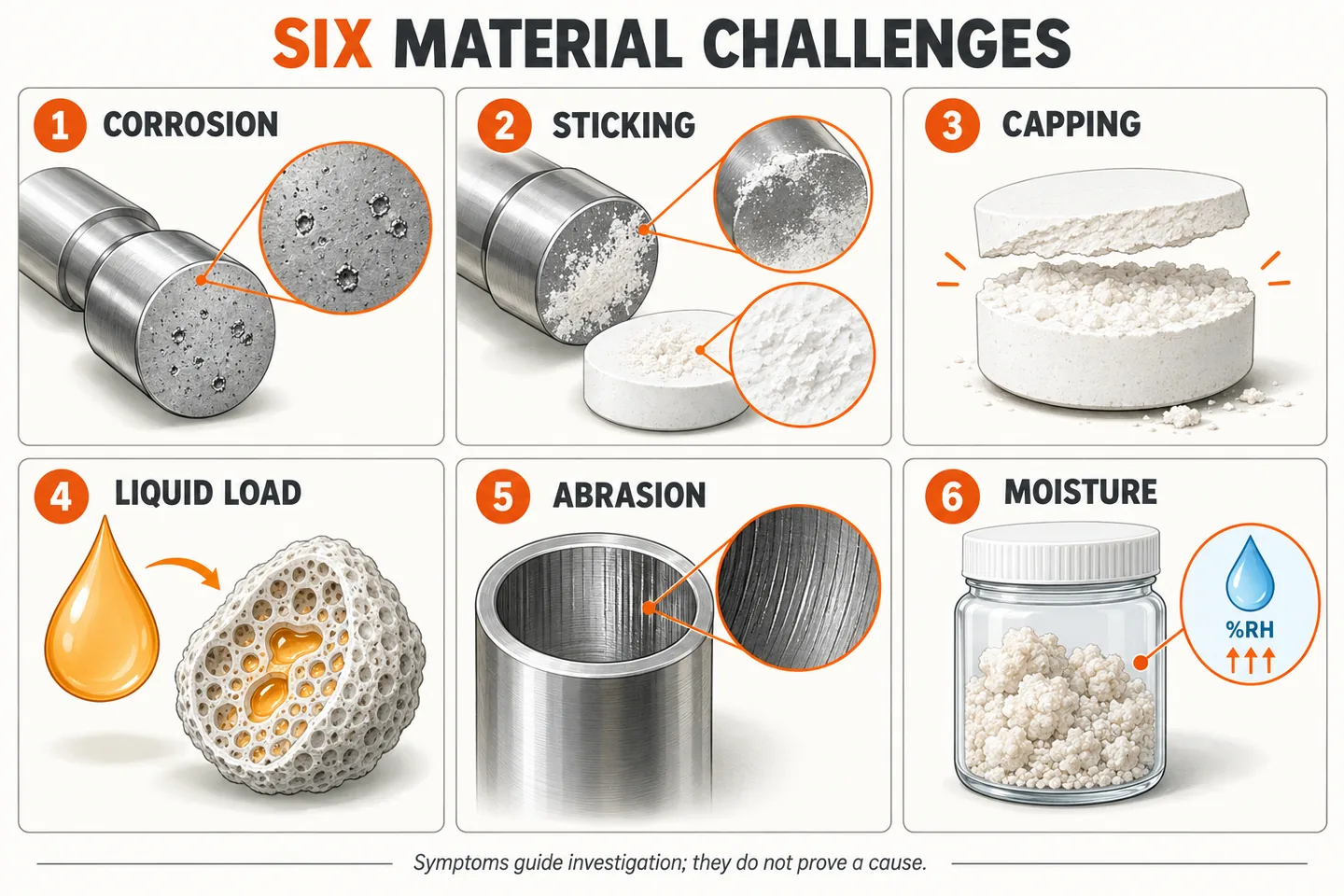
A quick map of six material challenges
| Challenge | Observation to document | First investigation step |
|---|---|---|
| Corrosion concern | Pits, discoloration or surface damage | Separate product contact, cleaning and storage histories. |
| Sticking or picking | Residue on tooling; damaged tablet detail | Map where residue first appears and when it grows. |
| Capping or weak tablets | A detached cap, layers or low strength | Compare compression conditions with measured tablet behavior. |
| Liquid-loaded material | Smearing, poor binding or liquid migration | Review liquid load, carrier and binder together. |
| Abrasion concern | Progressive scratches or dimensional wear | Track inspected tool condition against exposure. |
| Moisture sensitivity | Clumping or drift during exposure | Measure the environment and actual material response. |
These observations are investigation prompts, not diagnostic tests. Several mechanisms can coexist, and similar tablet defects can have different causes. A useful pharmaceutical tableting record connects each proposed explanation with evidence that could support or contradict it.
1. Corrosion: confirm the exposure before choosing a coating
A mark on a punch face does not by itself prove chemical corrosion. Inspect the cleaned surface using the site’s approved method, retain photographs, and compare affected and unaffected tools. Document whether the change appeared during manufacture, after cleaning, or during storage.
Tool steels differ in corrosion resistance, wear resistance and toughness. Even a corrosion-resistant grade can discolor or rust under unsuitable conditions. Selection should therefore consider the formulation and service conditions, rather than a “premium steel” label alone. Natoli: Tablet Tooling FAQs.
- Material evidence: formulation revision, supplier information, moisture measurements and the exposure sequence.
- Tooling discussion: substrate compatibility, surface condition, coating integrity and an inspection method agreed with the supplier.
- Process review: cleaning-agent compatibility, rinse and drying records, hold times and storage protection.
Avoid setting one room-humidity ceiling for every product. Also avoid changing to wet granulation simply because a formulation is suspected of being corrosive. A change involving water or heat requires an assessment of compatibility and stability. The appropriate route should be demonstrated for the product.
A manufacturer’s aspirin case discussion illustrates that wear, corrosion and sticking may need attention within the same application; it does not establish a universal tooling or granulation prescription for every aspirin formulation. I Holland: Alleviating Aspirin Issues. For routine inspection records, see our tablet tooling maintenance guide.
2. Sticking: match the surface to the actual formulation
Sticking describes material adhering to tooling; picking commonly concerns material pulled away around tablet lettering or other detail. Surface interactions, moisture, temperature and formulation properties can all contribute. A mirror-polished punch is not automatically the least adhesive surface for every blend. I Holland: How to Avoid Sticky Situations.
For pharmaceutical tableting trials, photograph the same punch features at defined intervals. Compare the initial residue with later buildup. Record whether the problem is concentrated around embossing, on the cup, or along the die wall; that distinction helps make a supplier discussion more specific.
- Material evidence: actual moisture, temperature history and any change in blend preparation or lubricant mixing.
- Tooling discussion: surface finish, coating compatibility, cup geometry and lettering features that retain residue.
- Process trial: a defined comparison of operating conditions, with observations of buildup, ejection and tablet quality.
A reduction in speed or a different surface treatment may be worth testing, but neither proves the root cause. Keep the trial scope explicit so that changes can be interpreted. Stop and clean according to the machine and site procedures; do not reach into an operating press to remove deposits.
If a formulation change is considered, compare its effect on the intended tablet performance as well as surface appearance. Our guide to tablet sticking and lubricant options explains why an additive should be assessed in the whole formulation.
3. Capping and weak tablets: study the compression response
Capping is separation of a tablet’s upper or lower portion; lamination involves separation into layers. Weak tablets can occur without either visible defect. Treat these as distinct observations in pharmaceutical tableting records, rather than assuming they share one remedy.
Natoli’s discussion of capping identifies precompression, main compression, punch penetration and turret speed as variables worth investigating. It also highlights the importance of compression rate and tooling configuration when moving between development and production equipment. Longer dwell time is not a universal answer for every formulation. Natoli: Preventing Capping and Other Tablet Defects.
- Material evidence: the preparation route, granule properties, lubricant history and measured tablet response.
- Tooling discussion: cup and head geometry, permitted loads, condition and compatibility with the press.
- Process trial: document the planned compression sequence, operating range and sampling times, including a defined post-compression observation period.
A tougher punch may address a tooling requirement, but it does not establish that the powder will form a sound tablet. Likewise, increasing main compression force should not be treated as an automatic correction for low strength. Compare the resulting defects and quality measurements across the proposed operating conditions.
Direct compression, dry granulation and wet granulation are development options, not universal rankings. The choice should reflect the formulation and intended product performance. Our guides to precompression and main compression and granulation and tablet quality provide more detail on those separate decisions.
4. Liquid loading: evaluate the carrier and binder together
A liquid-containing formulation presents a different development question from a conventional dry blend. Describe the liquid, its loading level, the carrier and the resulting intermediate. A botanical extract should not automatically be classified as oil-rich; its composition and supplied form need to be established.
A 2024 study of mesoporous-silica liquisolids found that liquid loading and filler/binder selection affected tabletability in the systems tested. The study supports evaluating these factors together. Its laboratory results are not ready-to-use production recipes for fish oil, vitamin products or unrelated extracts. Appelhaus, Steffens and Wagner (2024): Liquid Load and Binder Type.
- Material evidence: liquid-load records, carrier grade, mixing sequence, hold time and visible migration or smearing.
- Tooling discussion: observed contact behavior, cleaning compatibility and whether a surface comparison is justified.
- Process trial: compare defined intermediate preparations, then assess feeding, tablet formation and relevant stability outcomes.
A coating cannot compensate for an intermediate that does not bind adequately. Do not assume dry granulation will “lock in” every oil or that an oil-resistant surface will resolve weak tablets. Pharmaceutical tableting development should first establish whether the proposed intermediate and dosage-form design are suitable.
5. Abrasion: measure wear instead of inferring it from particle size
Fine particle size alone does not establish how abrasive a formulation will be in service. Inspect and trend the tools. Record the location and direction of scratches, dimensional measurements and production exposure, using consistent methods so that comparisons remain useful.
Higher hardness can improve wear resistance while introducing a different toughness or load-capacity tradeoff. Review the complete tooling specification with the supplier, including geometry and permitted operating loads. Do not select a coating independently of the substrate and application. Natoli: Tablet Tooling FAQs.
- Material evidence: lot identity, supplier specifications, particle-size information and any unexpected contamination finding.
- Tooling discussion: baseline dimensions, wear pattern, alignment findings and replacement criteria.
- Process review: correlate wear records with operating conditions and investigate filling variation separately.
Do not remove fine fractions from a formulated pharmaceutical blend as a routine wear remedy: doing so can change its composition and requires an appropriate assessment of product quality. If screening is proposed, define its purpose, material balance and verification plan before the trial.
Keep terminology precise. A glidant is selected to assist powder flow; a tablet lubricant is used to manage friction during compression and ejection. Machine lubrication serves equipment components. These are different functions and should not be substituted for one another in a pharmaceutical tableting instruction.
6. Moisture sensitivity: control exposure across the operation
Moisture-sensitive material needs an exposure history, not just a room reading taken once. KORSCH’s discussion of effervescent tablets highlights how humidity and temperature can complicate their manufacture and why environmental control matters. Those concerns do not establish one suitable humidity value for every tablet. KORSCH / MEDELPHARM: Effervescent Tablets.
Map the actual path from storage and dispensing to feeding, compression, intermediate holding and packaging. Look for open transfer steps, unplanned waiting periods and different conditions between areas. A stable compression room does not describe every exposure the material has experienced.
- Material evidence: moisture results, handling records and the timing of any change in flow or appearance.
- Tooling discussion: the observed surface condition and whether corrosion or sticking requires a separate investigation.
- Process trial: defined exposure conditions and hold times, with measurements of the material and tablets.
Set temperature, humidity, transfer and hold-time limits from product knowledge and supporting studies. More aggressive drying or cooling is not automatically appropriate. Where the concern is clumping or unstable filling, compare the material measurements with the press observations before choosing a correction.
Build a controlled pharmaceutical tableting trial
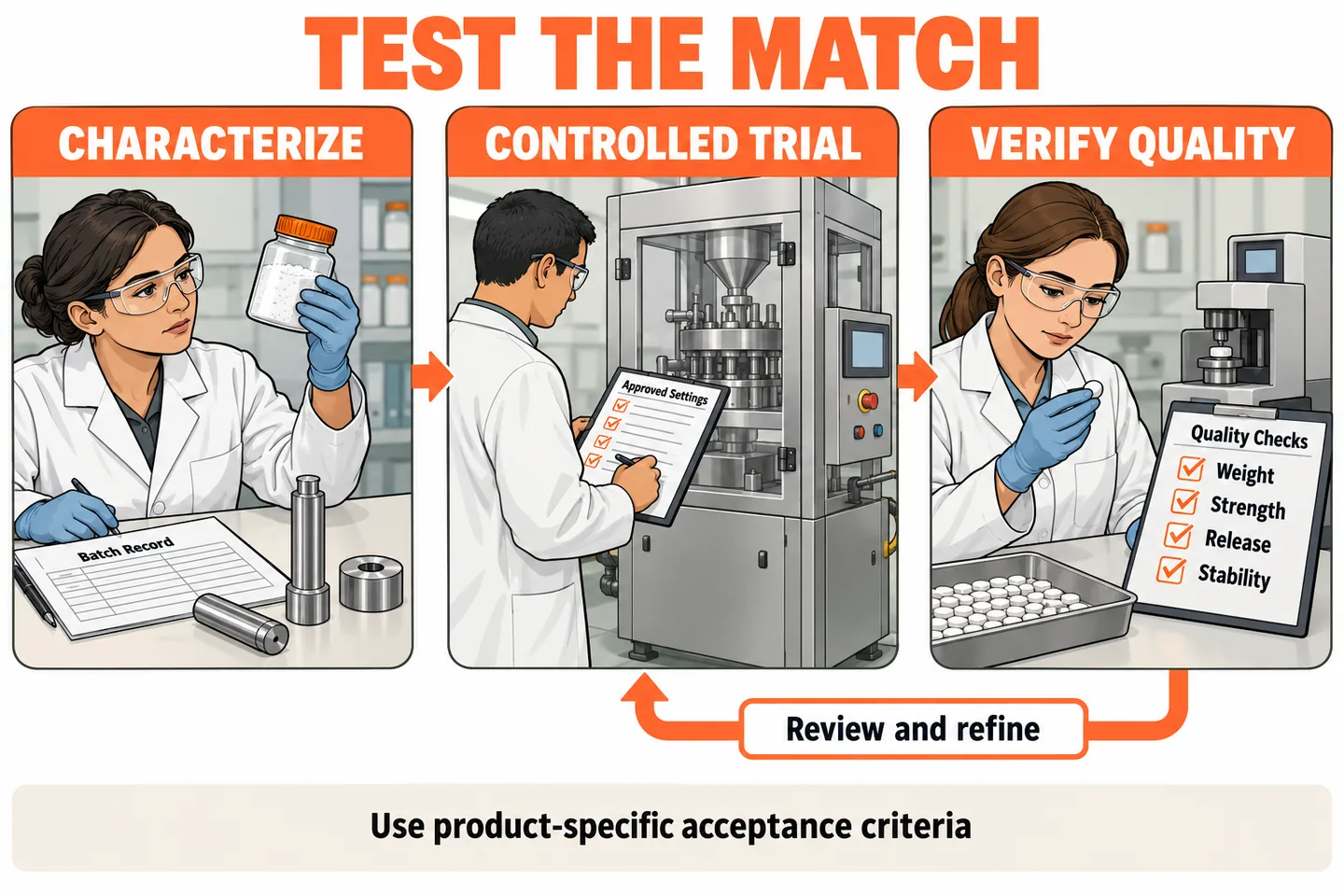
The following is a proposed worksheet structure, not a validated protocol. It helps a cross-functional team make a trial reviewable and prevents an attractive tablet surface from becoming the only measure of success.
- State the question: what specific result would support the proposed material, tooling or process change?
- Identify the inputs: material lots, formulation revision, tool-set identification, equipment and preparation records.
- Define the comparison: baseline conditions, planned changes and a reasoned experimental design when factors interact.
- Set boundaries: authorized equipment limits, monitoring arrangements, stop criteria and responsibility for decisions.
- Plan sampling: when and where samples are collected, how they are identified, and which observations are compared.
- Assess quality: applicable appearance, mass variation, assay/content uniformity, strength, friability, disintegration, dissolution and stability requirements.
- Record the outcome: observations that support the hypothesis, contradictory findings, uncertainties and the next decision.
A successful short trial is development evidence, not proof that a commercial process is validated. FDA’s process-validation guidance describes a lifecycle approach involving process design, qualification and continued verification. Decisions about implementation and continued monitoring need their own documented justification. FDA: Process Validation, General Principles and Practices.
For a pharmaceutical tableting transfer between sites or countries, compare the material grades, press and tooling configuration, environmental exposure, test methods and terminology. Record the actual units used. A setting copied from another facility is a hypothesis to evaluate, even when the nominal product and machine model appear similar.
Pharmaceutical tableting FAQs
Can one anti-stick coating work for every formulation?
No single coating should be assumed suitable for every formulation. Define the adhesion problem, confirm substrate and process compatibility, and compare performance under relevant conditions. Cleaning, inspection and tablet quality remain part of the assessment.
Should difficult powders always be wet-granulated?
No. Consider compatibility with water and heat, the required product performance and available development evidence. Direct compression or dry granulation may be suitable in some cases; wet granulation may be suitable in others. Difficulty on one trial does not decide the route by itself.
Is a room humidity limit of 45% suitable for all tablets?
No. A generic value cannot establish an acceptable exposure for every product. Use material and product studies to define justified environmental limits and hold times, then verify that the actual operation remains within them.
Will stronger punches prevent tablet capping?
Not by themselves. Punch strength concerns the tooling’s mechanical capability. Tablet capping requires investigation of the formulation, compression response, tool geometry and operating conditions. The two questions can overlap but should not be treated as equivalent.
What should I provide when requesting a tooling review?
Provide the observed defect, photographs, tool drawing and identification, press configuration, permitted loads, material information and relevant operating records. State which details are confirmed and which are suspected. This gives the supplier a clearer basis for a focused review.
Discuss the material, tooling and process as one system
For a pharmaceutical tableting enquiry, share the tablet drawing, intended output, known material challenges and available trial results. We can use that information to discuss equipment and rotary press tooling options that require further evaluation. Contact TabletPress Shop with your requirements; sensitive formulation details can be handled through an agreed communication process.
Sources and scope
The links below distinguish regulatory development guidance, original research and equipment or tooling manufacturers’ technical discussions. Manufacturer examples are application-specific; this article does not claim independent production trials or guaranteed improvements. Accessed 23 October 2026.
- FDA / ICH Q8(R2): Pharmaceutical Development
- I Holland: How to Avoid Sticky Situations
- I Holland: Alleviating Aspirin Issues
- Natoli: Tablet Tooling FAQs
- Natoli: Preventing Capping and Other Tablet Defects
- Appelhaus, Steffens and Wagner (2024): Liquid Load and Binder Type
- KORSCH / MEDELPHARM: Effervescent Tablets
- FDA: Process Validation, General Principles and Practices
3 thoughts on “Pharmaceutical Tableting: 6 Practical Checks for Better Results”
Comments are closed.