
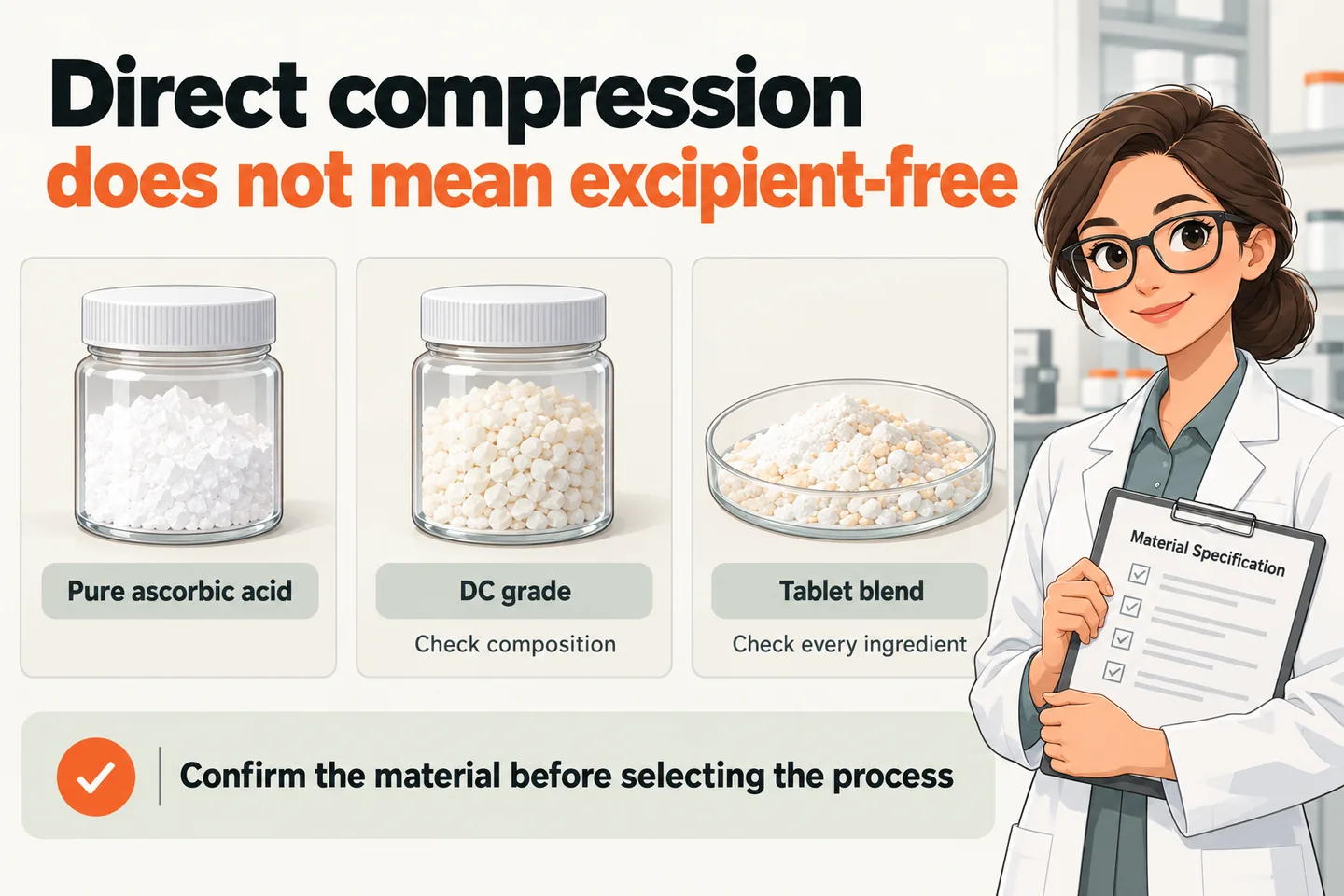
Vitamin C direct compression can simplify tablet manufacture when the selected material and formulation perform adequately. However, compressing pure L-ascorbic acid powder without excipients is a different development challenge from compressing a prepared vitamin C blend. A process described as “direct compression” does not automatically mean an excipient-free tablet.
Quick answer: Confirm the ascorbic acid grade and complete composition, then evaluate feeding, tablet formation, stability, tooling and press conditions together. A specialized grade or a developed formulation may behave differently from untreated powder. No particular coating, mirror finish, punch shape or pressure setting can establish that pure vitamin C will produce acceptable tablets.
This guide explains how to investigate capping, sticking, tablet-mass variation and discoloration in ascorbic acid tableting. It is intended for formulation, production and equipment discussions. It does not provide a validated manufacturing recipe, a clinical recommendation or a guarantee that a particular raw material can be compressed without additives.
On this page
What does vitamin C direct compression actually mean?
Direct compression generally describes forming tablets from a suitable powder blend without a separate granulation step in the tablet manufacturer’s process. Ingredients may already have been processed by their suppliers. The final blend can include a binder, filler, disintegrant, glidant or lubricant, depending on the product.
dsm-firmenich distinguishes straight vitamin C from granulated product forms for different applications. That distinction is a useful starting point when requesting material information, but the current specification and composition of the particular grade still need to be checked. dsm-firmenich: Vitamin C Product Forms.
- Pure ascorbic acid powder: identify its physical grade and whether the intended tablet must contain no other ingredients.
- Direct-compression grade: check particle preparation, assay and any binder, coating or carrier already present.
- Prepared tablet blend: document every ingredient and its function, including the lubrication approach.
“No added binder” is also different from “no excipients.” An investigation may use a lubricant even when the crystals were prepared without a binder. Keep these descriptions precise in specifications, trials and supplier enquiries so that a successful laboratory comparison is not mistaken for an excipient-free production process.
1. Define the material grade and formulation constraints
Start a vitamin C direct compression project with a clear product brief. Specify L-ascorbic acid if that is the intended material. Sodium ascorbate, calcium ascorbate and other vitamin C forms should not be treated as interchangeable powders simply because they provide vitamin C.
- Record the chemical identity, supplier, grade, lot and certificate of analysis.
- Confirm the composition of a granulated or coated ingredient, not just the vitamin name on the bag.
- State the intended vitamin C content per tablet and the basis used for the assay.
- Define the intended dosage form, tablet size and relevant quality attributes.
- Record whether excipients, particle engineering or a different preparation route are allowed.
If the brief requires pure powder with no formulation additives, treat that requirement as a feasibility question to investigate. First establish whether the selected material can feed, form tablets and eject under suitable conditions. Do not promise that purchasing more expensive tooling will overcome a material limitation.
Ask the supplier which properties are controlled for the grade and which require application testing. Compare the supplied particle data, handling history and intended use with your own observations. A chemical assay can confirm composition without demonstrating flow or tablet-forming performance.
For vitamin C direct compression, keep the product brief attached to the trial record. If a binder or another ingredient is introduced later, document the change explicitly. The resulting formulation may be useful, but it no longer answers the same excipient-free feasibility question.
2. Test flow and tablet formation as separate properties
A powder can feed reasonably well and still produce weak tablets. Another material can form strong compacts in a laboratory test yet feed inconsistently on the intended press. Evaluate both behaviors before deciding whether the difficulty lies in the formulation, feeding system or compression stage.
Kawashima and colleagues compared original ascorbic acid crystals with engineered spherical agglomerates. The agglomerates showed improved handling and compaction behavior, with changes in fragmentation, plastic deformation and elastic recovery. Their speed-dependent tableting tests included magnesium stearate. These results show that particle design and test conditions matter; they do not demonstrate an additive-free production recipe for untreated powder. Kawashima et al. (2002): Agglomerated Ascorbic Acid Crystals, KONA 20, pp. 251–260.
- Compare particle-size distribution and visible particle form between the candidate grades.
- Observe hopper discharge and die filling under a defined feeding condition.
- Record tablet mass, thickness, breaking force and friability using appropriate methods.
- Document capping, lamination or damage after ejection and after the specified hold.
- Record ejection behavior and the lubrication conditions used in each comparison.
For vitamin C direct compression, avoid explaining every defect as “hard crystals that spring back.” Particle rearrangement, fracture, deformation, bonding and unloading all contribute to the result. The practical question is how the actual grade responds under the intended conditions.
If a controlled trial shows poor feeding, investigate that issue before interpreting compression-force trends. If tablet formation remains inadequate with acceptable filling, reconsider the material or formulation. Our granule flowability guide and difficult-powder formulation guide provide related investigation questions.
3. Investigate moisture, exposure and discoloration
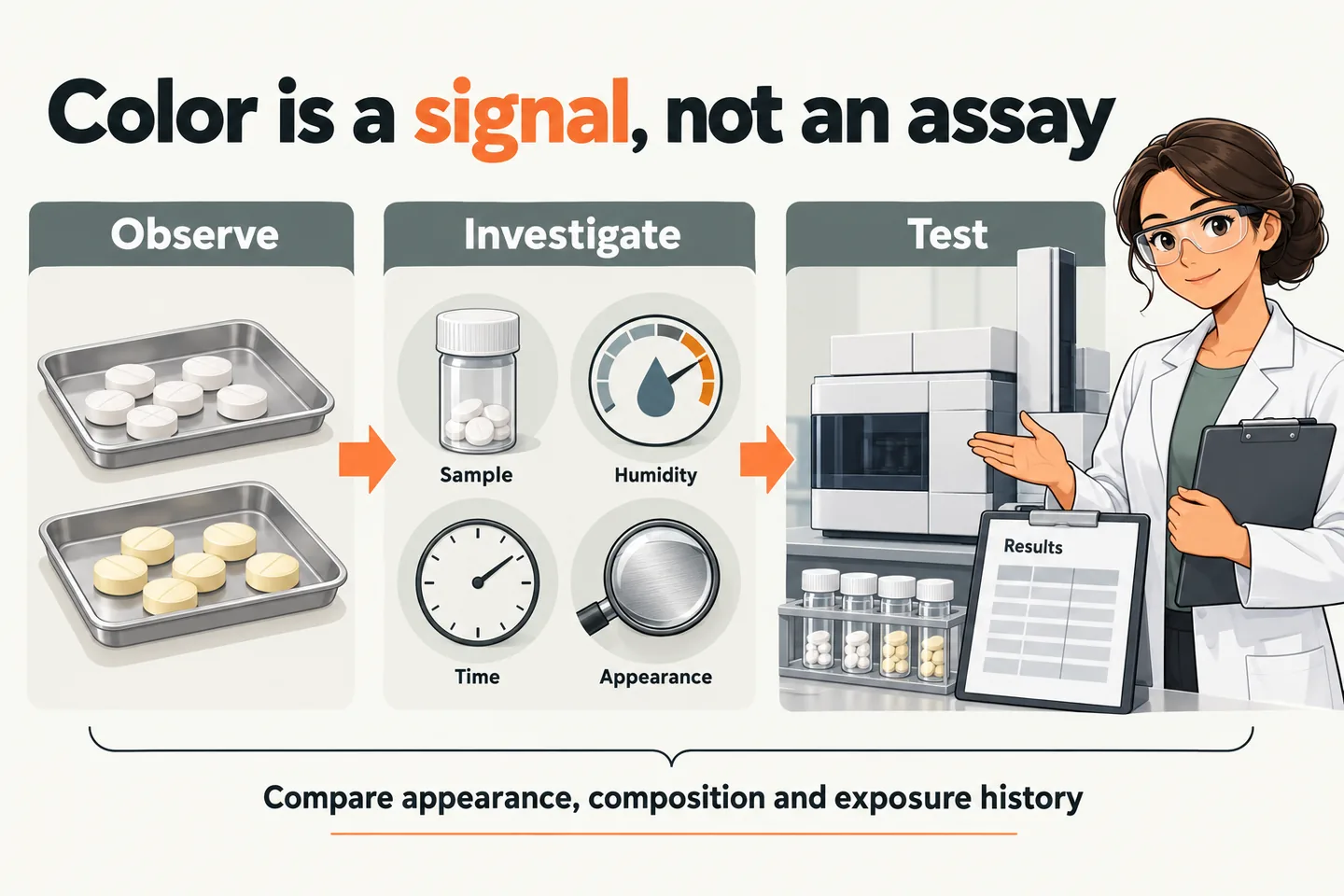
Stability is a separate part of vitamin C direct compression development. Skipping a wet-granulation and drying step may reduce certain exposures, but it does not establish the stability of the incoming powder, the finished tablet or the packaged product.
Research by Hiatt at Purdue examined how formulation, relative humidity, temperature and deliquescence affect vitamin C stability. Deliquescence is the uptake of enough atmospheric moisture for a crystalline solid to form a solution. The work found that vitamin form and co-formulated ingredients influence moisture behavior and degradation. It does not support describing every ascorbic acid powder as immediately sticky whenever it contacts air. Hiatt: Deliquescence, Formulation and Vitamin C Stability, Purdue University.
Ascorbic acid is a weak acid; its reducing behavior is a different chemical property from acid strength. A quoted solution pH needs a concentration and test condition. It is not a pH measurement of dry powder or, by itself, a tooling-corrosion specification.
Sigma-Aldrich’s chemical information describes the influence of oxygen and transition-metal ions on ascorbic acid in aqueous solution. That is relevant background for investigating possible moisture and contamination effects, but solution behavior should not be converted directly into a claim of instant degradation in a dry tablet. The cited material is laboratory information, not a production-grade ingredient recommendation. Sigma-Aldrich: L-Ascorbic Acid Chemical and Solution-Stability Information.
- Record incoming appearance against the material specification and a suitable reference.
- Track temperature, humidity, open-container time and transfer or storage conditions.
- Retain samples from before compression, during the run and after the relevant hold.
- Investigate contact surfaces or contamination when observations justify that hypothesis.
- Use suitable analytical tests to assess content and relevant degradation or impurity concerns.
Yellowing is a signal to investigate, not a quantitative assay of vitamin C loss. A white tablet is not proof of chemical stability either. Apply the approved appearance and analytical specifications when deciding material disposition; do not assume that changing the punch coating resolves every color change.
4. Select tooling from evidence, not a universal coating list
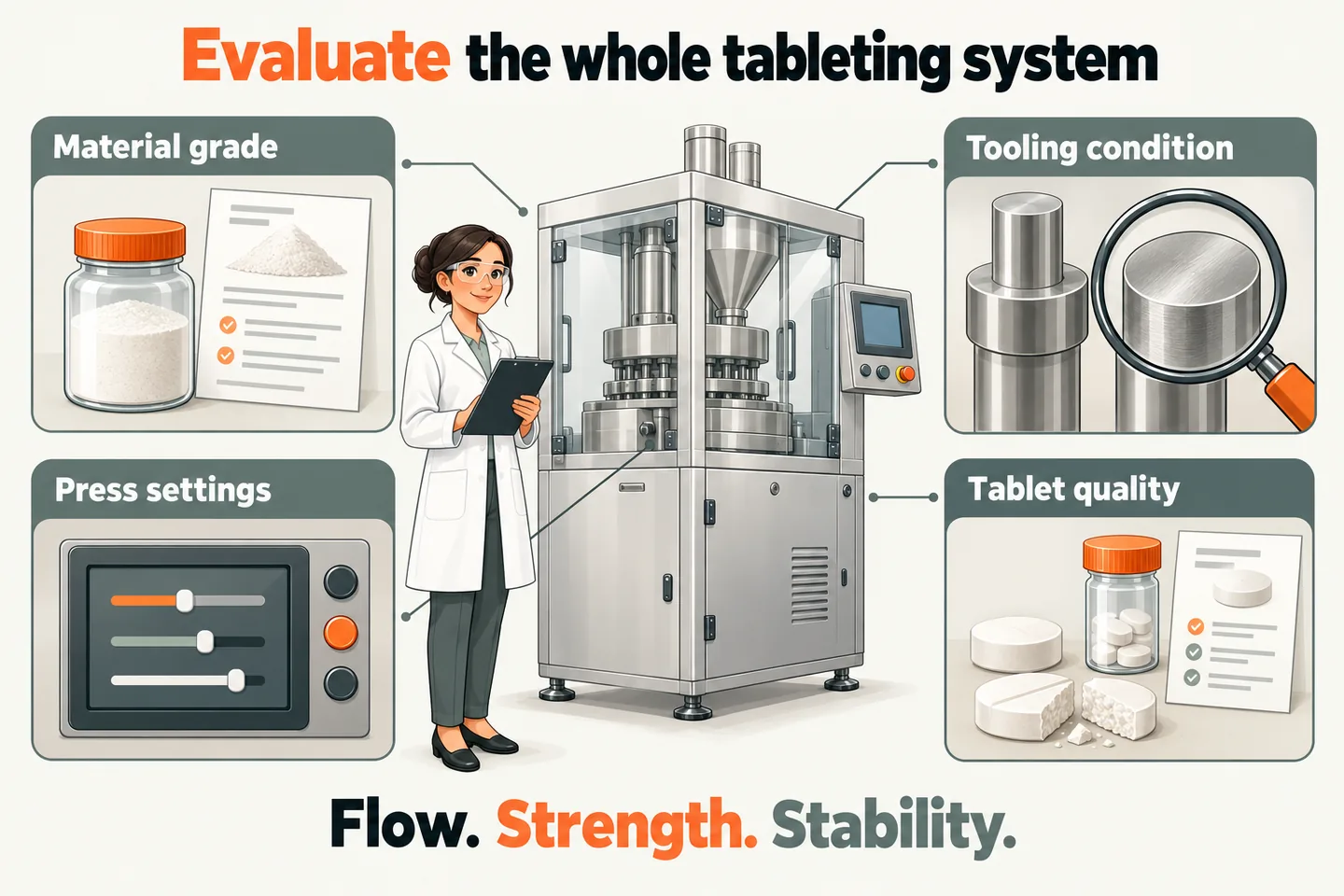
For vitamin C direct compression, assess the material in contact with the tooling and the conditions under which that contact occurs. Dry powder, damp residue and cleaning solutions are different exposure situations. Record the formulation, observed surface changes and cleaning history before specifying a replacement material.
Natoli’s tooling guidance treats material selection as application-specific and discusses trade-offs between wear resistance and toughness. It also notes that 440C, despite being corrosion-resistant, can rust or discolor. Carbide and stainless steel therefore should not be described as universally corrosion-proof solutions. Natoli: Tablet Manufacturing and Tooling FAQs.
Review the following points with the equipment and tooling supplier. They form an enquiry checklist, not a dimensional specification:
- Material: compatibility, toughness, wear and corrosion concerns for the actual application.
- Surface: existing finish, deposits, damage and the proposed treatment’s purpose.
- Geometry: tablet shape, cup profile, edges, score lines and markings.
- Fit: dimensions and tolerances from the approved drawing and equipment requirements.
- Care: compatible cleaning, drying, inspection and storage procedures.
I Holland explains that sticking can involve the formulation, tooling surface, equipment conditions and environment. Its technical discussion specifically challenges the assumption that a mirror finish always prevents sticking. Do not present a universal roughness limit or mandatory DLC or TiN coating as a proven solution for all ascorbic acid powders. I Holland / Tabletting Science: How to Avoid Sticky Situations.
Flat punches should not be categorically prohibited for all vitamin C-containing formulations. Roquette’s multivitamin example contains ascorbic acid and other ingredients and specifies a round flat punch. That is an example for a developed formulation, not evidence that the same geometry will work with pure powder. Roquette: Multivitamin Suckable Tablet Formulation for Direct Compression.
For a vitamin C direct compression trial, choose a defined tooling comparison and document the outcome. Inspect contact surfaces after the run using the site’s stop and isolation procedures. The tooling maintenance guide provides related care and inspection considerations.
5. Evaluate feeding and compression settings together
Precompression can be a useful trial variable, but its availability does not guarantee suitable tablets or chemical stability. It is a feature of the compression process and machine configuration, not a universal “anti-oxidation structure” built into a tooling set.
Natoli’s capping guidance discusses precompression, main compression, punch penetration, turret speed and tooling configuration. Their effects depend on the material and equipment, and increasing force is not always beneficial. Use these as investigation variables rather than prescribing one force ratio or speed reduction for every batch. Natoli: Preventing Capping and Other Tablet Defects.
- Confirm the press and tooling limits before defining the trial range.
- Document feeder configuration, hopper behavior and interruptions.
- Record actual precompression and main compression conditions with units.
- Compare speed and compression response using a defined sampling plan.
- Trend tablet defects, mass and relevant press signals over the run.
Vitamin C direct compression results should be compared at known conditions. “Low speed” on one press is not a complete specification for another. Preserve the equipment configuration and relevant timing information so the production team can assess what has changed during scale-up.
If a force feeder is being considered, test whether it improves filling without introducing other problems. More aggressive feeding is not a substitute for understanding the powder. Similarly, reducing speed may be a useful comparison, but the final decision should consider observed tablet quality and throughput together.
Use our precompression and main compression guide when planning the pressure comparison. Keep equipment adjustments within approved procedures, and stop for investigation when damage or unexpected operating behavior appears.
6. Confirm quality through storage and packaging
An acceptable tablet at the press is only one development result. Vitamin C direct compression also needs evidence that the intended tablet remains suitable through handling, packaging and the relevant storage period. Establish the applicable criteria before choosing the preferred trial.
- Composition: confirm identity, content and relevant impurity requirements.
- Consistency: assess tablet mass and the applicable dose-uniformity requirements.
- Physical quality: assess dimensions, breaking strength, friability and visible defects.
- Performance: use the appropriate disintegration or dissolution tests for the dosage form.
- Stability: evaluate the intended package and justified storage or handling conditions.
Do not use color alone as the stability endpoint or breaking force alone as the physical-quality endpoint. A change that produces a stronger compact can still require review of other product characteristics. Likewise, a protective package should be assessed as part of the product system rather than selected from an assumed universal shelf life.
ICH Q8(R2) connects pharmaceutical development with understanding material attributes, process parameters and product quality. It supports a reasoned control strategy, not a promise that a successful short trial validates routine production. Apply the framework within the relevant product and regulatory context. FDA / ICH Q8(R2): Pharmaceutical Development.
For vitamin C direct compression, document which questions remain open at the end of development. A trial report can conclude that a particular powder is unsuitable under the tested conditions. That is useful evidence for revising the grade, formulation or process brief before purchasing production equipment.
A practical defect-investigation checklist
| Observation | Evidence to collect | Shortcut to avoid |
|---|---|---|
| Sticking or picking | Record deposit location, timing, material exposure and surface condition. | Assuming the coating is the only cause. |
| Capping or weak tablets | Compare filling, formulation, compression conditions and post-ejection observations. | Increasing force without checking the response. |
| Yellowing or other color changes | Retain samples; compare appearance with analytical and exposure records. | Equating color with a measured amount of vitamin C loss. |
| Tablet-mass variation | Trend mass with feeder behavior, hopper level and sample time. | Assigning every variation to tooling dimensions. |
| Rust, pitting or unusual deposits | Inspect the affected surfaces and review material contact and cleaning history. | Assuming stainless steel cannot corrode. |
These questions help structure an investigation; they do not assign a root cause. Preserve the material and tooling evidence before making changes. Adding lubricant, replacing a grade or reprocessing a batch can change the product and should follow the site’s approved development, change-control or rework process.
Prepare a trial record that another site can understand
A concise vitamin C direct compression record should identify the question, baseline, materials, equipment and decision criteria. Include the full composition, sample locations, hold times and results, along with any conditions that limited the interpretation.
When transferring work between countries or facilities, compare ingredient specifications and test methods rather than relying on trade names. Distinguish ascorbic acid content from total tablet mass, and state whether a supplier assay is reported on a dried or as-received basis. Agree the intended market and product category with the responsible quality team.
For example, “the tablet looked good at the end of the run” is incomplete. A more useful record identifies the tested lot and formulation, the run conditions, the sampling interval, the measured quality results and the follow-up stability work. This supports a concrete discussion without inventing production-yield or shelf-life claims.
Vitamin C direct compression FAQs
Can pure ascorbic acid powder be directly compressed?
It requires a grade-specific feasibility assessment. Particle properties and test conditions matter, and evidence from an engineered or lubricated material cannot automatically be applied to untreated powder. Define whether “pure” excludes binders, lubricants and other ingredients before planning trials.
Does a direct-compression grade contain only vitamin C?
Not necessarily. Check the current composition and specification for that grade. The name describes its intended processing use, not an assurance that it contains no binder, coating or other excipient.
Does yellowing prove that a vitamin C tablet has failed?
Color change warrants investigation and may fail an appearance specification, but it does not quantify remaining vitamin C. Assess the product against its approved appearance and analytical criteria. A normal appearance does not replace content or stability testing.
Are DLC-coated punches mandatory for ascorbic acid?
No universal requirement is established here. Select compatible tooling and surface treatments for the actual formulation, machine and failure mode. Compare performance under defined trial conditions rather than assuming one coating solves sticking and corrosion together.
Does precompression prevent vitamin C oxidation?
It is not a substitute for stability controls. Evaluate precompression for its effect on tablet formation, and investigate chemical stability separately through material, exposure, analytical and packaging studies.
Discuss the material before specifying the machine
For a vitamin C direct compression project, share the material grade, complete formulation or excipient restriction, intended tablet dimensions, output and trial results. Contact TabletPress Shop to discuss the equipment questions and rotary press tooling options that need further evaluation.
Sources and scope
Sources include original research, manufacturer technical information and pharmaceutical development guidance. Laboratory results and supplier examples apply to their stated materials and conditions. This article does not claim validated production performance or clinical benefit. Technical review remains appropriate before applying changes. Accessed 23 October 2026.
- dsm-firmenich: Vitamin C Product Forms
- Kawashima et al. (2002): Agglomerated Ascorbic Acid Crystals, KONA 20, pp. 251–260
- Hiatt: Deliquescence, Formulation and Vitamin C Stability, Purdue University
- Sigma-Aldrich: L-Ascorbic Acid Chemical and Solution-Stability Information
- Roquette: Multivitamin Suckable Tablet Formulation for Direct Compression
- I Holland / Tabletting Science: How to Avoid Sticky Situations
- Natoli: Tablet Manufacturing and Tooling FAQs
- Natoli: Preventing Capping and Other Tablet Defects
- FDA / ICH Q8(R2): Pharmaceutical Development