
Granule moisture variation can contribute to inconsistent feeding, sticking and tablet quality, but those symptoms do not confirm uneven water distribution. A batch with both sticking and capping may have several interacting problems. The useful question is whether representative measurements show a meaningful moisture difference, and whether that difference explains the observed behavior.
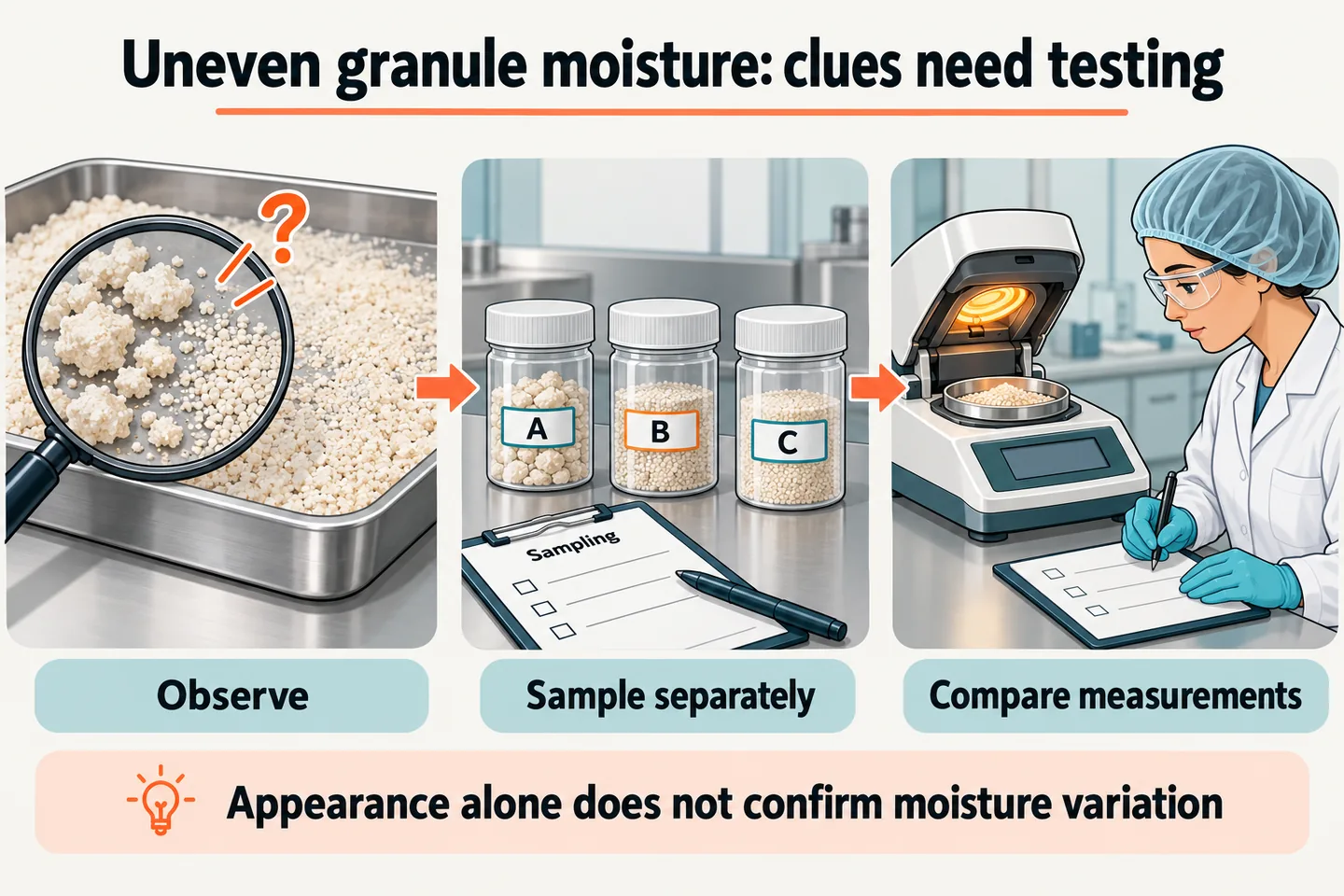
Quick answer: Investigate suspected uneven moisture by collecting separate, identified samples across relevant locations or process times, protecting them from moisture exchange, and testing them with a suitable method. Compare individual results with method variability and product-specific criteria. Appearance, touch, color and tablet defects are investigation clues, not standalone proof.
This guide explains how to turn workshop observations into a documented investigation. It covers sampling, sample handling, loss on drying, Karl Fischer titration, near-infrared measurement and the connection to tableting. It does not prescribe a universal moisture target, sampling count or manufacturing correction.
On this page
What does uneven granule moisture mean?
Uneven granule moisture means the relevant moisture or water measurement differs among portions of the material beyond what the sampling and analytical method can reasonably explain. The difference might occur between containers, within a material bed, among particle fractions, or over the course of discharge. These are different investigation questions and may need different sampling plans.
A suitable batch average does not establish uniformity. Conversely, a uniform batch may still be too wet or too dry for its intended use. Evaluate both the level and distribution against the product’s requirements, using the same measurement method and reporting basis.
Specify what the reported value represents. A loss-on-drying result measures mass lost under defined heating conditions; a water-specific method answers a different analytical question. Labeling both simply as “moisture %” can hide a method mismatch. Preserve the method name, units and sample preparation in every comparison.
Which shop-floor clues deserve investigation?
Clumps, fines, changes in color or irregular feeding can justify checking granule moisture. Record them without assigning a cause prematurely. A color difference can reflect composition or particle properties, and a hard lump does not prove that its interior is wet. Use appropriate sampling tools and handling procedures rather than bare-hand squeezing as a release test.
| Observation | Why it is worth checking | Other explanations to examine |
|---|---|---|
| Clumps mixed with loose fines | Different portions may have experienced different processing or exposure. | Binder distribution, sizing, compaction history or segregation. |
| Different appearance or color | The difference may identify samples worth comparing. | Composition, particle size, lighting or material degradation. |
| Sticking and capping in the same run | Multiple material or operating conditions may be changing. | Lubrication, trapped air, compression conditions or tooling. |
| Variable tablet mass or breaking force | Feeding or tablet formation may be inconsistent. | Particle distribution, feeder settings, press variation or testing differences. |
| Irregular ejection or unusual equipment noise | The process needs prompt assessment under site procedures. | Deposits, wear, alignment, lubrication or mechanical faults. |
Natoli’s sticking guidance identifies several formulation and operating influences, including moisture, lubricant level and compression force. Therefore, the combination of sticking and cracking should trigger a broader investigation, not a “100% moisture” diagnosis. Natoli Engineering: How to Avoid Sticking and Picking.
Do not assign a fixed direction to every quality change. Wetter material does not always produce lighter or softer tablets, and drier material does not always produce heavier or harder ones. The response depends on the formulation, filling, deformation, bonding and operating conditions.
1. Design a sampling plan that preserves location and time
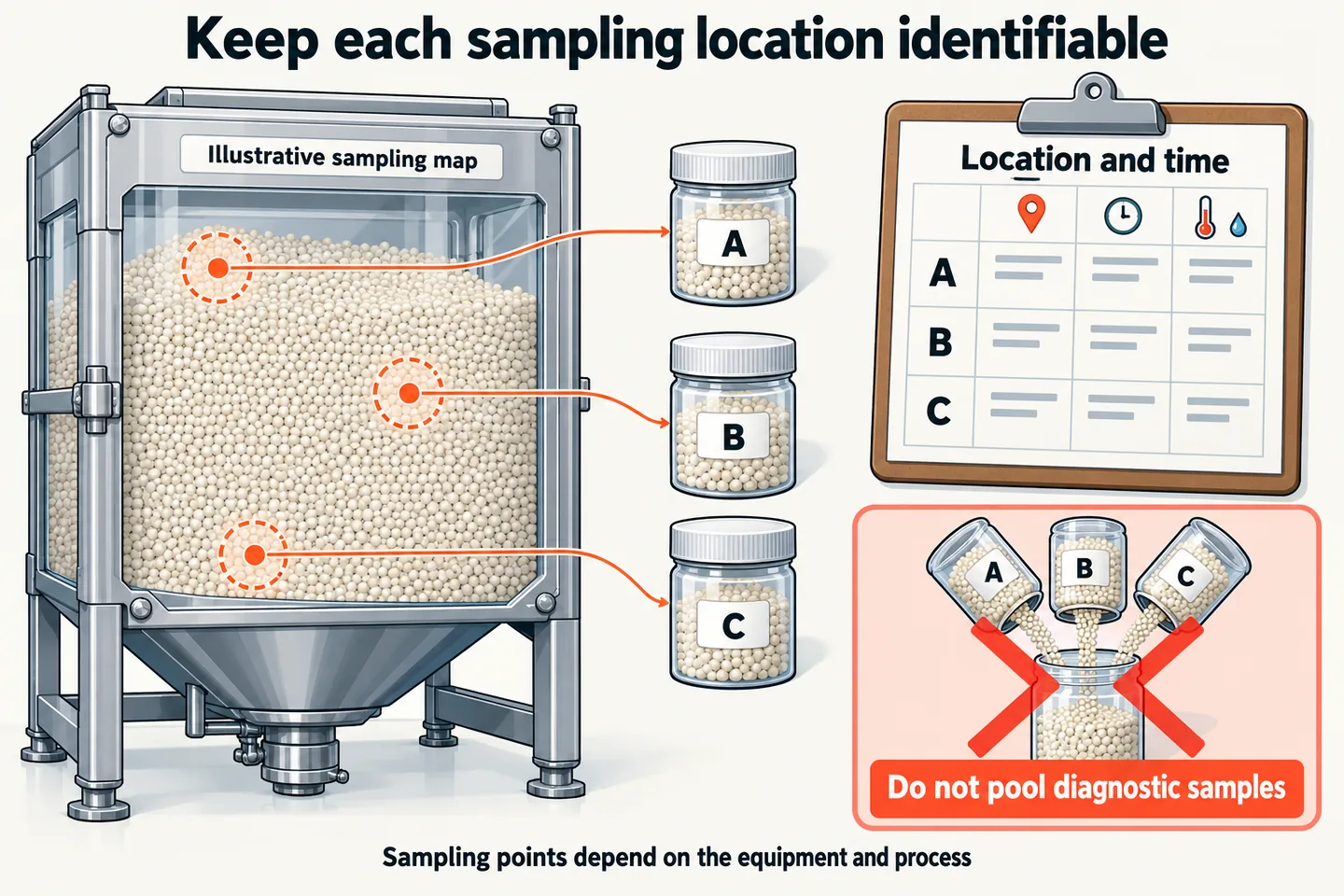
Begin with the specific concern. If you suspect variation across a dryer load, identify relevant positions or discharge intervals. If the problem appeared after storage or transfer, compare those stages. Sampling only the easiest surface location may answer a different question from the one being investigated.
Research on fluidized-bed drying notes that maldistribution can make the material observed by a measurement unrepresentative of the overall bed. A sophisticated sensor cannot remove that limitation by itself. Plan where the sample or measurement comes from, not just which instrument will analyze it. Monitoring Fluidized Bed Drying of Pharmaceutical Granules.
- Define the batch, process stage and suspected pattern before taking samples.
- Choose locations, containers or time intervals that address that pattern.
- Use suitable equipment and approved access arrangements; do not reach into operating machinery.
- Keep diagnostic samples separate and identify each location or collection interval.
- Record the sampling tool, method, sample amount, time and relevant process condition.
A composite sample can be useful for some average measurements, but pooling material can conceal the local variation you are trying to detect. For a granule moisture investigation, retain the individual identities when the question is spatial or time-dependent uniformity. Do not mix the batch first and then claim that the original distribution was uniform.
The number of samples should reflect the equipment, batch size, expected variation and investigation objective. Three positions in an illustration are not a universal sampling requirement. Consider whether the sampler preferentially collects fines or coarse particles, and document any inaccessible or unrepresented part of the batch.
2. Protect samples between collection and analysis
A sample may gain or lose water while waiting in an open container. Differences in transport, cooling, opening time or preparation can then appear as batch differences. Establish a consistent handling procedure and record the elapsed time from collection to testing.
- Use suitable clean containers and closures for the material and selected method.
- Close samples promptly and label them without losing their location or time identity.
- Record storage and transport conditions, including unusual temperature or humidity exposure.
- Control the interval and procedure for opening, weighing and preparing each sample.
- Preserve a separate retained portion where the investigation plan requires follow-up analysis.
Metrohm’s oven-based Karl Fischer guidance describes tightly sealed sample vials and controlled thermal extraction. Such preparation illustrates the importance of protecting samples and choosing conditions that release the relevant water without introducing unsuitable thermal effects. The required setup still depends on the material and method. Metrohm: Oven Method for Sample Preparation in Karl Fischer Titration.
Do not add an unplanned grinding, drying or equilibration step merely to make samples easier to compare. Preparation may be necessary, but it must match the validated or justified method. For granule moisture mapping, excessive handling can erase the difference of interest before it is measured.
When investigating a suspected wet core within individual granules, a bulk result cannot establish the internal profile on its own. Identify whether you need evidence about the whole sample, a particle-size fraction or individual particles. Avoid claiming “dry outside, wet inside” from a surface photograph or a single bulk average.
3. Select and verify the analytical method
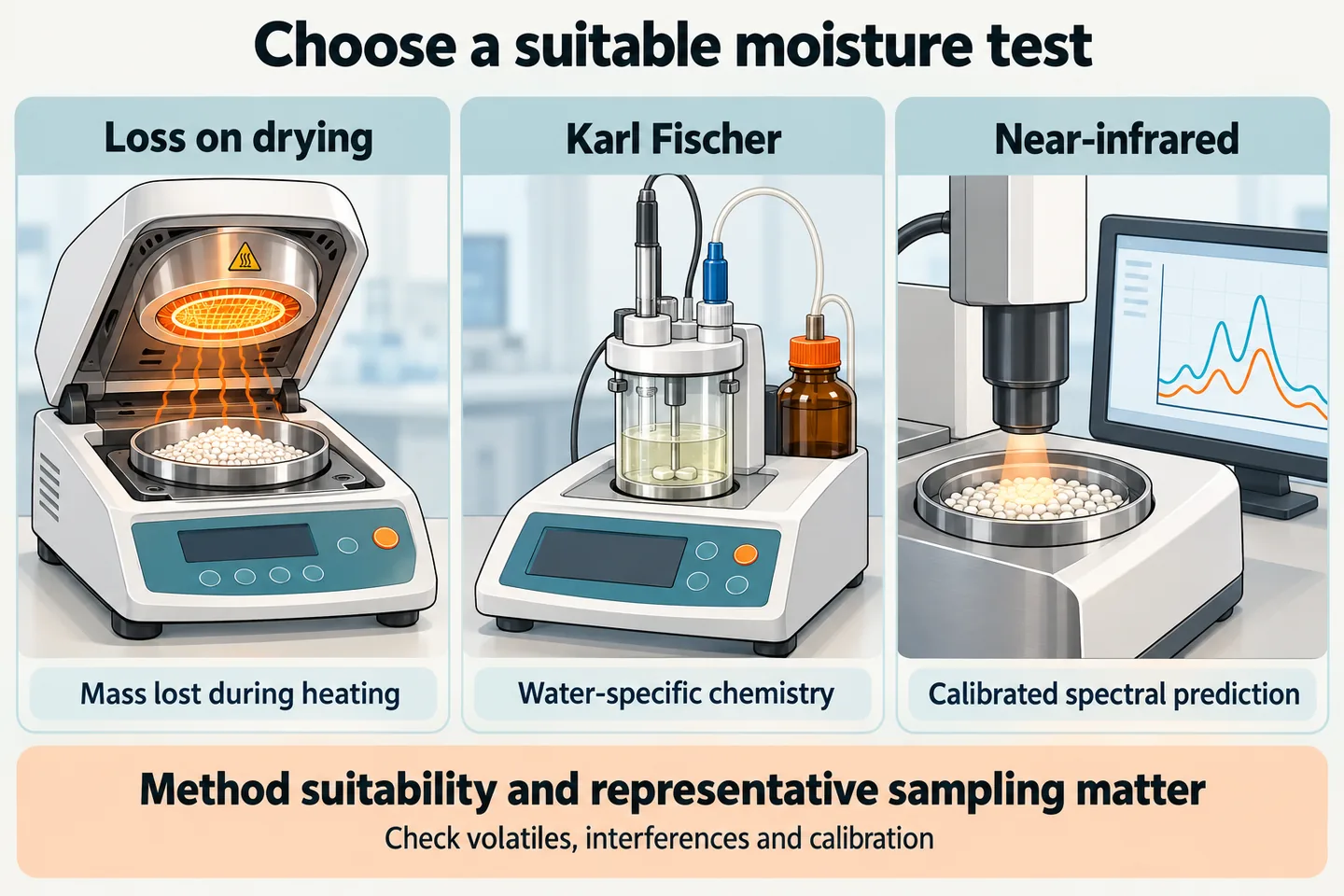
The best granule moisture test is the method shown to be suitable for the intended measurement and material. Fast analysis is useful only when the result has a clear meaning. Keep comparisons on a consistent method, or establish the relationship between methods before combining their results.
Loss on drying and halogen moisture analyzers
Loss on drying measures the mass change under specified conditions. Water may contribute, but other volatile substances or thermal decomposition can also affect the result. A halogen moisture analyzer uses heating and weighing to follow this change. METTLER TOLEDO emphasizes sample preparation, method development and comparison with a reference procedure. METTLER TOLEDO: Guide to Moisture Analysis.
Document the sample amount, preparation, heating program and endpoint criterion. Check the balance and heating performance according to the applicable procedure. Do not assume that a familiar oven temperature or an automatic endpoint is suitable for every extract, binder or granulated formulation.
Karl Fischer water determination
Karl Fischer titration is intended to measure water specifically. Method suitability still matters: water must be extracted or released adequately, and interfering reactions must be considered. Metrohm’s monograph discusses sample preparation, side reactions and the distinction from drying loss. A different result from loss on drying is therefore not automatically an instrument fault. Metrohm: Water Determination by Karl Fischer Titration.
Choose direct analysis, extraction or an oven approach through appropriate method work. Record the relevant preparation, blank and performance checks. If a method releases only part of the water of interest, repeatable results alone do not demonstrate that it measures the intended quantity.
Near-infrared measurement
Near-infrared spectroscopy can provide rapid measurements when its calibration is suitable for the material and process. A pilot-scale fluidized-bed study developed moisture models using separate calibration and validation batches. Its approach illustrates why model performance must be demonstrated over relevant conditions. Accuracy Improvement of In-line Near-Infrared Spectroscopic Moisture Monitoring in a Fluidized Bed Drying Process.
Check the reference method, calibration range, sample presentation and ongoing model performance. A probe measures the material presented to it; one reading does not automatically describe every part of a bed. Changes in formulation, particle properties or process conditions may require reassessment rather than continued use of an unexamined model.
Research on near-infrared chemical imaging has examined moisture and size distributions in pharmaceutical granules after fluid-bed drying. This provides an example of a more detailed investigation approach, not a requirement that every production site purchase an imaging system. Two-Dimensional Moisture Content and Size Measurement of Pharmaceutical Granules Using Near-Infrared Chemical Imaging.
4. Compare individual results, variation and measurement uncertainty
For granule moisture uniformity, retain the individual values alongside the average. Organize them by location, container, particle fraction or collection time. Review the range and other suitable statistics, together with the method’s precision and the limitations of the sampling plan.
| Illustrative sample set | Individual results on the same basis | Mean | Range |
|---|---|---|---|
| A | 2.9%, 3.0%, 3.1% | 3.0% | 0.2 percentage points |
| B | 2.0%, 3.0%, 4.0% | 3.0% | 2.0 percentage points |
Illustrative arithmetic only: These invented values demonstrate that equal means can hide different spreads. They are not production results, moisture targets or acceptance limits. Neither sample set can be classified as acceptable without a justified specification, a suitable method and adequate sampling.
Repeated analyses of aliquots from one container help assess analytical repeatability. Independently collected samples address a different question about sampling and material variability. Do not treat three repeat readings from the same preparation as proof that three parts of the batch have the same water content.
- Check units, wet- or dry-basis reporting and preparation before comparing numbers.
- Preserve individual results and document unusual values rather than averaging them away.
- Compare differences with relevant method precision and uncertainty information.
- Look for patterns across locations or time, not only an overall pass/fail average.
- Apply a justified investigation and disposition procedure if results exceed established criteria.
There is no universal acceptable range or relative standard deviation for all granule moisture measurements. Criteria need to reflect analytical capability and the product’s performance requirements. If evidence is inconclusive, state what the available samples can and cannot establish before deciding on additional work.
5. Connect moisture results with the tableting observations
A measured moisture difference does not yet prove that it caused a defect. Link the identified material to tablets made under recorded conditions. Capture when sticking, capping, mass variation or ejection changes appeared, including interruptions and adjustments during the run.
- Record particle-size distribution, fines and binder or lubrication history when relevant.
- Keep feeder configuration, speed, compression conditions and tooling identity traceable.
- Compare tablet mass, dimensions and breaking force using consistent test methods.
- Assess friability, disintegration, dissolution or other product attributes where applicable.
- Use a planned comparison to separate a moisture contribution from simultaneous process changes.
Do not infer dissolution failure or clinical performance from an uneven-looking granule sample. Those conclusions require the applicable product tests and evidence. Similarly, a compliant granule moisture result does not establish that every other quality attribute is acceptable.
For related investigations, see our granule flowability guide, tablet sticking guide and precompression and main compression guide. Use these to organize alternative hypotheses when the moisture measurements do not explain the observed defects.
6. Investigate the source and verify the proposed control
Once the granule moisture pattern is credible, review where it may have arisen. Relevant stages can include liquid addition, granulation, drying, transfer and bulk storage. Compare the actual records with the intended process rather than selecting a correction from appearance alone.
A segmented fluid-bed drying study identified incoming material properties, granulation conditions, air temperature, humidity and airflow as influences on residual moisture. These interacting variables explain why a single dryer setting is an incomplete description of the process. End-Point Prediction of Granule Moisture in a Segmented Fluid Bed Dryer.
- Check binder preparation and liquid distribution against the process record.
- Review loading, drying conditions, endpoint assessment and relevant equipment behavior.
- Examine transfer routes, container closures, holds and environmental exposure.
- Define the proposed change and the evidence needed to assess its effect.
- Repeat appropriate sampling and product testing after the change, retaining the earlier results.
Additional blending does not necessarily correct internal moisture differences, and extra drying can create new problems. Neither should be an automatic response. Decide whether a proposed conditioning, reprocessing or equipment change is appropriate through the site’s established quality and technical review process.
FDA’s process analytical technology framework supports understanding and controlling manufacturing through appropriate measurements. It is not a claim that installing a sensor alone establishes process control. FDA: Process Analytical Technology Framework.
ICH Q8(R2) provides a development framework connecting material attributes and process parameters to product quality. Use that relationship to justify a granule moisture control strategy and its limits. An improvement observed in one trial should be confirmed over the conditions relevant to the intended process. FDA / ICH Q8(R2): Pharmaceutical Development.
A concise investigation record for production and laboratory teams
Use a shared record so that laboratory results can be traced back to the actual material and process stage. When comparing work between sites or countries, record temperatures in °C, humidity in %RH and the analytical reporting basis. Descriptions such as “dry room” or “normal moisture” are not sufficient for a technical comparison.
- Material: product, formulation version, batch, supplier lots and processing route.
- Sampling: location or time interval, tool, sample identity, amount and collection conditions.
- Handling: container, closure, preparation, storage and time to analysis.
- Method: instrument, procedure version, settings, calibration or model identity and checks.
- Results: individual values, units, statistics, repeat analyses and observed limitations.
- Decision: supporting evidence, alternative explanations, responsible review and next action.
Keep observations and interpretations in separate fields. “Clumps in sample B” is an observation; “sample B retained more water” requires suitable measurements. This distinction makes the record easier to review and reduces the chance that an early assumption becomes an unsupported batch conclusion.
Frequently asked questions about granule moisture
Can appearance or touch confirm uneven water content?
No. They can identify a reason to investigate, but color, clumping and texture are influenced by more than water. Use representative samples and an appropriate analytical method to assess the suspected difference.
Does simultaneous sticking and capping prove moisture nonuniformity?
No. Both defects can involve material, lubrication, compression or tooling factors. Keep moisture on the investigation list, then compare measurements and process evidence before assigning the cause.
Is one mixed sample enough to assess uniformity?
A composite may support an average measurement, but it can hide variation among the portions combined. When the objective is to assess differences across locations or time, use a justified plan that preserves individual sample identities.
Should loss on drying and Karl Fischer give identical results?
Not necessarily. They measure different analytical responses and may release or detect different components under their specified conditions. Establish method suitability and any expected relationship before treating the values as interchangeable.
What is the correct moisture percentage for tablet granules?
There is no single percentage suitable for every formulation and route. Establish product-specific criteria using an appropriate method and evidence linking the material condition to processing and finished-product quality.
Prepare a focused equipment enquiry
For a granule moisture investigation involving equipment, share the processing route, sampling map, measurement method, individual results and the timing of the observed tableting issue. Include the dryer or press configuration and relevant environmental conditions. That record is more informative than asking for a machine adjustment based only on a photograph.
Our granulation quality guide and granule strength guide provide related process questions. Use the contact page to discuss the equipment information needed for a defined trial.