
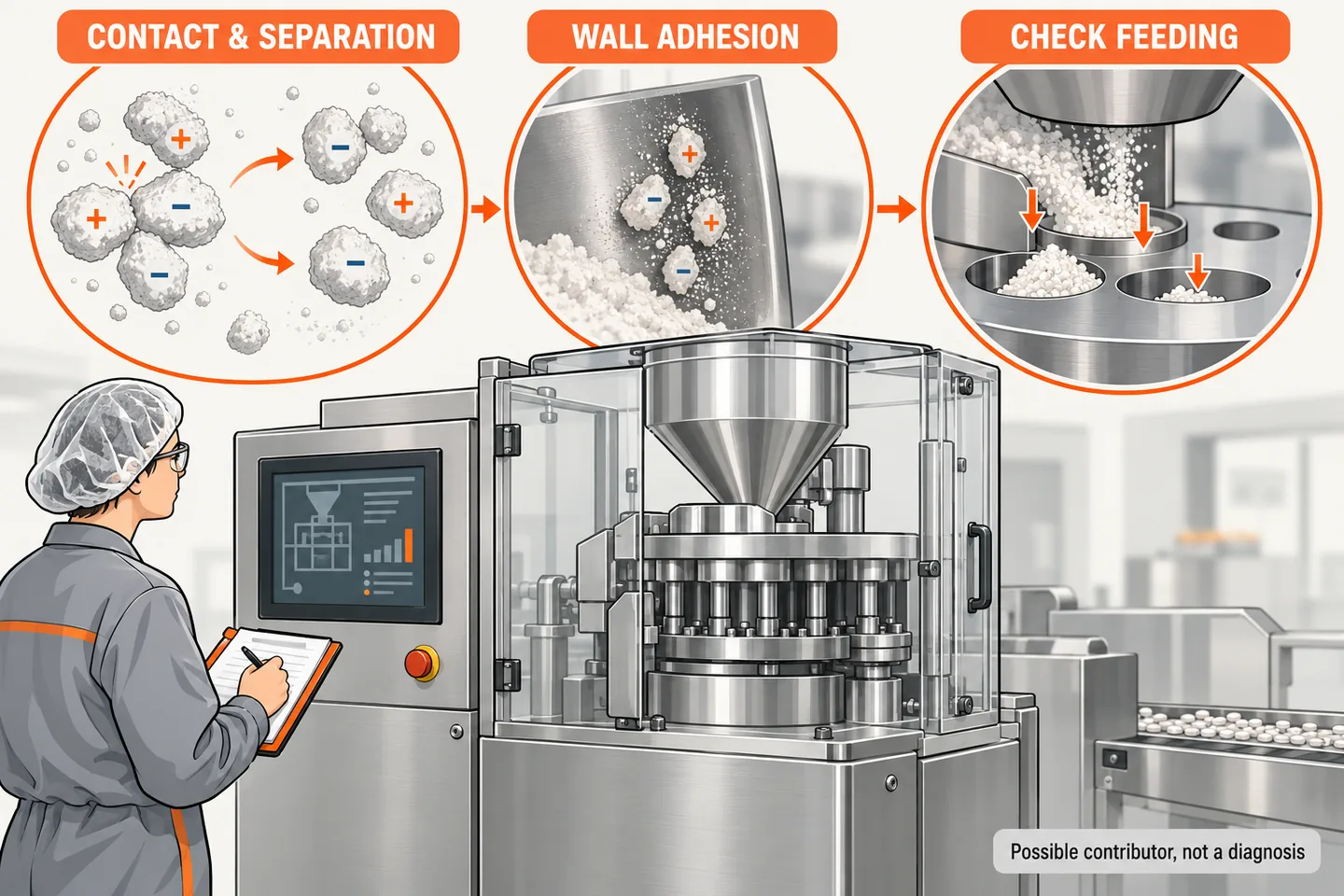
Static electricity in tableting can contribute to powder adhesion, uneven feeding and changes in blend behavior. It deserves investigation when a powder begins clinging to transfer surfaces or the feed pattern changes after a handling step. These observations are clues, however, not a diagnosis. Moisture, particle size, feeder setup and tooling condition can produce similar symptoms.
Quick answer: Investigate static by comparing charge measurements with powder flow, environmental conditions and tablet results. Check equipment bonding and grounding, then evaluate changes within the material’s approved processing window. A response to humidity or a grounded hopper alone does not establish that electrostatic effects are under control.
The seven checks below help organize a technical investigation. They do not prescribe one humidity target, antistatic additive or operating speed for all formulations. Keep equipment changes and product decisions within the relevant engineering, formulation and quality procedures.
On this page
1. Understand how static electricity in tableting develops
Powder particles repeatedly contact and separate from one another and from equipment during blending, transfer and feeding. This contact electrification, often called tribocharging, can leave charge on the surfaces involved. Sliding friction is one route, but visible rubbing is not required. The resulting behavior depends on both the powder and the surface it touches.
A charge can persist when there is no effective path for it to dissipate. Many pharmaceutical ingredients have low conductivity. Smaller particles may be particularly sensitive to electrostatic forces relative to their weight, but fine-powder percentage alone does not predict the sign or magnitude of charge. Surface condition, material composition and handling history also matter.
Research on pharmaceutical powders has used controlled contact with stainless steel and noncontact sensing to compare chargeability. That approach illustrates why the contact material and measurement conditions belong in the test record. It does not provide a universal acceptable charge value for every tablet blend. Measuring the chargeability of pharmaceutical powders (2006).
| Factor to record | Why it is relevant | Avoid assuming |
|---|---|---|
| Powder grade, lot and particle-size distribution | The same ingredient name can cover different surface and bulk properties | Every fine powder charges identically |
| Transfer route and contact materials | Hoses, liners, feeders and containers change the contact history | Metal equipment prevents all charging |
| Relative humidity, temperature and conditioning time | These influence material-water interactions and charge decay | Higher humidity always reduces charge |
| Speed, residence time and previous processing | The charging and dissipation balance can change during handling | Lower speed or a waiting period is automatically sufficient |
2. Follow powder adhesion through to feeding and tablet weight
When investigating static electricity in tableting, start with the powder path: container, transfer line, hopper, feeder and die-filling zone. Record where residue accumulates, when it first appears and whether it releases intermittently. A photograph after shutdown is useful, but it should be matched to the operating timeline and the affected material lot.
Adhered material may reduce the amount reaching the feeder, while intermittent release may disturb delivery. Whether either mechanism changes tablet mass depends on the extent of deposition and the press’s filling and control behavior. A light dusting on a wall does not establish a meaningful loss of feed or a change in die volume.
A 2023 study of direct-compression isomalt and mannitol grades measured both feeding performance and process-induced charge. The grades differed in charging and adhesion, and pre-blending changed the response under the tested conditions. This supports measuring the actual material and process together, rather than selecting a remedy from ingredient name or particle size alone. Beretta and colleagues: charge and continuous feeding of polyols (2023).
Compare the mean tablet mass and its variation at identified sampling points, including startup, steady operation and hopper refill where relevant. Use a consistent sampling plan and a suitable balance. Check feeder seating, powder supply, metering settings and mechanical condition in parallel. A force-control trend can support an investigation, but it is not a direct weighing result.
If flow is inconsistent before the powder enters the press, review the granule flowability guide. Keep the distinction between a charging problem and a general flow problem: several mechanisms can coexist, and a change that improves one may worsen another.
3. Check blend consistency without assuming charge is always harmful
Static electricity in tableting can change how particles interact. Oppositely charged particles may attract, while similarly charged particles may repel. In a real blend, cohesion, particle size, density and handling also influence the result. Electrostatic attraction may sometimes support an adhesive mixture, so eliminating as much charge as possible is not automatically the best formulation objective.
Pu and colleagues investigated two model systems containing caffeine with lactose or microcrystalline cellulose. Uncontrolled charging was associated with poorer homogeneity, but minimizing charge was not uniformly beneficial; deliberately opposite charging of ingredients improved mixing in their experiments. This is evidence of a material-specific response, not a recommendation to install a charging system on a production line. Pu and colleagues: electrostatic charging and blend homogeneity (2009).
Another study related charge measurements at different blender locations to homogeneity in three model formulations. Such measurements may be useful during development, but their correlation does not replace a suitable content-uniformity method for a different product. Hao and colleagues: charge measurements and powder blending (2013).
For a suspected segregation problem, compare representative material at agreed locations and times. Check the transfer after blending as well as the blender itself. Confirm whether active ingredient concentration actually changes; similar tablet weights do not prove equal composition. Keep the sampling method consistent because sampling and transfer can alter the charge being investigated.
4. Separate possible static effects from other tablet defects
Powder adhesion can occur alongside sticking, surface marks or unstable tablet strength. None is specific to static electricity in tableting. Before assigning a mechanism, examine retained powder and tablets, review the compression record, and check the condition of the tooling. Investigate a visible deposit as a deposit first, then establish what produced it.
| Observed problem | What to examine | What the observation does not prove |
|---|---|---|
| Powder on punch faces or feeder walls | Charge, moisture, residue, surface condition and material adhesion | That static is the only source of sticking |
| Spots, pits or chipped edges | Material identity, contamination, filling, tooling and handling | That electrostatic agglomerates caused the mark |
| Variable breaking force or friability | Tablet mass, thickness, compression history and formulation | That charge directly weakened every tablet |
| Changed disintegration or dissolution | The required product tests and any formulation or process changes | That a cleaner feeder guarantees equivalent performance |
| Punch drag, unusual noise or wear | Safe mechanical inspection, clearances and contamination | That antistatic measures will repair damaged tooling |
Do not assume that electrostatic agglomerates always create porous, weak tablets, or that charged fines preferentially collect magnesium stearate in every blend. These proposed explanations require evidence from the actual formulation. Mechanical properties and drug-release behavior have several interacting causes; assess them separately from the appearance of the powder.
For intrusive inspection or cleaning, isolate the machine using its approved procedure. Keep potentially affected material identified for quality review. The tablet sticking and lubricant guide and tooling maintenance guide provide related checks when surface condition or mechanical faults remain plausible.
5. Measure static electricity in tableting with a controlled comparison
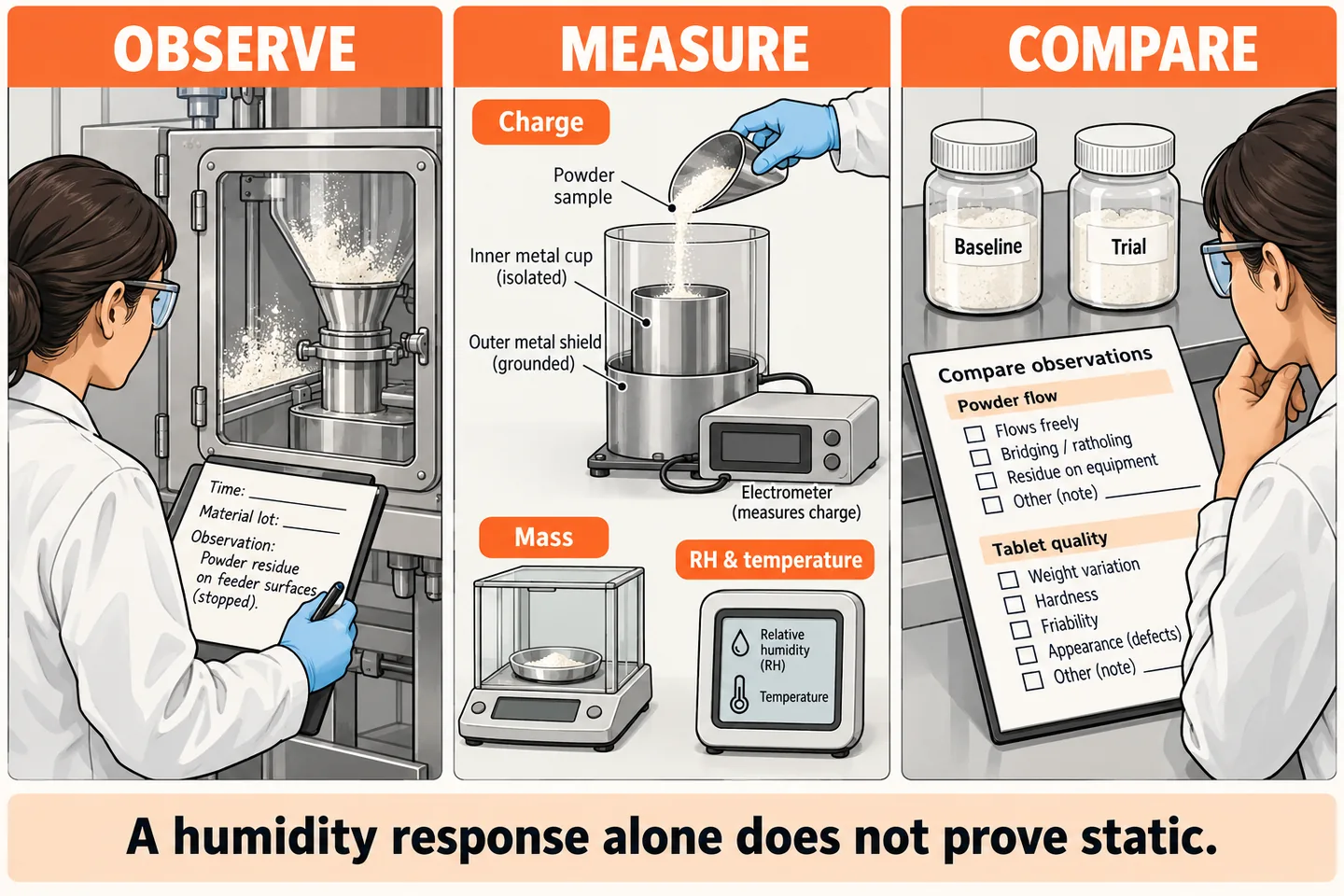
A useful investigation combines observations, a repeatable measurement method and a planned comparison. Changing humidity, speed and lubricant together may make symptoms disappear while leaving the cause uncertain. Start with a baseline and define what evidence would support or weaken the static hypothesis before making the next change.
Record the baseline and sample history
Document the material lot, formulation, contact surfaces, transfer route, time since blending, temperature and relative humidity. Add press and feeder settings, the location of deposits and the timing of tablet samples. Record an acceptable run for comparison where one is available. A shift average can hide a change following refill or a transfer interruption.
Use a measurement method suited to the question
A Faraday cup with an electrometer can measure the net charge of a collected powder sample; dividing by sample mass gives a charge-to-mass result. State the units, sampling location and delay before measurement. Use the instrument’s specified procedure and suitable controls. A field-meter reading near equipment answers a different question and is sensitive to position and geometry.
A low net result can also conceal a mixture of positive and negative particles whose charges partly cancel. Interpret a bulk value alongside repeat samples and the process observations. Neither a single measurement nor the absence of a visible spark proves that a powder is uncharged. Electrostatic test equipment must suit the location, especially if combustible dust may be present.
Treat humidity as a test variable, not a diagnostic shortcut
An improvement after a humidity change does not, by itself, confirm static as the cause. Water uptake can also change cohesion and other powder properties. In a study of several pharmaceutical materials, humidity produced different charging responses; mannitol did not follow a simple “more humidity, less charge” rule. Beretta and colleagues: material-specific humidity responses (2020).
Evaluate only a justified humidity range compatible with the material, product and facility. Allow the defined conditioning time, measure the material response, and keep other relevant conditions comparable. For static electricity in tableting, the stronger result is a reproducible relationship between the controlled change, charge behavior and the original quality symptom.
6. Select controls that fit the powder and equipment
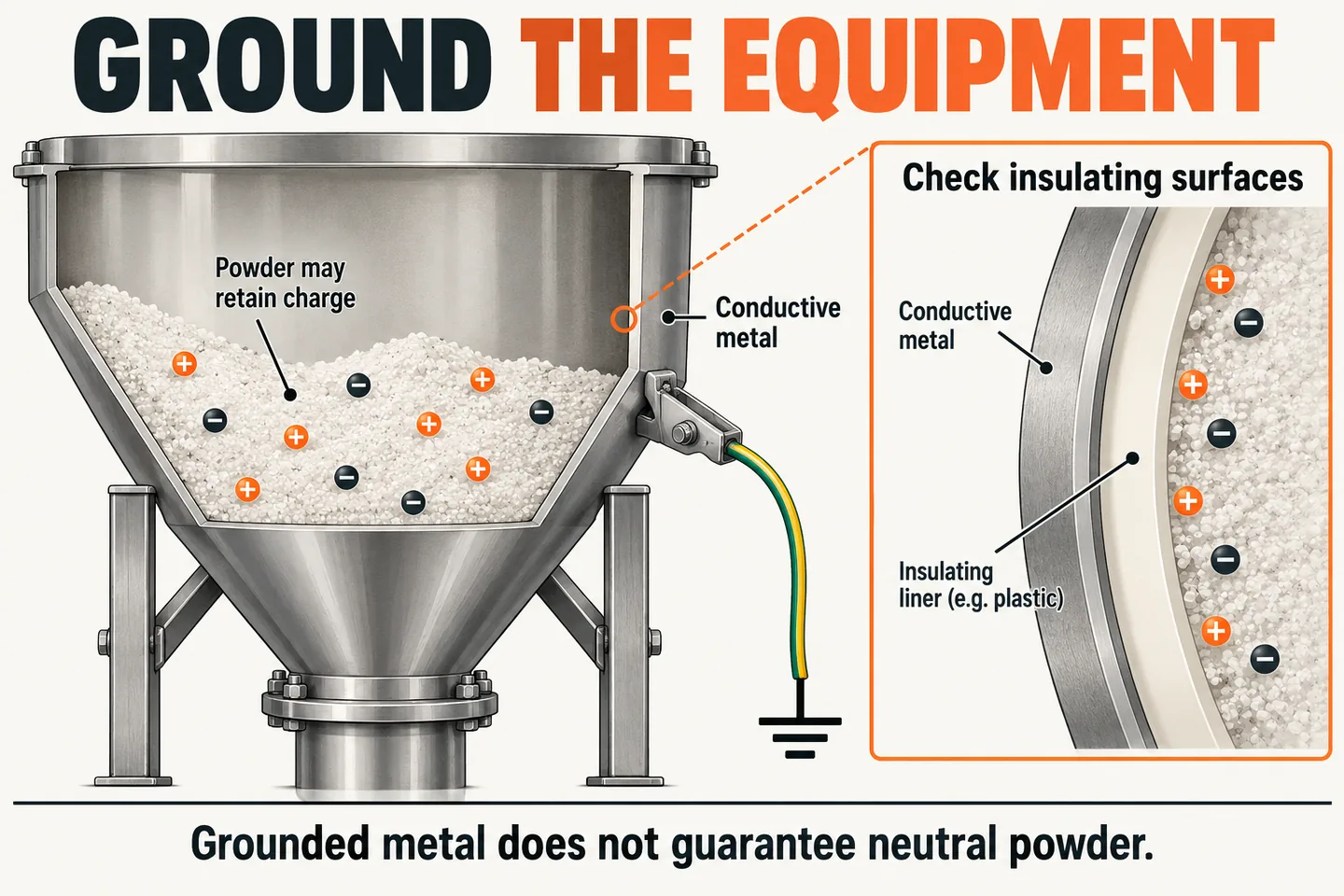
Bonding and grounding serve an important equipment-safety function. Bonding connects conductive parts electrically; grounding provides a path to earth. Have the designated personnel verify the intended connections, including removable equipment and components separated by gaskets or insulating supports. A clamp that looks attached is not evidence of effective electrical continuity.
HSE guidance on powder transfer identifies bonding and earthing of conductive components among measures for reducing electrostatic discharge hazards. Its examples are guidance from a particular jurisdiction and context, not a complete design specification for every tablet facility. HSE: earthing and electrostatic hazards in powder transfer.
A grounded metal hopper does not necessarily neutralize an insulating powder or an insulating inner surface. Research on low-shear pharmaceutical blending specifically discusses the limits of equipment grounding as a powder-charge control strategy. Keep equipment grounding in place while investigating the powder itself. Electrostatic behavior during low-shear powder blending (2006).
| Control to evaluate | Purpose | Conditions to confirm |
|---|---|---|
| Bonding and grounding | Provide the intended discharge path for conductive equipment | Continuity, clean contact points and the approved engineering design |
| Compatible contact surfaces and transfer components | Reduce problematic contact or accumulation | Cleanability, wear, product contact and electrostatic suitability |
| Material-compatible humidity control | Evaluate a favorable moisture-charge response | Stability, moisture uptake, flow and product performance |
| Transfer, mixing and feeding adjustments | Change unnecessary handling or conditions associated with charging | Blend consistency, feed delivery and the required output |
| Suitable ionization, where justified | Evaluate charge neutralization in an accessible treatment zone | Application suitability, coverage, maintenance and hazardous-area assessment |
| Formulation or particle-engineering changes | Address a demonstrated material contribution | Compatibility, function, quality tests and change control |
For static electricity in tableting, do not add an unspecified conductive excipient or spray an antistatic treatment onto product-contact surfaces. Changes to lubricant grade, amount or mixing can affect performance independently of charge. Evaluate those changes through formulation development and appropriate product testing; the tablet formulation guide provides a broader framework.
A rest period after mixing is another hypothesis to test, not a standard remedy. Charge decay depends on the material and environment, and the next transfer may charge the powder again. Measure after the proposed wait and again after the subsequent handling step. Define any hold time through the product’s established procedures.
Where combustible powder or flammable vapor may be present, process-safety assessment must address electrostatic ignition alongside other ignition sources. Do not introduce improvised ionizers or electrical probes into that area. Reducing visible wall adhesion is a quality observation, not evidence that ignition hazards have been adequately controlled.
7. Verify the result and keep a record that transfers between sites
Close an investigation of static electricity in tableting with more than “the powder looked better.” Compare the original symptom before and after the change using the same methods. Record whether feeding, deposition and the charge measurement all moved consistently, and identify any remaining alternative explanation.
| Outcome | Suggested comparison |
|---|---|
| Powder handling | Deposit location, retained material and feeding consistency |
| Electrostatic behavior | Repeat measurements with the same sampling and timing method |
| Tablet consistency | Mass distribution, appearance and relevant mechanical tests |
| Product performance | Required content-uniformity, disintegration or dissolution results |
| Reproducibility | Repeat run, lot and operating-condition checks appropriate to the change |
For projects in different countries, record conditions at the actual point of use. A climate label such as “tropical” or “dry winter” cannot replace indoor humidity, temperature and material-conditioning records. Include the equipment model, contact materials, local grounding arrangements and applicable site requirements when transferring a successful setting between facilities.
If support is needed, send the material description, defect photographs, sampling timeline and measured results with the machine identification. Our ZPW29 / ZPW31 rotary press and VH V-type mixer pages provide equipment context. Contact Alex to discuss the process brief and configuration; suitability for a charged or combustible powder requires a specific technical review.
Static electricity in tableting FAQ
Can static electricity cause tablet weight variation?
It can contribute if adhesion or altered powder behavior disturbs delivery and die filling. Confirm the link with feed observations and measured tablet masses. Powder flow, feeder settings and mechanical problems remain alternative explanations, so a weight trend alone does not identify static as the cause.
What is the best relative humidity for tableting?
There is no single target suitable for every material. Use a justified range that accounts for moisture sensitivity, flow, charge and product performance. A condition that reduces charge in one formulation may have little benefit or an unwanted effect in another.
Will grounding the tablet press remove powder charge?
Grounding can dissipate charge from connected conductive equipment. It does not guarantee neutralization of insulating particles or liners. Verify equipment grounding and investigate powder-charge behavior as related but distinct tasks.
Can adding more lubricant solve an electrostatic problem?
It is not a general remedy. A lubricant change can alter powder surfaces, mixing behavior and tablet properties, with or without a charge effect. Make changes only through an appropriate formulation assessment, then check the required product results.
Is a short waiting period after blending enough?
Not necessarily. Some powders retain charge, and downstream handling may generate it again. Test charge and process behavior at defined times and after the next transfer. Do not adopt an arbitrary waiting period as evidence that static electricity in tableting is controlled.
Technical sources and scope
These sources support the discussion of charge, blending, feeding, humidity and equipment safety. The seven-check workflow and comparison tables are editorial planning aids, not validated instructions for an individual formulation. Laboratory findings are described within their tested scope; equipment settings and acceptance criteria require product-specific confirmation.
- Measuring the chargeability of pharmaceutical powders (2006)
- Pu and colleagues: electrostatic charging and blend homogeneity (2009)
- Hao and colleagues: charge measurements and powder blending (2013)
- Beretta and colleagues: material-specific humidity responses (2020)
- Beretta and colleagues: charge and continuous feeding of polyols (2023)
- HSE: earthing and electrostatic hazards in powder transfer
- Electrostatic behavior during low-shear powder blending (2006)