
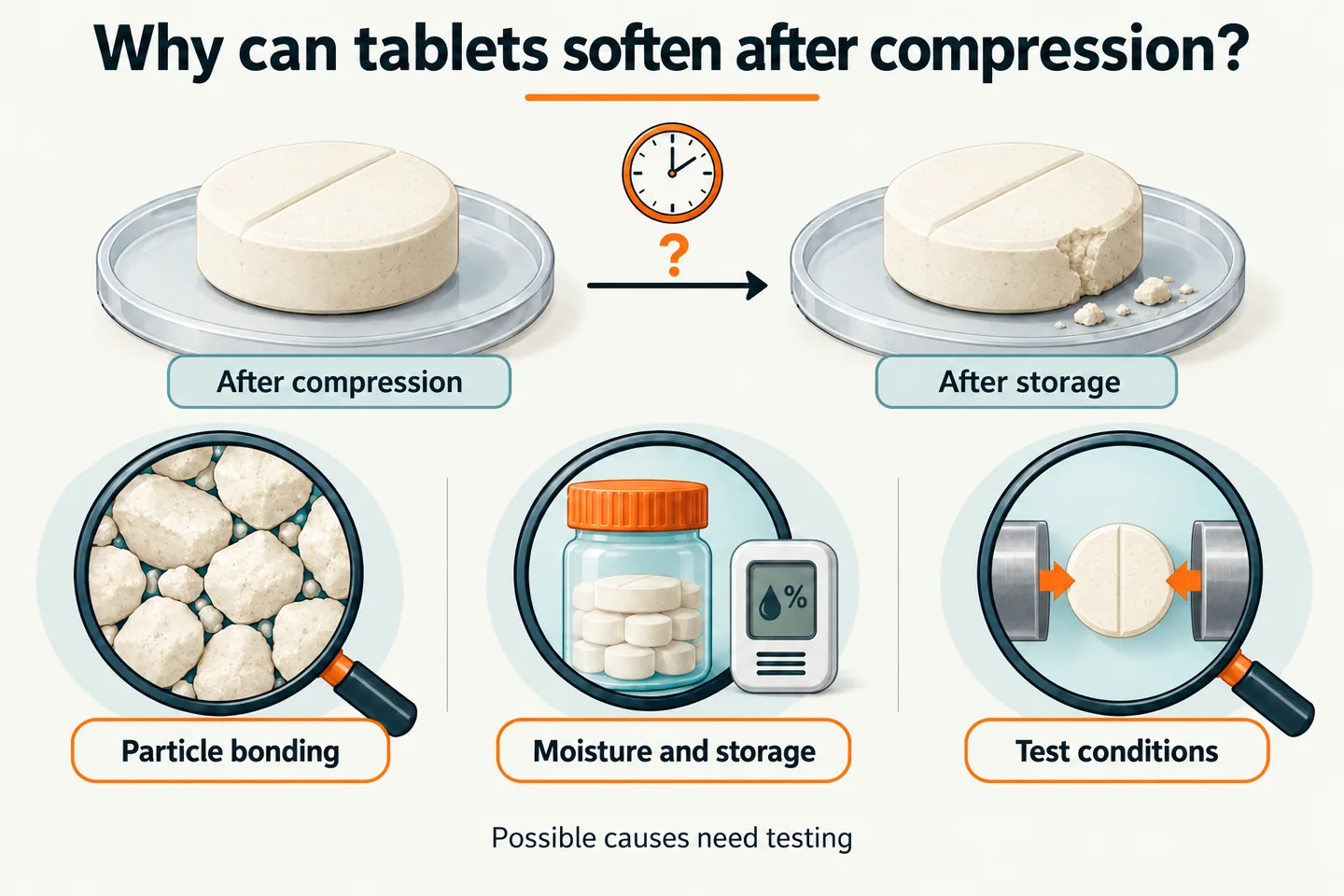
Tablet softening after compression can appear as lower breaking force, greater friability, powder shedding or chipped edges after several hours or overnight. A tablet that feels firm at the press may behave differently after storage. However, that observation alone does not identify the cause or prove that the granules were poorly prepared.
Quick answer: First confirm the change with comparable tests at defined times. Then investigate moisture and storage, granule properties, drying, lubrication and compression conditions. Elastic recovery is one possible contributor, not a diagnosis for every weak tablet. Use product-specific limits and verify the proposed improvement after the relevant hold and packaging steps.
This guide is for formulation, production and equipment teams investigating tablets that become weaker after manufacture. It provides a practical investigation framework, not a universal formulation, moisture target or release specification. The aim is to identify evidence that separates competing explanations before changing the process.
On this page
What does tablet softening after compression mean?
In this article, tablet softening means a measured reduction in mechanical integrity after compression. Describe the actual result: lower breaking force, increased friability, visible cracking, or damage during handling. These observations can occur together, but they are not interchangeable measurements.
“Hardness” commonly refers to tablet breaking force, usually reported in newtons. It is the force required to break a tablet under specified conditions, rather than an intrinsic material hardness. Copley Scientific describes breaking-force testing separately from friability testing. Copley Scientific: Pharmaceutical Testing, Tablet Breaking Force.
When tablet geometry and the fracture mode support the calculation, tensile strength can help compare mechanical behavior while accounting for dimensions. Use an appropriate, justified calculation rather than applying a flat-tablet equation to every shape. A change in thickness or test orientation can complicate a simple comparison of force values.
Capping is separation of a tablet’s top or bottom portion; lamination involves separation into layers. Crumbling and edge chipping need their own descriptions. Photograph the defect and record when it becomes visible so that different failure modes are not grouped under one label.
1. Confirm the change with comparable measurements
Start a tablet softening investigation by checking the measurement system and sample history. A freshly collected warm sample and a next-day sample tested by a different method are not a controlled comparison. Record collection time, conditioning, storage and the actual testing time.
- Use a defined instrument, test method, loading conditions and tablet orientation.
- Identify the sample by batch, run position and container; record tablet mass and dimensions.
- Measure breaking force and inspect the fracture; assess friability or handling damage separately.
- Use a justified sample size and report individual results or their spread alongside the average.
- Apply consistent conditioning before testing and document any deviation.
For an initial investigation, a team might compare a defined baseline, a later sample and a next-day sample. Those are planning examples, not prescribed release times. Select the intervals around the observed onset of the defect, and extend the study when the relevant process or storage period is longer.
Breaking-force and friability tests consume or alter the tested tablets. Prepare representative, matched sample groups for each time point instead of retesting the same broken tablets. Label retained groups before storage, and keep enough material for follow-up work if the first comparison reveals a difference.
Before calling the change tablet softening, check whether the difference is larger than ordinary sampling and measurement variation. Retain the original results, including acceptable samples, rather than recording only the weakest tablets. A single attractive starting value is a poor baseline for a variable batch.
2. Separate elastic recovery from moisture and storage effects
Elastic recovery describes dimensional recovery as compression load is removed and, for some materials, during subsequent storage. Stress relaxation describes a change in stress with time under constrained deformation. These concepts are related to compaction behavior, but they should not be used as interchangeable explanations for every delayed defect.
Haware and colleagues examined in-die and out-of-die recovery, including expansion during storage. Their results illustrate the importance of measurement timing and compression conditions when characterizing elasticity. A later drop in breaking force alone does not measure recovery. Haware et al.: Evaluation of a Rapid Approximation Method for the Elastic Recovery of Tablets.
Moisture can also change the tablet matrix. Maclean and colleagues found that the physical stability of directly compressed tablets depended on excipient combinations and storage conditions; high humidity was associated with increased porosity and reduced tensile strength in several tested formulations. These findings are formulation-specific, not a prediction for every product. Maclean et al.: Investigating the Role of Excipients on the Physical Stability of Directly Compressed Tablets.
Strength does not always decrease with aging. In a bilayer-tablet study, Kottala and colleagues observed different responses among cellulose/lactose and lactose/lactose combinations, including strengthening attributed to solid-bridge formation. Bilayer results should not be transferred directly to a single-layer product, but they show why “all tablets rebound and weaken” is an unreliable rule. Kottala et al.: Impact of Environmental Conditions on the Strength of Bilayer Tablets.
- Track dimensions as well as strength when recovery is a working hypothesis.
- Compare defined exposure conditions with the intended packaging or qualified bulk container.
- Record temperature, relative humidity and exposure duration, including time outside storage.
- Consider moisture uptake, loss or redistribution alongside binder and other material behavior.
- Investigate solid-state or chemical changes with suitable analytical support when the evidence warrants it.
A closed container does not automatically establish a dry environment. Its initial contents, closure and moisture protection matter. For tablet softening during an overnight hold, inspect the actual container and room history before assuming the press is the sole source of the problem.
3. Review granulation and particle properties
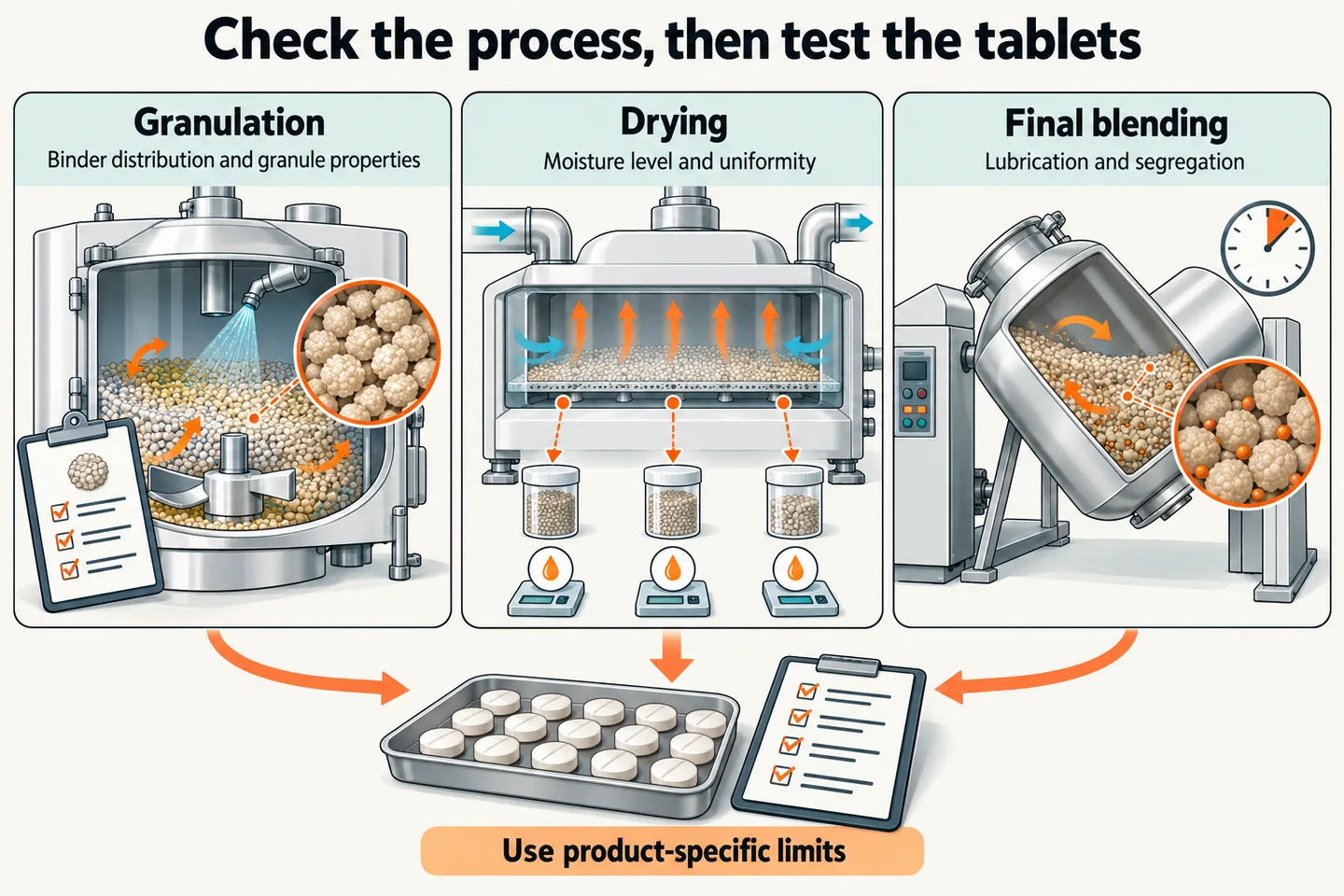
For a granulated formulation, compare binder preparation and distribution, liquid addition, mixing conditions and the defined granulation endpoint. Keep the investigation specific to the route used. Direct-compression products have no in-house wet-granulation stage to correct, and dry-granulated products require a different review.
- Confirm binder identity, grade, preparation, addition method and recorded quantities.
- Check whether the wet mass or granules were sampled representatively.
- Compare particle-size distribution, granule strength and the observed amount of fines.
- Review milling or sizing conditions and material transfers after granulation.
- Connect granule observations with tablet results from the same identified material.
A hand-squeeze observation may help an experienced operator describe a wet mass, but it is not a sufficient standalone endpoint for a controlled pharmaceutical process. Define measurable criteria appropriate to the formulation and equipment. Keep informal observations separate from the approved acceptance criteria.
Fine particles are not automatically more elastic, and removing more fines does not always improve tablets. Particle behavior depends on the material and preparation. Razavi and colleagues found different particle-size sensitivities in lactose monohydrate and spray-dried lactose systems, alongside lubrication effects. This supports testing the actual material rather than adopting a universal coarse-versus-fine rule. Razavi et al.: Quantification of Lubrication and Particle Size Distribution Effects on Tensile Strength and Stiffness of Tablets.
In a tablet softening investigation, compare a suspected granulation change with a suitable reference under matched compression and storage conditions. Otherwise, a difference caused by packaging or testing could be attributed incorrectly to granule preparation. See our granulation and tablet quality guide and granule strength control guide for related questions.
4. Verify drying endpoints and moisture distribution
Both moisture level and moisture distribution matter. A batch average can conceal variation, but uniformity does not make an unsuitable moisture level acceptable. Establish the relevant sampling locations, test method and acceptance criteria for the product rather than ranking uniformity as universally more important than the measured value.
A study of a segmented fluid bed dryer identified incoming material properties, granulation conditions, airflow, air temperature and humidity as influences on residual granule moisture. This is a useful reminder that drying is a process to characterize, not a temperature setting alone. Rehrl et al.: End-Point Prediction of Granule Moisture in a Segmented Fluid Bed Dryer.
- Review the drying profile, loading, airflow and applicable equipment records.
- Take representative samples using a plan suited to the dryer and batch configuration.
- Record the moisture method, sample handling and calculation basis consistently.
- Compare results at the drying endpoint and after any specified bulk hold.
- Check whether transfer or storage introduces additional exposure or segregation.
Do not automatically increase moisture by a fixed percentage to address tablet softening. A change may alter compaction, sticking, disintegration or stability, and the direction of benefit depends on the formulation. Any proposed adjustment needs a justified trial range and evaluation of the relevant quality attributes.
Similarly, neither slower drying nor a particular dryer type guarantees a better result. If uneven drying is suspected, test that hypothesis with suitable sampling and measurements. “Dry outside, wet inside” should be an explanation supported by evidence, not an assumed description of every unstable batch.
If a conditioning or equilibration hold is part of the process, define its duration, container and environmental conditions and demonstrate its suitability. Simply sealing warm granules in an uncontrolled bulk hold is not a validated corrective action. Record the hold as a process step that can be evaluated.
5. Check lubrication, blending and segregation
Lubrication needs a balance between manageable die-wall friction and acceptable tablet properties. Research comparing common lubricants found effects on mechanical strength, disintegration and other performance measures, with material-dependent responses. A universal magnesium stearate percentage cannot establish that balance for every formulation. Paul and Sun: Systematic Evaluation of Common Lubricants for Optimal Use in Tablet Formulation.
- Confirm lubricant identity, grade, quantity, addition order and material lot.
- Review blender type, fill level, speed, time and the actual mixing history.
- Account for subsequent handling or feeding that may add further mechanical exposure.
- Assess blend uniformity and possible segregation through transfers and hopper discharge.
- Compare ejection behavior with strength, friability and relevant performance tests.
Over-lubrication can reduce particle bonding in susceptible formulations. However, a weak tablet and a tablet that loses strength during storage are different observations. Describing the first measurement as “false hardness” does not establish why the later result changed. Demonstrate the time-dependent effect in matched samples.
For tablet softening associated with a blending change, compare the candidate conditions using the same material and a defined storage plan. Do not shorten mixing arbitrarily if that undermines uniform distribution. Equally, additional mixing is not a general remedy for segregation after transfer.
Document the permitted blend hold and actual elapsed time before compression. Examine top, middle or late-run differences only through an appropriate sampling plan; avoid assuming that every hopper has a fine-rich bottom. Our flowability guide provides additional handling and filling considerations.
6. Evaluate compression and confirm performance through storage
The press remains part of the investigation. Record feeder behavior, speed, precompression, main compression, tooling geometry and any relevant ejection signals. Compare identified tablets produced under known conditions, including interruptions or restarts that could explain run-to-run differences.
Natoli’s dwell-time guidance treats the time under compression as an important development variable alongside force and other conditions. A successful laboratory setting should be assessed on the intended equipment configuration. More force is not a universal cure, and higher force does not invariably mean more delayed weakening either. Natoli Engineering: How Crucial Is Compaction Dwell Time?.
For tablet softening, assess the chosen compression trial at the same later time points used for the original problem. An improved initial breaking-force value does not demonstrate that the storage trend has been corrected. Include disintegration, dissolution or other product requirements where applicable, rather than selecting a setting on strength alone.
After a promising change, confirm its effect through the relevant hold, handling and packaging stages. An engineering comparison is not a substitute for the required stability program. ICH Q8(R2) describes development around understanding material attributes, process parameters and product quality; use that logic to justify the proposed control. FDA / ICH Q8(R2): Pharmaceutical Development.
The precompression and main compression guide can support the equipment discussion. Preserve the original settings and observations, change variables through an approved trial plan, and record both the intended benefit and any new defect.
Troubleshooting table: match observations with the next check
| Observation | Possible explanation | Useful next check |
|---|---|---|
| Lower force only after a test-method or orientation change | A comparison or sampling issue | Repeat a matched comparison using defined conditioning and test settings. |
| Lower strength with dimensional change | Recovery, moisture effects or other matrix changes | Track dimensions and moisture alongside strength under controlled storage. |
| Greater change in exposed samples than packaged samples | An environmental contribution | Compare documented temperature, humidity, exposure and package conditions. |
| Variation among run positions or granule samples | Material distribution, drying, handling or filling variation | Connect representative material samples to identified tablet groups. |
| Weakness after a lubrication or blending change | A formulation or mixing contribution | Compare lubrication performance and tablet properties at matched time points. |
| Cracks, capping or chipping with little change in average force | A distinct defect or variation hidden by the mean | Inspect failures and individual results; review tooling, ejection and handling. |
This table organizes hypotheses. It does not diagnose a batch from appearance alone. Record which explanation was tested, the comparison made and whether the results supported or weakened that explanation.
A practical record for repeatable comparisons
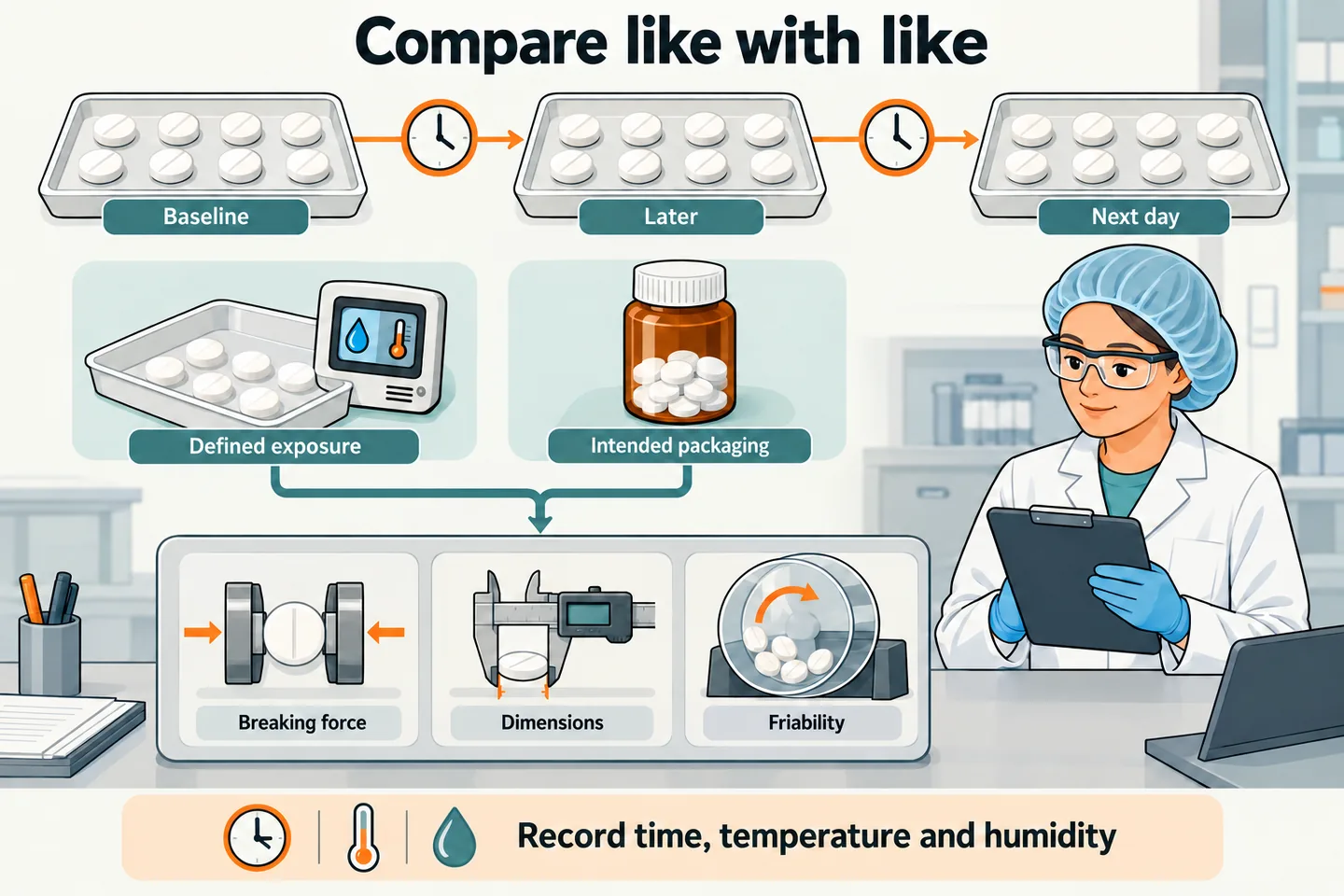
Use one record for each tablet softening comparison so that production, laboratory and equipment teams can follow the same samples. When work moves between sites or countries, preserve units, methods and exposure conditions rather than relying on descriptions such as “normal humidity” or “overnight.”
- Identity: product, formulation version, material lots, batch and sample group.
- Process: granulation, drying and blending history, equipment configuration and press settings.
- Timing: collection, baseline definition, storage intervals and testing timestamps.
- Environment: temperature in °C, relative humidity in %RH, container and closure.
- Measurements: mass, dimensions, breaking force in N, applicable strength calculation and friability result.
- Interpretation: individual variation, photographs, other quality tests, conclusion and next action.
Keep proposed acceptance criteria distinct from observations. If the comparison suggests a packaging contribution, record that result without declaring the formulation stable. If no clear trend appears, review sample representativeness and measurement variation before expanding the trial. Preserve negative results because they help prevent repeated changes based on the same unsupported assumption.
Frequently asked questions about tablet softening
Why do tablets become soft several hours after compression?
Possible contributors include dimensional recovery, moisture-related changes, formulation behavior and process variation. First establish that the measured change is real and repeatable. Its timing helps plan the investigation, but does not prove a particular mechanism.
Is delayed weakening always caused by poor granulation?
No. Granulation may contribute, but storage, testing, lubrication and compression also need consideration. Direct-compression tablets can show physical changes during storage even though the manufacturer did not use a wet-granulation step.
Should I add more moisture or reduce magnesium stearate?
Neither adjustment should be automatic. Define a justified comparison based on the formulation and observed evidence. Evaluate friction, strength and the other relevant quality attributes together; no fixed water increase or lubricant percentage is appropriate for every product.
Can increasing compression force prevent tablet softening?
It may change the initial tablet properties, but it does not establish storage stability. Compare the response across suitable compression conditions and the relevant later time points. Keep the trial within the equipment, tooling and approved process limits.
Can a tablet become stronger during storage?
Yes, some formulations show strengthening while others weaken. Material composition and storage conditions influence the direction of change. Either trend deserves evaluation against the complete product requirements; higher strength is not automatically better performance.
Prepare a focused equipment discussion
If tablet softening is affecting a planned production trial, share the observed defect, material route, tablet dimensions, time-point results, storage conditions and press configuration. These details help separate a tooling or compression question from a formulation, measurement or packaging issue.
Use the contact page to discuss the equipment information needed for a trial. The most useful starting point is a documented comparison, followed by product-specific verification of the proposed change.